
Azelaic Acid vs Retinol: Which Is Better for Acne and Pigmentation?
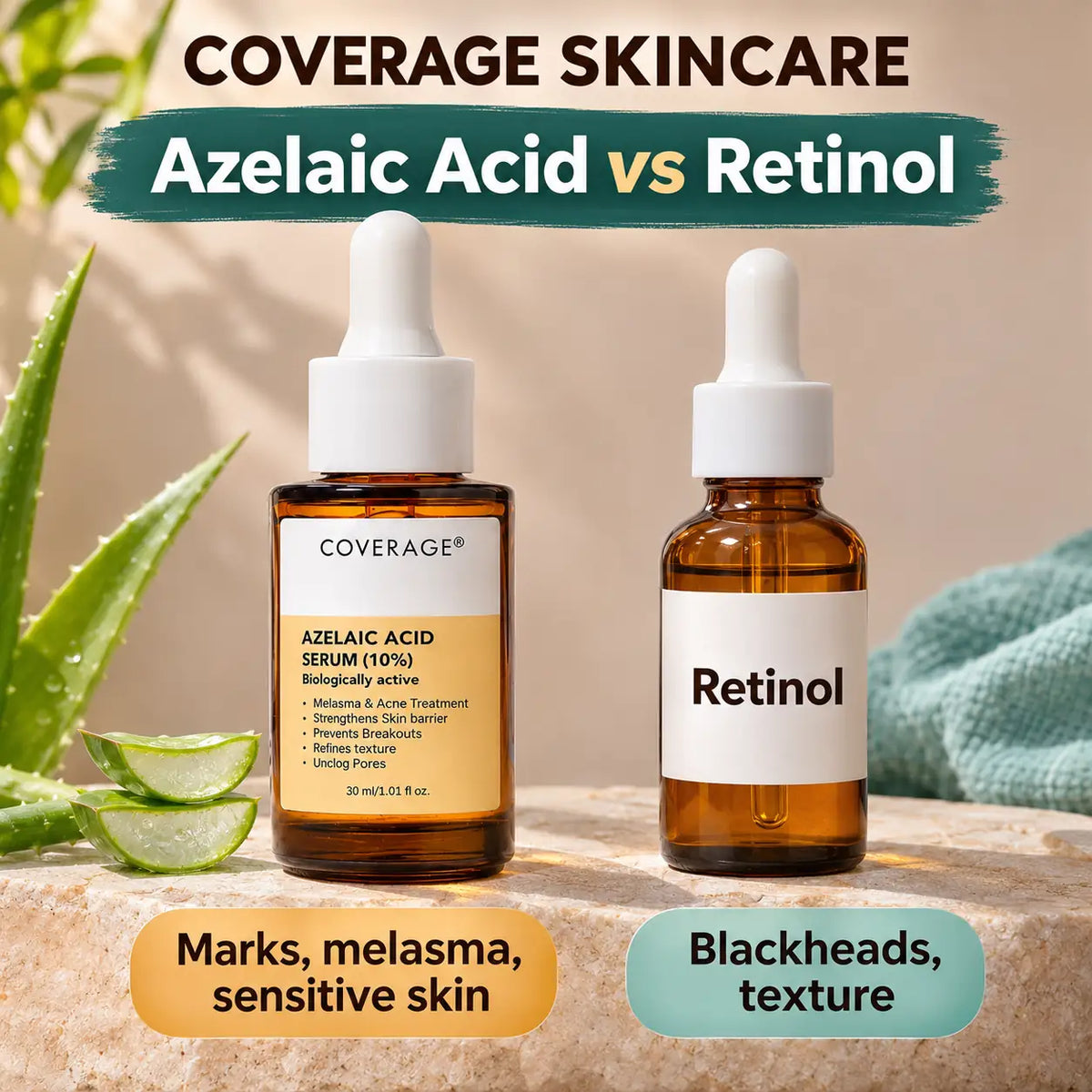
Quick answer: azelaic acid vs retinol. For acne marks (daag dhabbe), melasma (chaiyan), redness and sensitive brown skin, azelaic acid is usually the better first choice. It calms inflammation, slows the overactive pigment behind dark marks, and is easier to live with every day. For blackheads, whiteheads and clogged pores, a retinoid is the stronger tool, and prescription retinoids such as tretinoin and adapalene carry far more acne evidence than cosmetic retinol. Many people do best with both: azelaic acid in the morning, retinol at night, and a tinted SPF 50+ every day. Pregnant? Stop retinoids. The American Academy of Dermatology says azelaic acid is thought to be safe, but always check with your doctor.
If you are choosing between a retinol serum and an azelaic acid serum, you are probably dealing with one of three things: keel muhase that keep coming back, dano ke nishan that stay for months after a pimple heals, or chaiyan spreading across your cheeks. Both ingredients appear on almost every "best for acne" list, but they work differently, suit different skin, and carry very different evidence. Retinol vs azelaic acid is not a question with one answer for everyone.
Shopping for marks, melasma or sensitive acne-prone skin? Our Azelaic Acid Serum 10% is a lightweight, non-comedogenic daily serum made for daag dhabbe, chaiyan and keel muhase, with no fragrance, no alcohol and no propylene glycol. Already using retinol at night? It is the morning partner we designed it to be. Made in Lahore and delivered across Pakistan with cash on delivery.

In this guide we compare azelaic acid vs retinol concern by concern, using dermatology guidelines and clinical trials, and then show exactly how to use one or both on Pakistani skin. COVERAGE® has delivered more than 72,000 orders across Pakistan since 2023, so we also share what we see in real routines.
Azelaic acid vs retinol: the short comparison
| Azelaic acid | Cosmetic retinol | Prescription retinoids (tretinoin, adapalene) | |
|---|---|---|---|
| What it is | A dicarboxylic acid, not a retinoid | A vitamin A ingredient your skin converts into retinoic acid | Active retinoid medicines |
| Main jobs | Calms inflammation, reduces acne bacteria, keeps pores clearer, slows excess pigment | Speeds cell turnover, smooths texture, helps keep pores clear | Unclogs pores, treats comedonal and inflammatory acne, fades marks |
| Acne evidence | AAD 2024: conditional recommendation, moderate evidence | Small cosmetic studies only | AAD 2024: strong recommendation, moderate evidence |
| Pigment evidence | Trials for brown marks, red marks and melasma (15 to 20%) | Very limited direct data | Trials for brown marks and melasma (0.1% tretinoin), with frequent irritation |
| Usual irritation | Mild tingling or itching early on | Dryness, flaking or redness in some people | Common "retinoid dermatitis" in the first weeks |
| Time of day | Morning or night | Night | Night |
| Pregnancy | AAD: thought to be safe; check with your doctor | Usually stopped | Stop tretinoin and adapalene; never tazarotene |
| Best fit | Marks, melasma, redness, sensitive and brown skin | Texture, mild clogging, early signs of ageing | Persistent comedonal or moderate acne, under a doctor |

What azelaic acid actually does
Azelaic acid is a naturally occurring dicarboxylic acid. On the skin it does four useful jobs at once: it calms inflammation, reduces the acne bacteria living in pores, helps skin cells shed normally so pores clog less, and slows tyrosinase, the enzyme that overactive pigment cells use to make excess melanin.
That last point is why it matters so much for Pakistani skin. Azelaic acid works on excess, overactive pigment rather than on your normal skin tone, which is why it fades marks without "whitening" anything. We explain this in detail in does azelaic acid lighten skin.
Prescription azelaic acid comes as a 15% gel and a 20% cream. Cosmetic serums, including ours, typically use 10% so that people can apply them every day for months. Our full ingredient guide is here: azelaic acid serum benefits and uses in Pakistan.
What retinol is, and why it is not the same as tretinoin
Retinol belongs to the retinoid family, but it is the weakest link in a chain. Your skin converts retinol into retinaldehyde, then into retinoic acid, which is the form that actually switches on retinoid receptors. Tretinoin is retinoic acid itself, and it is a prescription medicine. Adapalene, tazarotene and trifarotene are synthetic prescription retinoids.

This difference changes how you should read the evidence:
- A 2016 comparison in the Journal of Cosmetic Dermatology found that retinol produced the same kinds of changes in skin as retinoic acid, but smaller in magnitude.
- An earlier study by Kang and colleagues (Journal of Investigative Dermatology, 1995) found retinol thickened the outer skin in a way similar to low-strength retinoic acid, with little or no redness.
So retinol is gentler and slower. That is helpful for tolerance, but it also means that trials run on tretinoin or adapalene cannot be quoted as proof for a cosmetic retinol serum. The same rule applies to azelaic acid: the trials below used prescription 15% and 20% azelaic acid.
Retinoids are also broken down by light and make skin more sun-sensitive, which is why retinol belongs in your night routine.
Which is better for acne (keel muhase)?
What the guideline says
The American Academy of Dermatology's 2024 acne guideline (Reynolds et al., JAAD) gives topical retinoids a strong recommendation based on moderate evidence, and azelaic acid a conditional recommendation, also based on moderate evidence. It adds that azelaic acid may be particularly helpful for patients with sensitive skin or darker skin types, because it also fades dark marks. In plain terms: retinoids are the core acne drug class, and azelaic acid is the option that fits brown, reactive, mark-prone skin best.
What happens when they go head to head
Direct comparisons are rare, but the two we found point the same way:
- Azelaic acid vs tretinoin: In a 6-month study of 289 people with comedonal acne, 20% azelaic acid cream was as effective as 0.05% tretinoin cream at reducing comedones and in overall response, and it was better tolerated, with fewer local side effects.
- Azelaic acid vs adapalene: In a randomised, investigator-blind study of 55 adult women (Thielitz et al., 2015), 15% azelaic acid gel was compared with 0.1% adapalene gel; adapalene caused significantly more dryness and scaling at 6 and 12 weeks.
- Azelaic acid vs other acne treatments: Two randomised, blinded trials led by Gollnick (2004), one against 5% benzoyl peroxide in 351 patients and one against 1% clindamycin in 229 patients, found 15% azelaic acid gel as effective as both, with median reductions in inflamed spots of 70% and 71%.
Where cosmetic retinol stands
Cosmetic retinol has much thinner acne data. A small 8-week trial by Ruamrak and colleagues (2009) found 0.2% retinol reduced inflammatory acne lesions, with better results when it was combined with 5% sodium ascorbyl phosphate. A 4-week 2025 study of 43 women with acne used a product combining 0.06% retinol with niacinamide and other ingredients, so it cannot tell us what retinol did alone. Retinol can help mild clogging, but it is not a substitute for a prescription retinoid in moderate acne.
Our verdict for acne
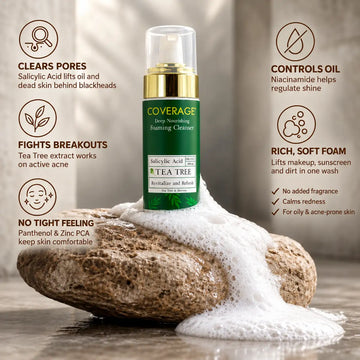
- Mostly blackheads and whiteheads: a retinoid is the stronger tool. A salicylic acid cleanser such as our Deep Nourishing Foaming Cleanser, with salicylic acid second in the formula plus tea tree and zinc PCA, helps keep pores clear alongside it.
- Red, inflamed pimples on sensitive or brown skin that leave marks: azelaic acid is usually the better daily fit, because it treats the pimple and the mark it leaves behind. If oily-skin breakouts are your main issue, compare it with salicylic acid in azelaic acid vs salicylic acid for acne.
- Moderate, painful or scarring acne: see a dermatologist for a prescription retinoid plan. Azelaic acid can still sit alongside it. For a full Pakistani acne plan, see keel muhase ka ilaj.
Which is better for acne marks and dark spots (daag dhabbe)?
First, identify the mark. Brown or grey-brown flat marks are post-inflammatory hyperpigmentation (PIH). Pink or red flat marks are post-inflammatory erythema (PIE). Pitted or raised marks are scars, and no serum fills those.

The azelaic acid evidence
- Brown and red marks together: A 2024 randomised, double-blind, placebo-controlled trial (Shucheng et al., Dermatology and Therapy) gave 72 acne patients 15% azelaic acid gel twice daily for 12 weeks. It significantly improved both red marks (PIE) and brown marks (PIH) compared with placebo, with minimal side effects.
- Brown marks on darker skin: A multicentre randomised trial by Lowe and colleagues (Clinical Therapeutics, 1998) in 52 people with skin types IV to VI, skin types common in Pakistan, found 20% azelaic acid cream reduced pigment significantly more than a placebo cream over 24 weeks.
The retinoid evidence
- Tretinoin works, at a cost: In a 40-week NEJM trial in Black patients (Bulengo-Ransby et al., 1993), 0.1% tretinoin lightened PIH by 40% toward normal skin colour versus 18% with placebo. But retinoid dermatitis developed in 50% of the tretinoin group.
- Retinoids are the most studied option: A 2024 systematic review of PIH treatment in skin of colour found topical retinoids were the most frequently investigated treatment.
- The irritation trap: A 2021 clinical review by Callender and colleagues supports retinoids for acne with PIH in skin of colour, but warns that retinoid irritation can itself cause new dark patches, and recommends applying moisturiser first to reduce irritation.
None of these trials used cosmetic retinol for PIH, so its effect on daag dhabbe is plausible but unproven.
Our verdict for marks
For flat brown or red acne marks on Pakistani skin, azelaic acid is the more direct and lower-risk choice, because it calms the inflammation that creates new marks and slows the pigment behind existing ones. Retinoids can help too, especially when acne is still active, but go slowly, because irritated brown skin often darkens. Our Azelaic Acid Serum 10% paired with daily tinted SPF is the routine we built for daag dhabbe. For the wider picture, read the best serum for dark spots and pigmentation in Pakistan and how long azelaic acid takes to work.
Which is better for melasma (chaiyan)?
Melasma is hormonal and light-driven pigment, usually on the cheeks, forehead and upper lip, and it relapses easily. Both ingredients have been tested, but the trials look different:
- Azelaic acid: In a 24-week trial by Verallo-Rowell and colleagues (1989), 73% of people using 20% azelaic acid had a good or excellent response, compared with 19% using 2% hydroquinone. A 2023 meta-analysis of six randomised trials and 673 patients found azelaic acid reduced melasma severity scores (MASI) more than hydroquinone, with no significant difference in side effects.
- Tretinoin: A vehicle-controlled trial (Kimbrough-Green et al., 1994) found 0.1% tretinoin improved MASI by 32% versus 10% with placebo over 40 weeks, but mild retinoid dermatitis affected 67% of users.
Our verdict: for chaiyan, azelaic acid is the easier and better-supported first step, and a tinted sunscreen with iron oxides matters as much as any serum. Prescription tretinoin is usually used by dermatologists inside combination creams rather than alone. We cover melasma in depth in melasma treatment: chaiyan ka ilaj in Pakistan and compare the classic options in azelaic acid vs hydroquinone for melasma.
Brown and sensitive skin: why tolerance decides the winner
On Pakistani skin, the best active is the one you can use for months without irritation. That is not a small point:
- Dark marks are extremely common after acne in skin of colour. In a US clinic survey summarised by Davis and Callender (2010), PIH after acne was reported in 65.3% of Black, 52.7% of Hispanic and 47.4% of Asian patients, although the Asian group was only 19 people.
- Irritation on brown skin can leave its own dark patches, which is why the Callender review stresses slow starts and moisturiser.
- Heat, sweat, pollution and strong sun in Lahore, Karachi and Islamabad all make irritation more likely.

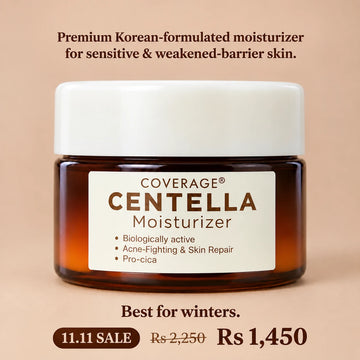
This is why the AAD guideline singles out azelaic acid for sensitive and darker skin, and why we chose a 10% strength in an aloe-led base. If your barrier already feels tight or stings with everything, repair it first with a calming moisturiser such as our Centella Moisturizer, and read our sensitive skin barrier repair guide. If your redness is rosacea-like, see azelaic acid for rosacea and redness on brown skin.
Which may suit which concern
| Your main concern | Better first pick | Why | COVERAGE® step |
|---|---|---|---|
| Brown acne marks (daag dhabbe) | Azelaic acid | Calms inflammation and slows excess pigment with less irritation | Azelaic Acid Serum 10% + Primer Tinted Sunblock SPF 50+ |
| Red or pink acne marks (PIE) | Azelaic acid | 2024 placebo-controlled trial improved PIE and PIH | Azelaic Acid Serum 10% |
| Melasma (chaiyan) | Azelaic acid + tinted SPF | Matched or beat hydroquinone in trials; visible light drives relapse | Azelaic Acid Serum 10% + Primer Tinted Sunblock SPF 50+ |
| Blackheads and whiteheads | Retinoid (or salicylic acid) | Retinoids normalise shedding inside the pore | Deep Nourishing Foaming Cleanser |
| Red, sore pimples on sensitive skin | Azelaic acid | AAD: may be particularly helpful for sensitive and darker skin | Azelaic Acid Serum 10% + Centella Moisturizer |
| Moderate, painful or scarring acne | Prescription retinoid via a dermatologist | Strong guideline recommendation | Azelaic acid can be added with your doctor's approval |
| Fine lines and rough texture | Retinol | Azelaic acid is not a wrinkle or collagen treatment | Retinol at night, our serum in the morning |
| Pregnancy or breastfeeding | Azelaic acid, with your doctor's approval | Retinoids are stopped in pregnancy | Azelaic Acid Serum 10% |

COVERAGE® Azelaic Acid Serum 10%: our pick for marks, melasma and sensitive brown skin

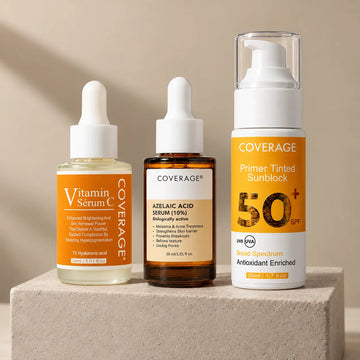
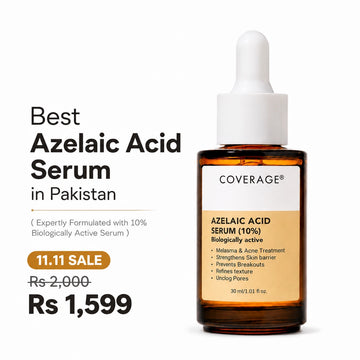
When people in Pakistan search for daag dhabbe ka ilaj serum, most of them have already tried something harsh. We built our Azelaic Acid Serum 10% (Pigmentation, Melasma & Acne) for exactly that person: someone who needs a serum they can use every day, through summer, for as long as marks take to fade.
What is inside
- 10% biologically active azelaic acid in a lightweight aqueous serum.
- Aloe Barbadensis leaf extract leads the ingredient list, ahead of water, so the base calms while the azelaic acid works.
- Sodium Hyaluronate for hydration through Lahore and Karachi summers, plus Tocopheryl Acetate (vitamin E).
- No fragrance, no alcohol, no propylene glycol, three of the most common irritants in prescription-strength creams.
- Lightweight, non-comedogenic and fast-absorbing, so it layers under sunscreen without pilling.
Full INCI: Aloe Barbadensis Leaf Extract, Aqua (Water), Azelaic Acid, Propanediol, Bis-Ethoxydiglycol, Xylitylglucoside, Isohexadecane, Polysorbate 60, Sodium Hyaluronate, Tocopheryl Acetate, Phenoxyethanol, Triethylene Glycol.
Why we chose 10%
The clinical trials in this article used prescription 15% and 20% azelaic acid, and 20% is the stronger strength, usually used for moderate acne under a dermatologist. We chose 10% because it is the strength most people tolerate well enough to use daily for months, and with pigmentation, consistency is what decides results. A gentler serum that you actually finish will do more for your marks than a stronger cream you stop after two weeks.
Who it suits
- Daag dhabbe and dano ke nishan that linger long after a breakout heals
- Chaiyan on the cheeks, forehead and upper lip
- Active keel muhase and congested pores
- Redness-prone and sensitive skin, including skin that reacted badly to strong exfoliants or retinoids
- Pregnancy and breastfeeding, once your doctor has approved it

How it fits next to retinol
COVERAGE® does not make a retinol, and we do not think you need to choose one or the other. If you already use retinol at night, apply our serum in the morning under sunscreen. You get azelaic acid's work on marks and redness during the day and retinol's work on texture overnight, without stacking two actives on the same skin at the same time.
How we make it
Our serum is Korean-formulated and made in our own manufacturing facility in Lahore, which has operated for 30 to 40 years and is GMP certified (ISO 9001). Every product is developed by our in-house chemical engineers, lab tested, and made through a formal, structured channel, not third-party white-label. We use high-grade raw materials, the same quality of ingredient that Korean brands use. Our products are Halal certified and cruelty-free.
What to expect
Most of our customers notice a difference within 1 to 3 weeks. Every skin type and condition is different, and some customers need more time. Clinical trials measured results over 12 to 40 weeks, because deeper pigment fades slowly, so give your routine at least three months alongside daily sunscreen. Mild tingling in the first days is normal; see azelaic acid side effects for what is expected and what is not.
Ready-made routines
- Acne Care & Sun Protection: the Azelaic Acid Serum 10% with the Primer Tinted Sunblock SPF 50+, for keel muhase and daag dhabbe.
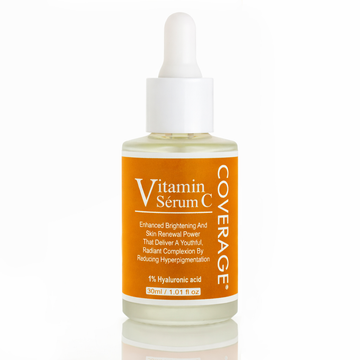
- Melasma, Dark Spots & Acne Marks Treatment: the Azelaic Acid Serum 10%, our Vitamin C + 1% HA Serum and the Primer Tinted Sunblock SPF 50+, for chaiyan and stubborn marks.
Can you use azelaic acid and retinol together?
Yes, most people can, and the two complement each other well. The simplest and gentlest method is to split them: azelaic acid in the morning, retinol at night. Start one first, wait until your skin is calm, then add the other. If you want both at night, introduce them on alternate nights, apply a moisturiser, and back off if stinging, peeling or redness lasts more than a few days.

We have a full layering guide, including order, wait times and what not to combine, in what you can mix with azelaic acid. Comparing other pairings? See niacinamide vs azelaic acid and azelaic acid vs vitamin C.
Routines for Pakistani skin

Routine A: acne marks, melasma or sensitive skin (no retinol)
Morning
- Gentle cleanse with lukewarm water.
- Azelaic Acid Serum 10%, 2 to 3 drops over the whole face.
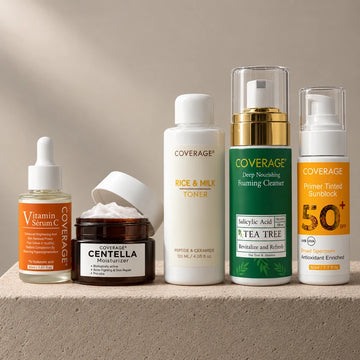
- Centella Moisturizer: ceramide, centella asiatica, ProBio-Cica, panthenol, niacinamide and squalane, non-comedogenic.
- Primer Tinted Sunblock SPF 50+, generously, as the last step.
Night
- Cleanse.
- Azelaic Acid Serum 10% (start every other night for the first week if your skin is reactive).
- Centella Moisturizer.
Routine B: active keel muhase and clogged pores
Morning
- Deep Nourishing Foaming Cleanser (salicylic acid, tea tree, zinc PCA, niacinamide).
- Azelaic Acid Serum 10%.
- A light moisturiser.
- Primer Tinted Sunblock SPF 50+.
Night
- Deep Nourishing Foaming Cleanser.
- Azelaic Acid Serum 10%, or your prescribed retinoid if a dermatologist has given you one.
- Moisturiser.
Routine C: you already use retinol at night
Morning
- Gentle cleanse.
- Azelaic Acid Serum 10%.
- Centella Moisturizer.
- Primer Tinted Sunblock SPF 50+.
Night
- Gentle cleanse.
- Moisturiser first if your skin is sensitive (the "buffer" method).
- Your retinol, 2 to 3 nights a week at first.
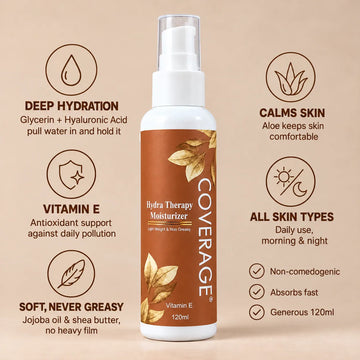
- Moisturiser. On dry or tight days, a richer moisturiser such as our Hydra Therapy Moisturizer, with glycerin, hyaluronic acid, jojoba and vitamin E, helps.
For a step-by-step application guide, see how to use azelaic acid serum.
Sunscreen: the step that decides both
Neither azelaic acid nor retinol can fade marks that the sun keeps re-darkening. The American Academy of Dermatology advises a broad-spectrum, water-resistant sunscreen with SPF 30 or higher, reapplied about every two hours when you are outdoors. For dark spots on darker skin, the AAD specifically recommends tinted sunscreen with iron oxide, because iron oxide helps protect against visible light, a cause of dark spots that plain sunscreen does not cover well.
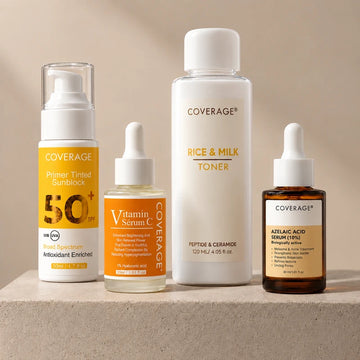
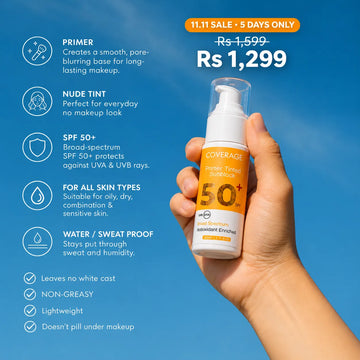
Our Primer Tinted Sunblock SPF 50+ is built on that advice: 100% mineral, with micronized zinc oxide and titanium dioxide as the only UV filters, an iron oxide tint for visible-light protection, water and sweat resistance for Pakistani heat, and a non-comedogenic primer finish. Our guides on tinted sunscreen in Pakistan and whether SPF 50 is enough in Pakistan go deeper.

Pregnancy and breastfeeding
This is where the two ingredients split most clearly. The American Academy of Dermatology says azelaic acid is thought to be safe to use during pregnancy, that most experts recommend stopping tretinoin and adapalene, and that tazarotene and oral isotretinoin must never be used. A 2022 review of acne treatment in pregnancy notes that only about 4 to 8% of azelaic acid is absorbed through the skin and lists it among first-line options for mild to moderate acne during pregnancy and breastfeeding. Most doctors also advise pausing cosmetic retinol.

No skincare can be guaranteed safe in pregnancy, so always check with your doctor before starting or continuing any active. Our full guide is is azelaic acid safe in pregnancy and breastfeeding.
Side effects: what to expect from each
- Azelaic acid: tingling, mild itching or warmth in the first one to two weeks, which usually settles. Stop if you get swelling, blistering or a rash.
- Retinol: dryness, flaking, tightness and redness, especially in the first month and in hot weather. Increase slowly.
- Prescription retinoids: "retinoid dermatitis" is common at the start; in the tretinoin pigment trials above it affected half or more of patients. Use only as your doctor directs.
- Both on brown skin: any irritation that lasts can leave new dark marks, so comfort comes before speed.
When to see a dermatologist
- Painful nodules or cysts, or acne that is leaving pitted or raised scars
- Acne that has not improved after 2 to 3 months of consistent care
- Patches that are spreading quickly, are very dark, or that you are not sure are melasma
- Pigment that appeared after a new medicine, or with other symptoms
- Pregnancy, breastfeeding or planning a pregnancy, before starting any acne or pigment product
- Skin that burns, swells or blisters after any product
A dermatologist can prescribe a retinoid or a 15% to 20% azelaic acid plan where your acne needs more than daily skincare. For a broader shortlist, see the best products for acne in Pakistan.
Frequently asked questions
Is azelaic acid better than retinol?
Neither is better for everyone. Azelaic acid is usually the better first pick for acne marks, melasma, redness and sensitive or darker skin, because it calms inflammation and targets excess pigment with less irritation. Retinoids are stronger for blackheads, whiteheads and clogged pores, and prescription retinoids have more acne evidence than cosmetic retinol. Many people use both: azelaic acid in the morning and retinol at night.
Which is better for acne marks, azelaic acid or retinol?
For flat brown acne marks, also called post-inflammatory hyperpigmentation or daag dhabbe, azelaic acid is usually the gentler and more direct choice. It slows overactive pigment cells and calms the inflammation that creates new marks. Prescription tretinoin also fades marks, but in trials it often caused irritation, and irritation can create new dark marks on brown skin. Daily SPF 50+ is essential with either.
Is azelaic acid or retinol better for melasma?
Azelaic acid is usually the easier melasma choice. In trials, 20% azelaic acid performed as well as or better than hydroquinone, while prescription 0.1% tretinoin helped melasma but needed about 40 weeks and commonly caused irritation. Melasma returns easily, so a tinted sunscreen with iron oxides every day matters as much as the active you choose.
Can I use azelaic acid and retinol together?
Yes, most people can. The simplest method is azelaic acid in the morning under sunscreen and retinol at night. Start one first, then add the other once your skin is calm. If you want both at night, start on alternate nights, apply a moisturiser, and stop if your skin stings, peels or turns red for more than a few days.
Should I use azelaic acid in the morning and retinol at night?
Yes, this is the easiest way to combine them. Azelaic acid sits well under sunscreen and can be used in the daytime, while retinol is best used at night because light breaks it down and retinoids make skin more sun-sensitive. Finish your morning routine with a broad-spectrum SPF 50+, ideally a tinted one.
Is azelaic acid safe in pregnancy when retinol is not?
The American Academy of Dermatology says azelaic acid is thought to be safe to use during pregnancy, and that most experts recommend stopping tretinoin and adapalene. Tazarotene and oral isotretinoin must never be used, and most doctors also advise stopping cosmetic retinol. Always check with your doctor before using any acne or pigmentation product while pregnant or breastfeeding.
Is retinol the same as tretinoin?
No. Retinol is a cosmetic vitamin A ingredient that skin must convert, in two steps, into retinoic acid. Tretinoin is retinoic acid itself and is a prescription medicine. Research shows retinol causes similar changes in skin to retinoic acid but of smaller magnitude, so tretinoin trial results should not be treated as proof for cosmetic retinol serums.
Which is gentler for sensitive skin, azelaic acid or retinol?
Azelaic acid is usually gentler. It can tingle or itch for the first one to two weeks, but it rarely causes the peeling and redness of retinoids. In a trial of adult women, adapalene caused significantly more dryness and scaling than 15% azelaic acid gel. If your skin is sensitive, start azelaic acid first and add retinol slowly.
Does azelaic acid lighten your natural skin colour?
No. Azelaic acid works on excess, overactive pigment, the kind behind acne marks and melasma. It is not a whitening or fairness product and does not change your natural skin tone. It helps even out marks so your skin looks more uniform.
How long do azelaic acid and retinol take to work?
In clinical trials, prescription azelaic acid and retinoids were measured over 12 to 40 weeks, and pigment fades slowly. With our Azelaic Acid Serum 10%, most of our customers notice a difference within 1 to 3 weeks. Every skin type and condition is different, and some customers need more time.
Which is better for blackheads and whiteheads?
Retinoids are the stronger tool for comedonal acne because they normalise how skin cells shed inside the pore. That said, one 6-month trial of 289 people found 20% azelaic acid cream as effective as 0.05% tretinoin for comedones, with fewer side effects. A salicylic acid cleanser can also help keep pores clear.
Can I use azelaic acid if I am on prescription tretinoin or adapalene?
Usually yes, but ask the doctor who prescribed your retinoid first. Dermatologists often pair azelaic acid with retinoids for acne and dark marks. Use azelaic acid in the morning, keep the retinoid at night, moisturise well and wear sunscreen daily.
Is retinol good for oily skin in Pakistan's heat?
It can be, if your skin tolerates it. Heat, sweat and sun make irritation more likely, so use retinol only at night, start two or three nights a week, use a light non-comedogenic moisturiser and wear SPF 50+ every morning. If you get burning or peeling, cut back to fewer nights.
The bottom line
Azelaic acid vs retinol is not a contest with one winner. If your biggest problems are daag dhabbe, chaiyan, redness or sensitive brown skin, start with azelaic acid. If blackheads and clogged pores are the main issue, a retinoid is the stronger tool, and moderate acne deserves a dermatologist. If you already love your retinol, keep it at night and let azelaic acid handle the mornings.
Whatever you choose, sunscreen decides the result. Start with our Azelaic Acid Serum 10%, protect it with the Primer Tinted Sunblock SPF 50+, and give your skin the consistent months it needs. Cash on delivery is available across Pakistan.
Related reading
- Azelaic Acid Serum in Pakistan: Acne, Melasma & Daag Dhabbe
- What Can You Mix With Azelaic Acid?
- Azelaic Acid vs Salicylic Acid for Acne
- Azelaic Acid vs Hydroquinone for Melasma
- Is Azelaic Acid Safe in Pregnancy and Breastfeeding?
- How Long Does Azelaic Acid Take to Work?
- Best Serum for Dark Spots and Pigmentation in Pakistan
References
- Reynolds RV, et al. Guidelines of care for the management of acne vulgaris. J Am Acad Dermatol, 2024. DOI
- Katsambas A, et al. Clinical studies of 20% azelaic acid cream in the treatment of acne vulgaris. Comparison with vehicle and topical tretinoin. Acta Derm Venereol Suppl, 1989. PubMed
- Thielitz A, et al. A randomized investigator-blind parallel-group study to assess efficacy and safety of azelaic acid 15% gel vs adapalene 0.1% gel in female adult acne. J Eur Acad Dermatol Venereol, 2015. Wiley
- Gollnick HP, Graupe K, Zaumseil RP. Azelaic acid 15% gel in the treatment of acne vulgaris: combined results of two double-blind clinical comparative studies. J Dtsch Dermatol Ges, 2004. PubMed
- Ruamrak C, Lourith N, Natakankitkul S. Comparison of clinical efficacies of sodium ascorbyl phosphate, retinol and their combination in acne treatment. Int J Cosmet Sci, 2009. PubMed
- Kong R, et al. A comparative study of the effects of retinol and retinoic acid on histological, molecular, and clinical properties of human skin. J Cosmet Dermatol, 2016. PubMed
- Kang S, et al. Application of retinol to human skin in vivo induces epidermal hyperplasia and cellular retinoid binding proteins characteristic of retinoic acid but without measurable retinoic acid levels or irritation. J Invest Dermatol, 1995. Abstract
- Kuai Z, et al. Anti-acne and hyperpigmentation effects of products containing retinol, niacinamide, ceramides and dipotassium glycyrrhizinate. Cosmetics, 2025. DOI
- Shucheng H, et al. Effects of 15% azelaic acid gel in the management of post-inflammatory erythema and post-inflammatory hyperpigmentation in acne vulgaris. Dermatol Ther (Heidelb), 2024. DOI
- Lowe NJ, et al. Azelaic acid 20% cream in the treatment of facial hyperpigmentation in darker-skinned patients. Clin Ther, 1998. Abstract
- Bulengo-Ransby SM, et al. Topical tretinoin (retinoic acid) therapy for hyperpigmented lesions caused by inflammation of the skin in black patients. N Engl J Med, 1993. PubMed
- Mar K, et al. Treatment of post-inflammatory hyperpigmentation in skin of colour: a systematic review. J Cutan Med Surg, 2024. SAGE
- Callender VD, et al. Effects of topical retinoids on acne and post-inflammatory hyperpigmentation in patients with skin of color. Am J Clin Dermatol, 2021. PMC
- Davis EC, Callender VD. Postinflammatory hyperpigmentation: a review of the epidemiology, clinical features, and treatment options in skin of color. J Clin Aesthet Dermatol, 2010. JCAD
- Verallo-Rowell VM, et al. Double-blind comparison of azelaic acid and hydroquinone in the treatment of melasma. Acta Derm Venereol Suppl, 1989. Abstract
- Albzea W, et al. Azelaic acid versus hydroquinone for managing patients with melasma: systematic review and meta-analysis. Cureus, 2023. PMC
- Kimbrough-Green CK, et al. Topical retinoic acid (tretinoin) for melasma in black patients. Arch Dermatol, 1994. JAMA
- American Academy of Dermatology. Is any acne treatment safe to use during pregnancy? AAD
- Treatment of acne vulgaris during pregnancy and lactation: a narrative review, 2022. PMC
- American Academy of Dermatology. How to apply sunscreen. AAD
- American Academy of Dermatology. How to fade dark spots in darker skin tones. AAD
This article is for general informational purposes only and is not a substitute for professional medical advice. All information and claims referenced above are drawn from publicly available dermatological studies and expert sources. Always consult a dermatologist for advice specific to your skin.

Leave a comment
This site is protected by hCaptcha and the hCaptcha Privacy Policy and Terms of Service apply.