

Melasma in Pakistan: Chaiyan Ka Ilaj That Actually Works
If you have been Googling chaiyan ka ilaj at two in the morning, you already know the frustrating part. Melasma is not a spot you can scrub off. It fades, it comes back in June, it sits on the same cheekbones every year, and every aunty has a different nuskha for it.
Here is what most people get wrong. They go looking for one miracle cream. Melasma does not work like that, because three major factors matter when managing it: light hitting your skin, pigment being produced faster than it should be, and oxidative stress telling your skin to keep producing it. One product cannot address three mechanisms.
You do not need ten products either. You need three steps.
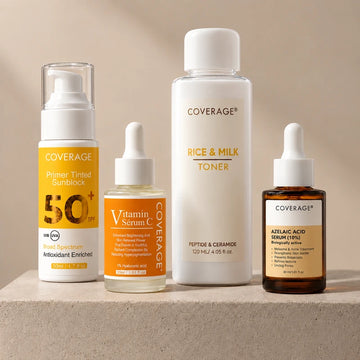
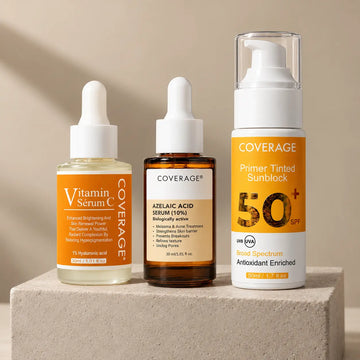
The COVERAGE Pigmentation Routine
Morning
Defend with Vitamin C + 1% HA Serum, then protect with Primer Tinted Sunblock SPF 50+
Night
Correct with Azelaic Acid 10% Serum
Three products, three different jobs, three of the mechanisms that actually drive melasma. The rest of this article explains why each one is there, so you can judge the reasoning rather than take our word for it.
Melasma kya hai?
Melasma is a pigmentation disorder. The pigment-producing cells in your skin, called melanocytes, get stuck in overdrive and deposit more melanin than they should in specific patches. Those patches show up in a recognisable pattern: both cheeks, the forehead, the upper lip, sometimes the bridge of the nose. Usually symmetrical, which is the biggest clue.
In Urdu you will hear it called chaiyan or chhaiyan. The same word gets used loosely for freckles, sun spots and post-acne marks, which is where most of the confusion starts. They are not the same thing and they do not respond the same way.

| What you see | What it is | How it behaves |
|---|---|---|
| Symmetrical brown or grey-brown patches on both cheeks and forehead | Melasma (chaiyan) | Worsens in summer, fades in winter, returns. Hormone and light driven. |
| Individual dark marks exactly where a pimple used to be | Post-acne marks (daag dhabbe) | Fades on its own over months. Responds faster than melasma. |
| Small scattered dots across nose and cheeks | Freckles or sun spots | Sun driven, not hormonal. Different pattern entirely. |
Most Pakistani women dealing with pigmentation have more than one of these at once. That is normal, and it is one of the reasons the three-step approach works better than a single product.
Why Pakistani skin gets melasma worse
This is not bad luck. Three things stack against us.
Skin tone. Melasma is most common in Fitzpatrick types III to V, which covers most of Pakistan. More melanin means more melanocyte activity to begin with, and more capacity to overreact.
The sun we actually get. Lahore, Karachi, Multan and Faisalabad spend months at UV levels most of the world sees for a few weeks a year. It is the duration as much as the intensity. Nine months of trigger.
Heat itself. Ambient heat, separate from UV, is an independent trigger. Standing over a stove counts. A bike commute counts. This is the part nobody warns you about, and it is why melasma here behaves differently to melasma anywhere cold.
Add the hormonal triggers that apply everywhere, pregnancy and birth control pills, and you have a condition that is genuinely harder to manage in Pakistan than almost anywhere else.
One thing that is not a cause, despite being prescribed constantly: iron deficiency. There is no evidence that iron tablets treat melasma.
So what do you do about triggers you cannot switch off? You block what reaches the skin, you slow down what the skin produces, and you neutralise the stress signal in between. That is the three steps, and this is why each one exists.
Step 1, protect: why ordinary sunscreen is not enough
This is the single most important section in the article.
Sunlight is not just UV. Roughly 45% of what reaches your skin is visible light, the part you can see. For years everyone assumed it was harmless. It is not, and in brown skin it is genuinely a problem. Visible light, especially the high-energy blue-violet end, switches on melanin production in Fitzpatrick III and above through a receptor in the skin that literally senses it.
And here is the uncomfortable part. Regular untinted sunscreen does not adequately protect against visible light. Clear sunscreen is, by design, transparent. Transparent means visible light passes straight through to the exact cells you are trying to calm down.
If you are treating pigmentation but your sunscreen does not block visible light, you are missing the largest part of the routine. You can use the best serum in Pakistan and still watch your chaiyan darken every June.

The fix is iron oxides. These are mineral pigments, the same ones that give tinted sunscreen its colour, and they absorb and scatter visible light in a way zinc oxide and titanium dioxide cannot do alone.
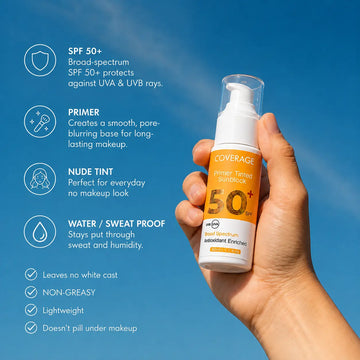
COVERAGE Primer Tinted Sunblock SPF 50+

Why this ingredient. Iron oxides are the only widely available way to extend sun protection into the visible spectrum. This is not a cosmetic preference for melasma. It is the functional difference between a sunscreen that works on your condition and one that does not.
Why this formulation. Ours is 100% mineral, so the only UV filters are micronized zinc oxide and micronized titanium dioxide, with the iron oxide tint doing the visible-light work on top. No chemical filters at all, which matters because melasma-prone skin is often reactive, and irritation feeds pigmentation. It is also water and sweat resistant, which in a Pakistani summer is the difference between protection that lasts and protection that slides off by noon.
Why it gets used. The tint blends into medium and fair tones on contact, so there is no white cast to talk yourself out of. It doubles as a primer and gives light everyday coverage, which means it replaces a step rather than adding one. Rs.1,399 for 50ml.
How to use it. Two finger-lengths for the face, every single morning, indoors included. Reapply at least once mid-day if you are out or sitting near a window. Visible-light protection depends on the tint physically being present, so reapplication is not optional.
When to expect results. This step does not fade existing pigment. It stops new pigment forming, which is what makes everything else work. You will notice its absence faster than its presence: skip it for a summer and the patches come back.
Protecting against pigmentation?
Primer Tinted Sunblock SPF 50+, the daily protection step
The evidence behind this is unusually clean. A 2020 study in the Journal of Drugs in Dermatology tested iron oxide formulations against a non-tinted mineral SPF 50+ in Fitzpatrick IV skin: the iron oxide formulations significantly protected against visible-light-induced pigmentation, the SPF 50+ without them did not. A 2025 randomised investigator-blinded study in the Journal of Cosmetic Dermatology followed 42 women with melasma through summer and found the tinted group held stable where the untinted group of equivalent SPF did not. Harvard Health says the same in plain language.
Step 2, correct: slowing down pigment production
Protection stops the problem growing. It does not undo what is already there. For that you need something that interferes with how melanin is made.
Azelaic acid inhibits tyrosinase, the enzyme melanocytes need in order to manufacture melanin. Less enzyme activity, less new pigment. It is also anti-inflammatory, which matters because inflammation is one of the things keeping melasma switched on in the first place.
What makes it particularly suited to melasma is that it is selective. It targets overactive melanocytes and largely leaves normal ones alone, so it does not lighten the skin around your patches into a different problem. It is not a bleach and it is not a fairness agent.
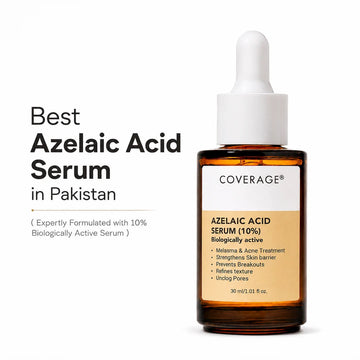
COVERAGE Azelaic Acid 10% Serum

| COVERAGE Azelaic Acid 10% Serum | |
|---|---|
| Concentration | 10% azelaic acid |
| Format | Lightweight serum, not a heavy cream |
| Size | 30ml |
| Price | Rs.1,600 |
| Supporting ingredients | Aloe vera extract, sodium hyaluronate, vitamin E |
| Prescription needed | No |
| Works on | Melasma, post-acne marks, active acne, uneven tone |
Why this formulation. Two decisions define this serum, and both are about the same thing: whether you are still using it in month four.
The first is the concentration. You will see 20% prescription creams in every pharmacy, and we will be straight with you: 20% has the deeper clinical evidence base, and under a dermatologist it is the stronger option for moderate acne. What it is also famous for is stinging. The number of people in Pakistan who buy a tube, use it ten days, react and abandon it is enormous. Melasma keeps improving over three to six months. A treatment you tolerate for six months beats a treatment you quit in two weeks, every time.
The second is the base. A thick cream in 42 degree Lahore heat sits on the skin and feels awful, so it gets skipped. A lightweight serum in an aloe and sodium hyaluronate base absorbs and disappears, so it gets used. The vitamin E and aloe are there to keep the barrier comfortable, because irritated skin produces more pigment, not less.
How to use it. At night, on the pigmented areas and across the face. Three nights in the first week, then every other night, then nightly once your skin is comfortable. Mild tingling for the first fortnight is normal. Burning or peeling is not, and means you should slow down.
When to expect results. Most of our customers see a visible difference within 1 to 3 weeks of consistent daily use. Every skin type and every concern is different, so some people need more time. Deeper pigmentation such as melasma keeps improving over a longer period, usually three to six months, fading inward from the edges rather than disappearing at once. For stubborn melasma, make your final judgement at month three, not at week three.
Pigmentation is your main concern?
Azelaic Acid 10% Serum, the night treatment step

Step 3, defend: the morning half nobody talks about
Here is the gap in most pigmentation routines. Sunblock blocks light. Azelaic acid slows production. Neither one deals with what happens in between, which is oxidative stress.
When UV and visible light hit skin, part of the damage is oxidative. That oxidative stress is itself one of the signals telling melanocytes to get busy. An antioxidant applied in the morning, underneath sunscreen, intercepts some of that stress before it becomes a message. Vitamin C also has its own mild tyrosinase-inhibiting effect on top of that, so it contributes to the correction side as well.
There is a catch, and it is specifically a Pakistani catch.
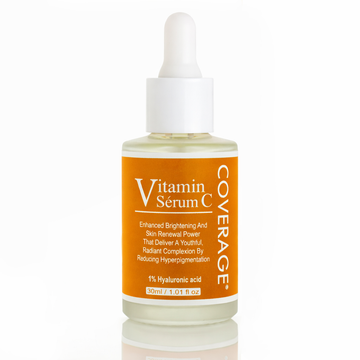
COVERAGE Vitamin C + 1% HA Skin Serum

Why most vitamin C fails here. Most vitamin C serums use L-ascorbic acid, which is unstable in heat and light. It oxidises. That is why the bottle you bought in March has turned orange-brown by June, and an oxidised vitamin C serum can lose its effectiveness and should not be relied on for antioxidant protection. In a country where a serum sits in a warehouse, then on a delivery bike, then on a bathroom shelf at 40 degrees, this is not a theoretical problem. It is the reason so many Pakistani women conclude vitamin C "does not work for me."
Why this formulation. Ours is built around a stable form of vitamin C precisely so it survives the journey and the summer. The 1% hyaluronic acid is there so it layers comfortably under sunblock instead of leaving skin tight, which sounds minor until you are applying three products before leaving the house in July. Rs.1,399.
How to use it. A few drops on clean skin in the morning, before moisturiser and sunblock. Every day.
When to expect results. Overall brightness and tone usually shift in six to eight weeks. On melasma specifically, its job is largely preventive, working alongside the other two rather than in place of them.
Want the complete pigmentation routine?
Pigmentation & Melasma Bundle pairs the azelaic serum with the tinted sunblock at Rs.3,850
Bright Shield Duo pairs vitamin C with the tinted sunblock at Rs.2,750
Putting it together

Morning
- Gentle cleanse with lukewarm water. No scrubs, no hot water.
- Vitamin C + 1% HA Serum. Defend.
- Moisturiser if your skin wants it.
- Primer Tinted Sunblock SPF 50+. Protect. Reapply mid-day.
Night
- Cleanse properly. Sunblock needs to come off.
- Azelaic Acid 10% Serum. Correct.
- Moisturiser to seal.
That is the whole routine. Not ten products. Three, each doing a job the other two cannot.
Real results from real customers

COVERAGE customer results with Azelaic Acid 10% Serum. Acne and post-acne marks. Individual results vary.
A note on honesty, because it changes what you should expect. The results above are acne and post-acne marks, which is where most of our customer photos come from. Melasma does not behave like that. Most of our customers see a visible difference within 1 to 3 weeks of consistent daily use. Every skin type and every concern is different, so some people need more time. Melasma is deeper, slower and patchier, and it keeps improving over three to six months of consistent use. If you expect melasma to follow the acne timeline and make your final judgement at week three, you may conclude it is not working when the deeper pigment simply has not had time.
What the research actually says
We want to show our working, because most Pakistani skincare content asserts things without a single source.
The landmark trial. Baliña and Graupe, International Journal of Dermatology, 1991: a 24-week double-blind study on 329 women comparing 20% azelaic acid against 4% hydroquinone, both with broad-spectrum sunscreen. Azelaic acid produced good or excellent results in 65% of patients, with no significant difference against hydroquinone on overall rating, lesion size or pigment intensity. Critically, no allergic sensitisation and no exogenous ochronosis with azelaic acid.
The meta-analysis. Albzea and colleagues, Cureus, 2023: six randomised controlled trials pooled, 673 melasma patients. Conclusion was that azelaic acid may outperform hydroquinone on MASI reduction, the standard clinical scoring system for melasma, with no significant difference in side effects.
The Pakistani trial. Researchers at Combined Military Hospital Abbottabad ran a randomised controlled trial on 50 Pakistani women with melasma over six months. Pakistani patients, Pakistani skin, Pakistani sun. That is rarer than it should be.
The honest counterweight. Not every study lands the same way. At least one comparative trial found 4% hydroquinone cleared pigment faster than 20% azelaic acid over a short study period. We are telling you because it is true, and because you should be suspicious of any brand that only ever shows you the studies that flatter it.
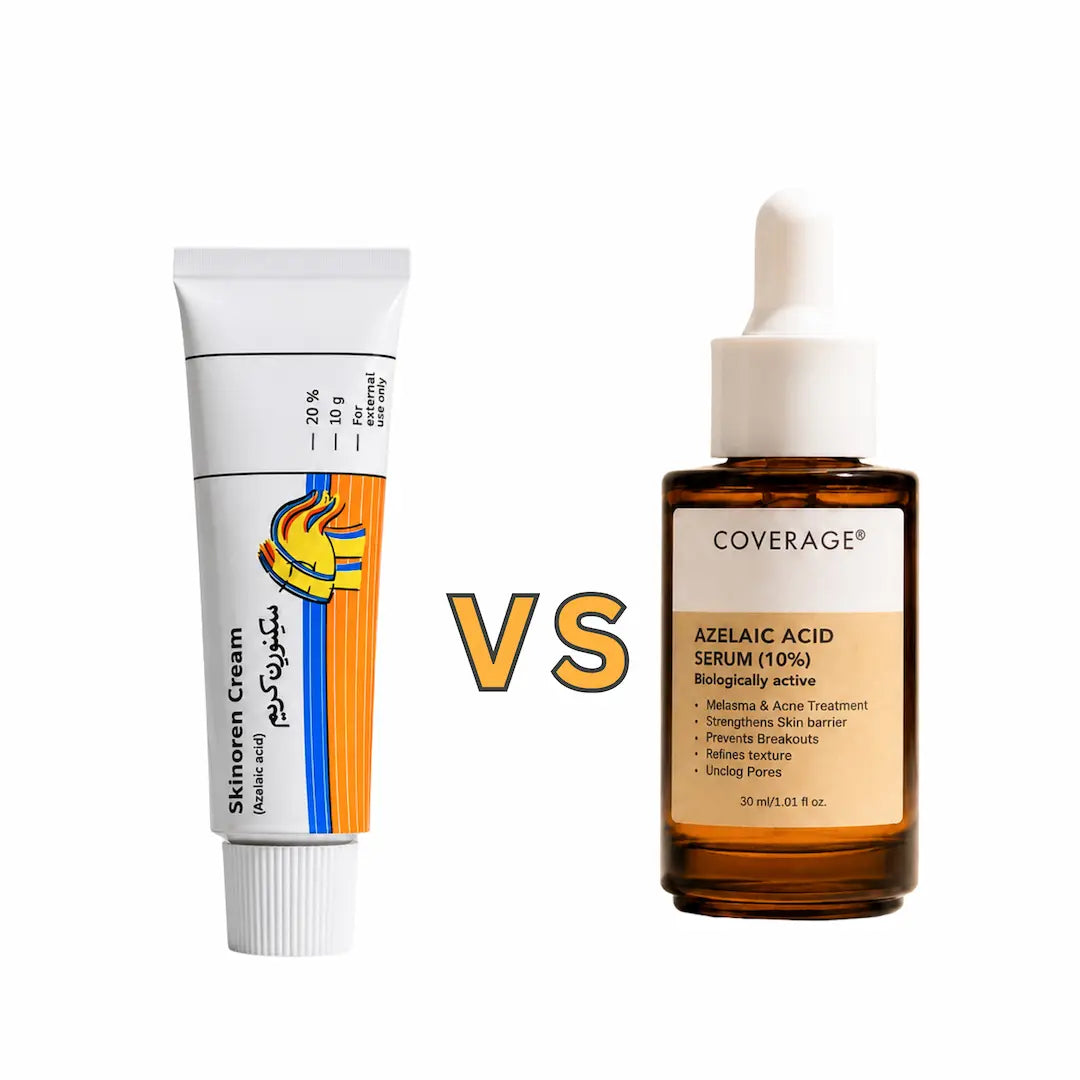
The fair summary: azelaic acid is a legitimate, evidence-backed melasma treatment performing in the same league as the prescription standard, with a meaningfully better long-term safety record. Full ingredient breakdown here: Azelaic Acid Serum in Pakistan, and the head-to-head against the prescription cream here: Skinoren vs COVERAGE Azelaic Acid 10%.
Fairness creams and hydroquinone: the risk nobody mentions
Walk into any general store in Pakistan and you will find shelves promising rangat gori in seven days. Some are harmless and useless. Some are neither.
The specific thing to understand is exogenous ochronosis. Long-term hydroquinone use, particularly at high concentrations and particularly on darker skin, can cause a permanent blue-grey-black discolouration. It is not melasma getting worse. It is a separate condition caused by the treatment, and it is extremely difficult to reverse. The cruel part is that it looks like the problem you were trying to fix, so people respond by applying more of the cream that caused it.
Unregulated fairness creams add mercury and high-dose steroids on top, neither of which appears on the label. Steroids thin the skin and cause rebound pigmentation worse than what you started with.
This is where that 1991 trial result stops being a technicality. Across 329 women over 24 weeks, azelaic acid produced no cases of exogenous ochronosis. That is the practical argument for it: six months of use does not risk leaving you with something permanent.
Hydroquinone under a dermatologist for a defined period is legitimate medicine. Hydroquinone bought over the counter and used indefinitely because it seemed to be working is how people end up in trouble.
How long this actually takes
- Weeks 1 to 4: Most of our customers see a visible difference in 1 to 3 weeks. Every skin is different, so some people need more time. Melasma is deeper and usually changes more slowly than acne marks.
- Weeks 4 to 8: Post-acne marks keep fading. Melasma may look slightly less dense at the edges.
- Months 3 to 6: Deeper melasma keeps improving. Patches lighten and shrink inward.
- Ongoing: Melasma is chronic. Stop the sunblock and it returns, usually by the next summer.
Expect it to look worse in June and better in December, every year, permanently. That is melasma behaving normally, not your routine failing.
When to see a dermatologist instead
We would rather you got better than bought another bottle, so here is the honest boundary.
See a dermatologist if you have used a proper routine consistently for six months with no meaningful change; if your pigmentation is deep or greyish rather than brown, which can indicate dermal melasma; if patches are spreading quickly or appeared suddenly; if you have used strong fairness or steroid creams long term and want to come off them safely; or if you are pregnant or breastfeeding and want to confirm what is safe.
What a dermatologist offers that a serum cannot: a Wood's lamp examination to determine whether your melasma is epidermal, dermal or mixed, which genuinely changes the plan. Oral tranexamic acid, which has good evidence and is prescription-only. Supervised hydroquinone for a defined course. Peels and lasers.
One warning on lasers. Melasma is notoriously laser-sensitive, and aggressive treatment on Fitzpatrick IV and V skin can trigger rebound pigmentation worse than the original. If a clinic offers laser on the first visit without examining the depth of your pigmentation, get a second opinion.
Common mistakes that make melasma worse
- Scrubbing. Physical exfoliation causes inflammation, and inflammation feeds melasma. Put the ubtan down.
- Lemon juice. A popular nuskha and a genuinely bad idea. Lemon on skin followed by sun can cause a burn reaction leaving darker marks than you started with.
- Stopping sunblock in winter. UV drops in December. It does not vanish, and visible light certainly does not.
- Skipping sunblock indoors. If you can see your hand, there is enough visible light to matter.
- Product-hopping. Changing everything every three weeks means stubborn melasma never gets the three months it needs.
- Treating heat as harmless. Stoves, tandoors, long bike commutes. Ambient heat is its own trigger.
Frequently asked questions
Chaiyan ka ilaj kya hai?
Melasma is managed rather than cured. The evidence-backed approach is daily broad-spectrum sun protection that also blocks visible light, plus a topical that slows melanin production such as azelaic acid, plus an antioxidant in the morning. With our azelaic acid serum, most of our customers see a visible difference in 1 to 3 weeks. Every skin is different, so some people need more time, and deeper melasma keeps improving over three to six months. Maintenance is ongoing.
Does melasma go away permanently?
No. Melasma is a chronic condition. It can be faded significantly and kept faded, but it recurs when sun protection stops. Anyone promising permanent removal is not being honest with you.
Is azelaic acid good for melasma?
Yes. It inhibits tyrosinase, the enzyme required for melanin production, and it is anti-inflammatory. Clinical trials including a 24-week study on 329 women and a 2023 meta-analysis of six trials support it as comparable to hydroquinone, with a better long-term safety record.
Which is better for melasma, azelaic acid or vitamin C?
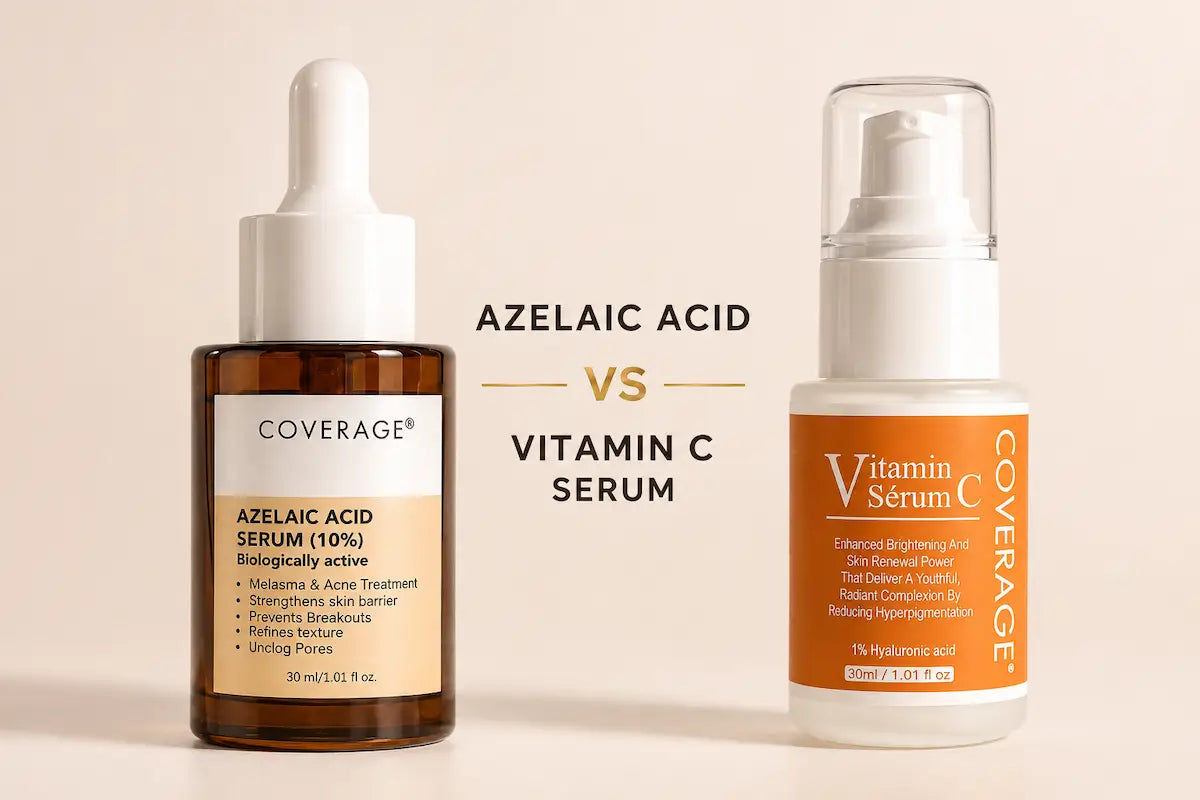
They do different jobs and work best together. Vitamin C is an antioxidant used in the morning to reduce the oxidative stress that triggers pigment. Azelaic acid is used at night to slow pigment production directly. Neither replaces sunscreen.
Can I use azelaic acid and vitamin C together?
Yes, and it is a sensible pairing. Use vitamin C in the morning under sunblock and azelaic acid at night. Splitting them across the day is gentler and easier to sustain than layering both at once.
Why is tinted sunscreen better for melasma?
Tinted sunscreens contain iron oxides, which block visible light. Clear sunscreen is transparent to visible light by design, and visible light is a documented trigger for melasma in medium and deeper skin tones. A 2025 randomised study found tinted sunscreen kept melasma stable through summer where untinted sunscreen of the same SPF did not.
Is hydroquinone safe for melasma?
Under dermatologist supervision for a defined period, it is a legitimate treatment. Used long term without supervision it carries a risk of exogenous ochronosis, a permanent blue-grey skin discolouration that is very difficult to reverse and more common in darker skin tones.
How long does azelaic acid take to work on melasma?
Most of our customers see a visible difference within 1 to 3 weeks of consistent daily use. Every skin type and every concern is different, so some people need more time. Melasma is a deeper pigmentation that keeps improving over a longer period, usually three to six months. It fades gradually and unevenly rather than clearing all at once.
Do iron tablets help with chaiyan?
No. Despite being commonly prescribed for pigmentation in Pakistan, there is no scientific evidence linking iron deficiency to melasma or supporting iron supplementation as a treatment for it.
Can melasma get worse in summer in Pakistan?
Yes, and it usually does. Higher UV, longer exposure and ambient heat are all triggers. Most people see their melasma darken between April and September and lighten in winter. This annual cycle is normal and is why year-round sun protection matters.
The bottom line
Melasma is stubborn, chronic and manageable. The reason so many people in Pakistan feel like nothing works is that they attack it with fairness creams and scrubs while leaving the actual triggers completely unaddressed.
You do not need ten products for chaiyan. You need three steps: defend in the morning with Vitamin C, protect all day with the Primer Tinted Sunblock SPF 50+, and correct at night with the Azelaic Acid 10% Serum.
Most of our customers see a visible difference within 1 to 3 weeks of consistent daily use. Every skin type and every concern is different, so some people need more time. Deeper pigmentation such as melasma keeps improving over three to six months. And if six honest months change nothing, go and see a dermatologist, because dermal melasma is real and no serum on earth will fix it.
Start the routine
Pigmentation & Melasma Bundle, Rs.3,850
This article is for general informational purposes only and is not a substitute for professional medical advice. All information and claims referenced above are drawn from publicly available dermatological studies and expert sources. Always consult a dermatologist for advice specific to your skin.

Leave a comment
This site is protected by hCaptcha and the hCaptcha Privacy Policy and Terms of Service apply.