
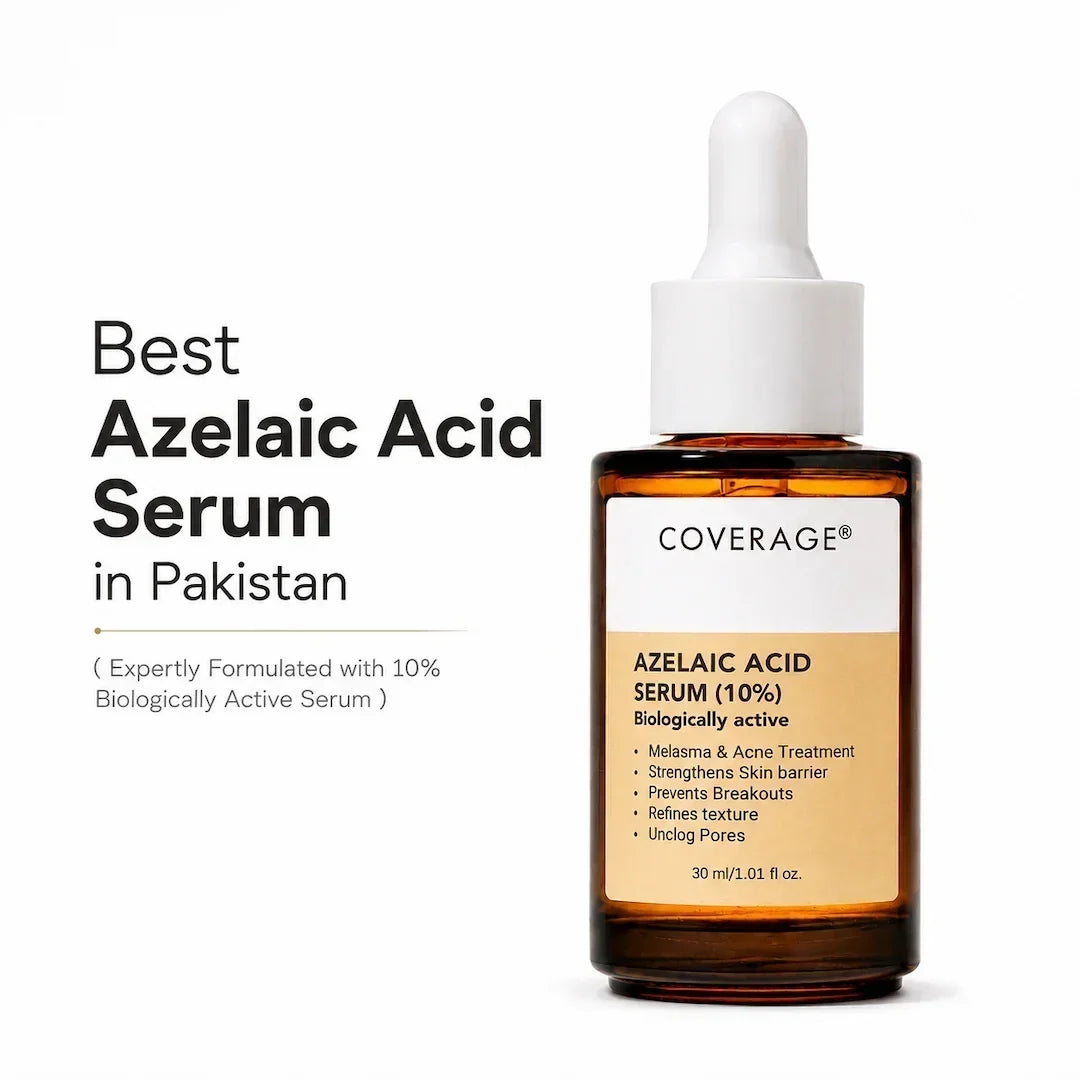
Azelaic Acid Serum in Pakistan: Acne, Melasma & Daag Dhabbe
If you have spent years cycling through creams for daag dhabbe, keel muhase or chhaiyan, you already know the pattern. Something works for two weeks, then the marks come back darker. Or the product stings, your skin peels, and you quietly stop using it.
Azelaic acid is one of the few ingredients in this category with a genuine clinical evidence base behind it, and one of the few that does not rely on bleaching your skin to make it look brighter. It is not a miracle and it is not fast. But for acne, melasma and post-acne pigmentation on Pakistani skin, an azelaic acid serum is one of the most sensible, best-tolerated places to start.
Here is what it actually does, what the research supports, and how to use it in Pakistan's heat and sun.
Azelaic acid at a glance
Acne (keel muhase) ✅ Yes Melasma (chhaiyan) ✅ Yes Dark spots and post-acne marks (daag dhabbe) ✅ Yes Redness and rosacea ✅ Yes Suitable for sensitive skin ✅ Yes, at 10% Safe for daily long-term use ✅ Yes Bleaches or lightens natural skin tone ❌ No Makes skin sun-sensitive ❌ No Prescription needed at 10% ❌ No Time to visible results: Most of our customers see a visible difference in 1 to 3 weeks. Every skin is different, so some people need more time. Daily sunscreen is required throughout.

Before and after, using COVERAGE Azelaic Acid 10% Serum alongside daily sunscreen. These are the customer's own photos, unedited and taken at home in ordinary lighting, shared with permission. Individual results vary.
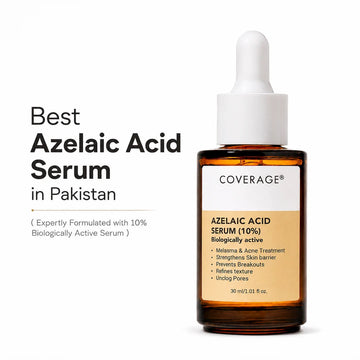
COVERAGE Azelaic Acid 10% Serum, Rs.1,600 for 30ml
Lightweight, fragrance free and gentle enough for daily use. No prescription needed. Cash on delivery across Pakistan.
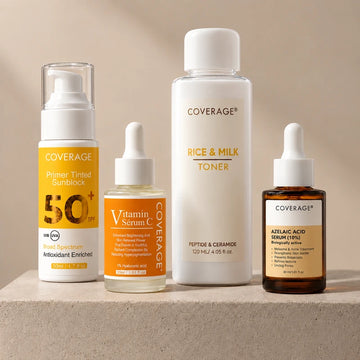
For melasma and dark spots, the Melasma, Dark Spots & Acne Marks Treatment set adds Vitamin C and mineral SPF 50+.
Azelaic acid kya hai? (What is azelaic acid?)
Azelaic acid is a naturally occurring dicarboxylic acid found in grains such as wheat, barley and rye. It is also produced on human skin by yeast that lives there naturally, which is part of why it tends to be so well tolerated.
In skincare it appears in two broad tiers. Cosmetic serums typically use 10%, available over the counter without a prescription and designed for daily use. Medicated formulations use 15–20% and are prescription products in Pakistan, sold as creams such as Skinoren, Aziderm and Acnoren.
The simplest definition: azelaic acid is a gentle multi-tasking acid that calms inflammation, unclogs pores and reduces excess pigment production, without bleaching normal skin.
That last point is the one most people miss, and it is the reason azelaic acid deserves a very different conversation from the whitening creams that dominate the Pakistani market.
Looking for an azelaic acid serum in Pakistan?
If you are researching products while reading this guide, you can view the COVERAGE Azelaic Acid 10% Serum here. Rs.1,600, 30ml, cash on delivery nationwide. This article explains exactly how it works, who it is for, and how to use it correctly.
How azelaic acid works
Most active ingredients do one job. Azelaic acid works through four separate mechanisms at once, which is why a single product can help with acne, redness and pigmentation together.
It reduces melanin production. Azelaic acid inhibits tyrosinase, the enzyme your skin uses to manufacture melanin. Less tyrosinase activity means less new pigment being deposited into the skin.
It normalises keratinisation. Skin cells shed on a cycle. When that cycle goes wrong, dead cells build up inside the pore, mix with oil, and form the plug that becomes a blackhead or a pimple. Azelaic acid helps that shedding happen more normally, so pores clog less.
It is antibacterial. It acts against Cutibacterium acnes, the bacteria involved in inflammatory acne, by interfering with bacterial protein synthesis.
It is anti-inflammatory. It reduces the reactive oxygen species that drive redness and irritation, which is why it is also a standard treatment for rosacea.
The critical detail for anyone with pigmentation concerns is selectivity. Azelaic acid acts primarily on overactive, abnormal melanocytes, the pigment cells that have gone into overdrive and are producing dark patches. It largely leaves normal, healthy melanocytes alone.
In plain terms: it targets the spot, not your skin tone. It is not a bleaching agent, it does not lighten your natural complexion, and it does not stain fabric.

What azelaic acid treats
A 2023 systematic review published in the Journal of Cosmetic Dermatology (King et al.) examined 43 randomised controlled trials of azelaic acid across acne, rosacea, melasma and skin ageing. The authors concluded that azelaic acid outperformed vehicle (placebo) for rosacea, acne and melasma, and that in head-to-head comparisons against other active treatments the results were frequently equivalent.
That is a meaningful body of evidence for a cosmetic-tier ingredient. Note that these trials studied azelaic acid as an ingredient, largely at medicated 15–20% concentrations, so read them as evidence for the ingredient rather than for any one product.
Azelaic acid for acne (keel muhase)
Azelaic acid attacks acne from three directions simultaneously: it unclogs the pore, reduces the bacteria inside it, and calms the inflammation that makes a spot red and swollen. It is particularly useful for people whose acne comes with a lot of redness, and for those who cannot tolerate benzoyl peroxide or retinoids.
It also works on the marks acne leaves behind, which for most Pakistani skin is the bigger long-term complaint.
"I've been consistently using COVERAGE Azelaic Acid 10% for a little over two weeks now, and I'm genuinely happy with the progress so far. One of the first things I noticed was that I stopped getting new active acne during this period, which was a big win for my breakout-prone skin. The formulation didn't sting or overwhelm my skin, which was very good."
Hina (@hinaali), shared with permission
Azelaic acid for melasma and dark spots (chhaiyan, daag dhabbe)
The benchmark study here is Baliña and Graupe (1991), published in the International Journal of Dermatology: a 24-week double-blind trial of 329 women comparing 20% azelaic acid cream against 4% hydroquinone. Azelaic acid produced good or excellent results in 65% of patients, performing comparably to hydroquinone over the study period.
That matters because hydroquinone is a potent depigmenting agent with real restrictions on long-term use. An ingredient that can be discussed in the same conversation, while being gentle enough for daily cosmetic use, is a genuinely useful option.
Post-acne marks and uneven tone
Post-inflammatory hyperpigmentation, the brown mark left behind after a pimple heals, is one of the most common skin complaints in Pakistan. Skin in the Fitzpatrick III–V range, which covers the vast majority of Pakistani skin tones, produces more melanin in response to inflammation. That means every spot, every scratch and every shaving nick has a higher chance of leaving a mark that outlasts the original problem by months.
Azelaic acid is well suited to this because it addresses both halves of the problem at once: it reduces the inflammation that triggers the pigment, and it inhibits the pigment production itself. Serums formulated at 10%, such as the COVERAGE Azelaic Acid 10% Serum, sit in this daily-use cosmetic tier.
Why choose the COVERAGE Azelaic Acid 10% Serum
Everything above is true of azelaic acid as an ingredient. What varies between products is the concentration, what else is in the bottle, and whether the formula is gentle enough that you actually keep using it.
COVERAGE Azelaic Acid 10% Serum. Rs.1,600. Cash on delivery nationwide.
Biologically active azelaic acid at the full 10% cosmetic strength, Korean-formulated and built on a barrier-supporting base rather than a bare acid formula. That base is the part most serums skip, and it is why this one is gentle enough to use every single day for the months that deeper pigmentation can take.
| Active | Azelaic acid 10%, biologically active |
| Supporting ingredients | Aloe vera, vitamin E, sodium hyaluronate |
| Size | 30ml / 1.01 fl oz |
| Targets | Melasma, acne, post-acne marks, dark spots, redness, texture, clogged pores |
| Skin types | All, including sensitive |
| Prescription needed | No |
| Price | Rs.1,600 (regular Rs.2,000) |
| Delivery | Cash on delivery nationwide |
| Reviews | 4.9 average rating from 5,000+ reviews across our store and social channels |
What it does
- Fades post-acne marks and dark spots, without bleaching your natural skin tone
- Calms redness and inflammation
- Prevents new breakouts by keeping pores clear
- Strengthens the skin barrier instead of stripping it
- Refines uneven texture
Why not a 20% prescription cream? Because you can actually stay on this one. Deeper, older pigmentation can keep improving over 8–12 weeks of uninterrupted use, and the most common reason people never get there is that a harsher product forced them to stop and restart.
Why not an imported serum? Imported 10% serums sell in Pakistan for anywhere between Rs.4,400 and Rs.7,000. This is Rs.1,600 for 30ml, delivered anywhere in Pakistan, and you pay only when the parcel is in your hands. Over 72,000 orders delivered across Pakistan, with a 4.9 average rating from more than 5,000+ reviews across our store and social channels.
Shop the COVERAGE Azelaic Acid 10% Serum

Why azelaic acid suits Pakistani skin
Most skincare advice online is written for skin and climates that are nothing like ours. Three local factors make azelaic acid an unusually good fit here.
Skin type. Fitzpatrick III–V skin pigments readily in response to inflammation. Ingredients that are highly irritating tend to backfire on deeper skin tones, because the irritation itself triggers new pigmentation. An anti-inflammatory pigment inhibitor is exactly the right shape of tool for this problem.
Sun and heat. Lahore's summer UV index regularly peaks near 11, which is classified as extreme. UV exposure is the single largest driver of melasma relapse, and heat alone can worsen it independent of UV. Azelaic acid is not photosensitising, meaning it does not make your skin more vulnerable to the sun the way some acids and retinoids do. It is also chemically stable and does not degrade in heat the way poorly formulated vitamin C does.
Melasma prevalence. A cross-sectional study of melasma patients conducted at Combined Military Hospital Lahore (n=126) found that 85.7% of patients were female and roughly 88% were in the reproductive age group, with a mean MASI score of 12.21 and a mean DLQI of 8.22. That DLQI figure is a quality-of-life measure, and a score in that range indicates melasma has a genuine effect on daily life. This is not a vanity concern. It is a common condition that affects how people feel about going out.
Add smog season in Lahore, humidity in Karachi and dry heat in the north, and you get a population dealing with pigmentation year round, mostly with products never designed for it.
A safer alternative to whitening creams
This part is uncomfortable but necessary.
In October 2025, accredited-lab testing reported by the Zero Mercury Working Group coalition found that 35 of 37 creams manufactured in Pakistan contained mercury at levels thousands of times above the legal limit of 1 part per million, with one product measuring 24,000 ppm. A separate 2026 study published in Biological Trace Element Research tested 10 skin-lightening brands sold in Lahore and found samples exceeding international limits, with hydroquinone measured up to 5.56% and mercury up to 4.9 ppm, surpassing USFDA, PSQCA and WHO standards.
The regulatory response has begun. The Competition Commission of Pakistan opened an inquiry into deceptive marketing and safety claims in the fairness cream category under Section 10 of the Competition Act 2010, and served notices to 12 cosmetic companies over misleading marketing.
Mercury and unregulated hydroquinone do produce fast visible lightening. They also cause the pattern most people recognise: skin that looks brighter for a few months, then becomes thin, reactive and darker than where it started, sometimes permanently.
Azelaic acid is a slower and less dramatic route. It does not bleach. It reduces overactive pigment production and lets your skin recover its own even tone over weeks and months. The trade-off is patience, and it is a trade worth making.
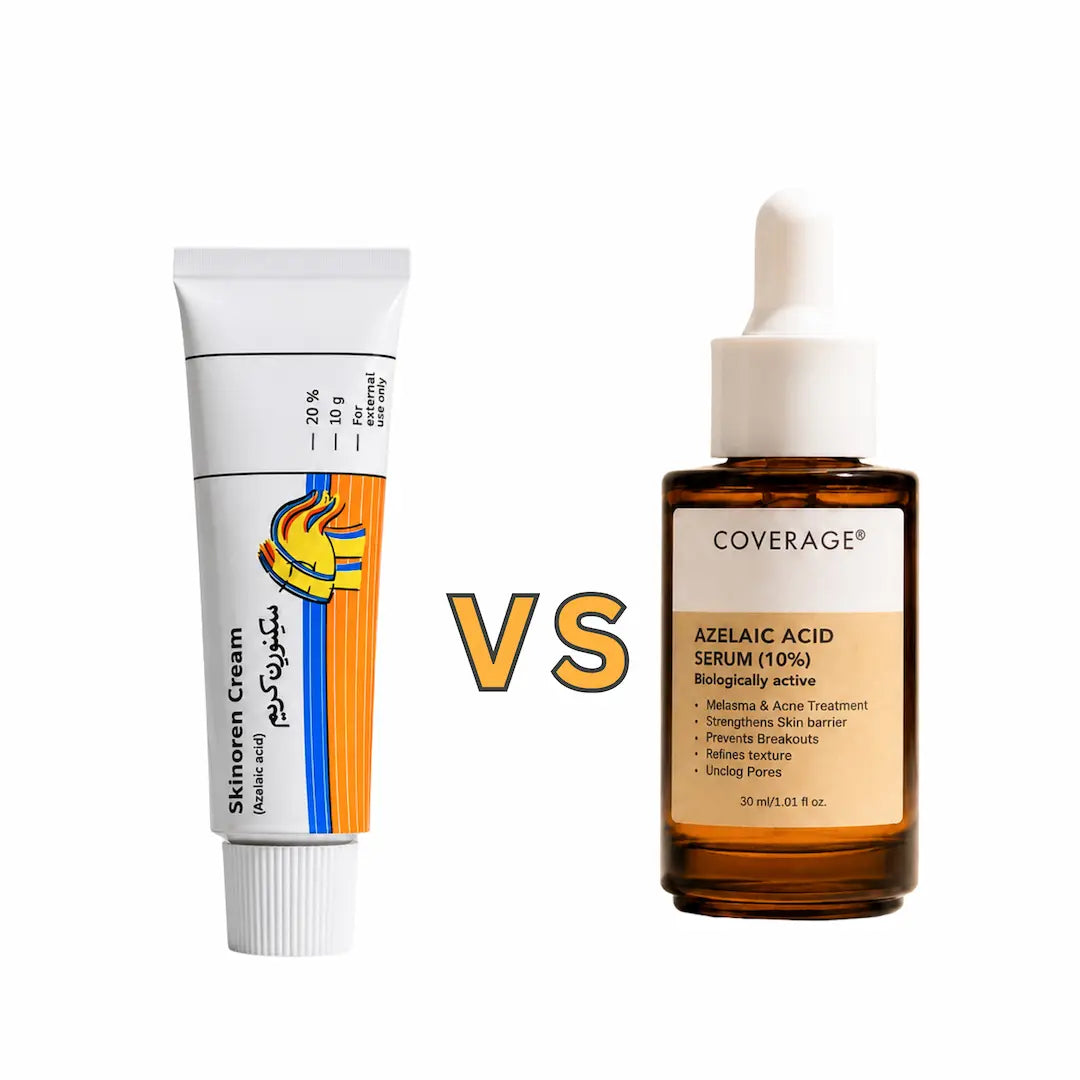
10% or 20%: how does a serum compare to Skinoren?
This is the most common question, and the honest answer is that the two are built for different jobs.
20% (Skinoren, Aziderm, Acnoren) is medicated, prescription-only, and it is the concentration used in most of the clinical trials. It is the more aggressive option, prescribed under a doctor's supervision for a defined treatment period. Skinoren typically sells for around Rs.751 to Rs.767 for a small 10g medicated tube in Pakistani pharmacies. Its own product labelling documents burning, stinging, itching and irritation as recognised side effects.
10% is the cosmetic tier: available without a prescription, formulated for daily long-term use, and considerably gentler.
Here is the part worth thinking carefully about. Most of our customers see a visible difference within 1 to 3 weeks of consistent daily use. Every skin type and every concern is different, so some people need more time. Deeper, older pigmentation can keep improving over 8–12 weeks of consistent use. That means consistency is not a minor detail, it is the whole game.
Not everyone tolerates 20% comfortably. When a product stings or causes peeling, people stop using it, restart, stop again. A gentler 10% that you can genuinely apply every day without interruption often gets you further in practice than a stronger product you keep pausing. This is a point about tolerability and adherence, not about one concentration being more powerful than the other.
| 10% serum (cosmetic) | 15–20% cream (medicated) | |
|---|---|---|
| Availability | Over the counter | Prescription only in Pakistan |
| Typical products | COVERAGE 10%, The Ordinary 10% | Skinoren, Aziderm, Acnoren |
| Designed for | Daily long-term use | Defined treatment course, doctor-supervised |
| Tolerability | Gentler, better tolerated | Burning, stinging and peeling documented on label |
| Best suited to | Maintenance, mild to moderate concerns, sensitive skin | Stubborn or long-standing pigmentation |
| Approximate price | Rs.1,600 (COVERAGE, sale) | Rs.751–767 for a 10g tube |
If you have stubborn, long-standing melasma, see a dermatologist and ask about medicated strength. If you want something you can build a sustainable daily routine around, 10% is the sensible tier.
The COVERAGE Azelaic Acid 10% Serum sits in this daily-use category: Korean-formulated with skin-barrier-supporting aloe vera, vitamin E and sodium hyaluronate, so your barrier stays intact while the azelaic acid works. That matters when you are using an active every day in a hot climate.
How to use azelaic acid serum
Morning: cleanse, apply azelaic acid serum, wait roughly two minutes, apply moisturiser, then sunscreen.
Evening: cleanse, apply azelaic acid serum, wait roughly two minutes, apply moisturiser.
Start slowly. Use it 2–3 times per week for the first two weeks. If your skin is comfortable, move to once daily, then twice daily. There is no prize for rushing this, and going too fast is the most common reason people conclude azelaic acid "did not work."
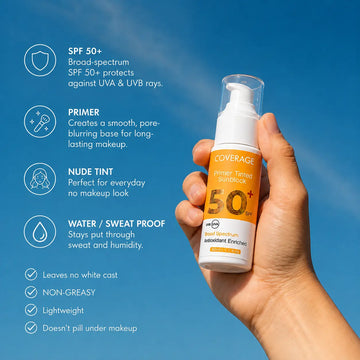
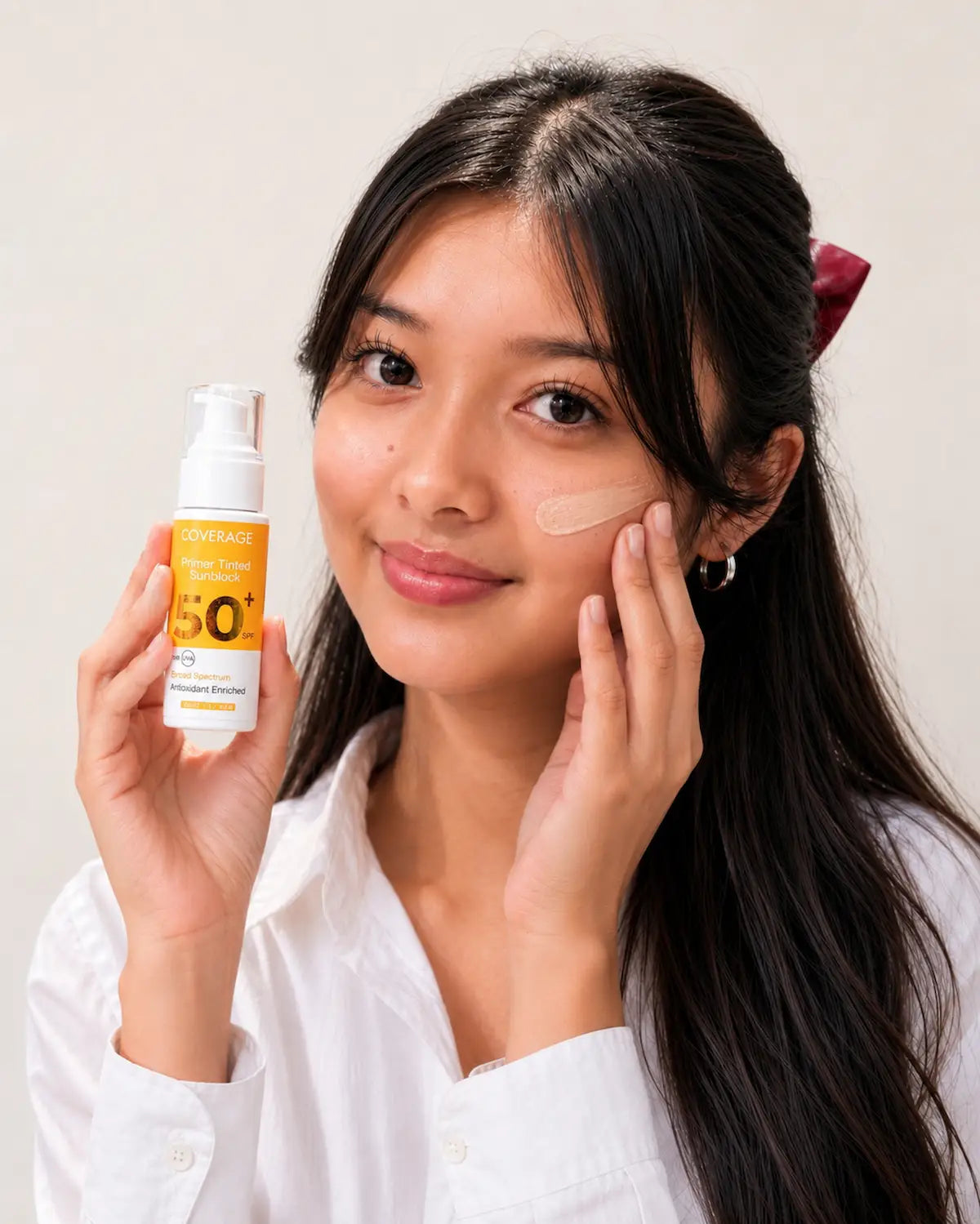
Sunscreen is not optional. This is the single most important line in this article. Every pigmentation active you will ever use is undone by UV exposure. Treating melasma without daily broad-spectrum SPF in Pakistan's sun is like bailing water out of a boat without plugging the hole. A daily SPF 50+ such as the COVERAGE Primer Tinted Sunblock covers the requirement, and the tint adds a layer of visible-light coverage, which is relevant because visible light is now understood to contribute to melasma in deeper skin tones.
Amount: three to four drops for the whole face. More is not better.
Where: apply to the full face rather than spot-treating. Pigmentation is rarely as localised as it looks.

Purging or breaking out? The adjustment period
Some people get a small increase in spots in the first few weeks. It helps to know which one you are dealing with.
Purging looks like more spots than usual, appearing in the areas where you normally break out, and they come and go faster than your usual spots. It happens because the ingredient is accelerating cell turnover, bringing existing congestion to the surface sooner. It typically settles within 2–6 weeks.
Irritation looks different: persistent burning or stinging that does not fade minutes after application, sustained redness, tightness, flaking, or spots appearing in places you never normally break out.
If it is purging, hold your routine steady and let it pass. If it is irritation, reduce to twice a week, add moisturiser before the serum to buffer it, and if it continues, stop and speak to a dermatologist. Mild tingling in the first minute or two after application is normal and usually settles as your skin adjusts.
It is also worth knowing that a rough start does not always mean the product is wrong for you. Sometimes it means your barrier needs repairing first.
"The first time I used your Azelaic Acid, it didn't suit my skin. I think my skin barrier wasn't healthy at the time. But now I've been using it consistently for almost a month, and it's working really well for my skin. My dark spots have faded noticeably, and the redness has calmed down a lot."
COVERAGE customer, shared with permission
If that sounds like your experience, focus on barrier repair for a few weeks first: a gentle cleanser, a good moisturiser, and daily sunscreen. Then reintroduce azelaic acid slowly, twice a week, and build from there.
How long until you see results?
Most of our customers see a visible difference within 1 to 3 weeks of consistent daily use. Every skin type and every concern is different, so some people need more time.
Redness and irritation: often the first thing to improve.
Active acne: fewer new breakouts is a common early difference.
Pigmentation, melasma and dark spots: deeper, older marks can keep improving over 8–12 weeks of consistent daily use, and often longer for melasma, which is a relapsing condition rather than something that is cured once.
Take a photo on day one, in the same light, at the same time of day. Gradual change is very difficult to see in the mirror day to day, and photographs are the reason most people stay consistent long enough to get a result.

A customer's own photo, 3 weeks apart, unedited, Individual results vary.
Combining azelaic acid with niacinamide and vitamin C
Azelaic acid layers well. It is not a temperamental ingredient.
| Azelaic acid | Niacinamide | Vitamin C | |
|---|---|---|---|
| Main action on pigment | Inhibits tyrosinase, so less melanin is made | Blocks pigment transfer into surface skin cells | Antioxidant, plus tyrosinase inhibition |
| Also helps with | Acne, redness, rosacea | Oil control, barrier support, pore appearance | UV defence, dullness, collagen support |
| Irritation risk | Low | Very low | Moderate, varies by form |
| Heat stability | Stable | Stable | Poor in many formulas, degrades in heat |
| Best time of day | Morning or night | Either | Morning |
| Works with the other two | Yes | Yes | Yes |
With niacinamide: these two work on different stages of the same process. Azelaic acid reduces melanin production at the enzyme level, while niacinamide interferes with the transfer of pigment into surface skin cells. Complementary, and niacinamide additionally supports barrier function, which makes the pair a good fit for sensitive skin.
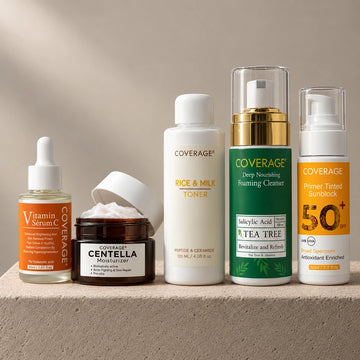
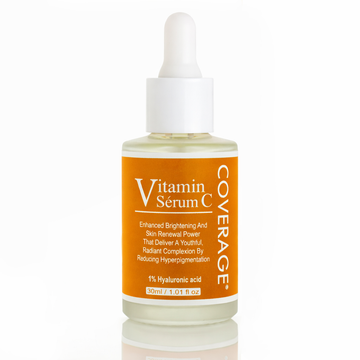
With vitamin C: vitamin C is an antioxidant that reduces UV-triggered pigment formation and also inhibits tyrosinase. The straightforward approach is vitamin C in the morning and azelaic acid in the evening. If you would rather use both together, apply vitamin C first, wait, then layer azelaic acid. The one we pair it with is our COVERAGE Vitamin C + 1% HA Serum, and our vitamin C serum guide for Pakistan explains how to choose one that holds up in the heat.
A simple routine: vitamin C plus sunscreen in the morning, azelaic acid plus moisturiser at night. Once tolerated, add azelaic acid to the morning as well.
Take care with: strong retinoids and high-strength exfoliating acids on the same night, at least while you are still building tolerance. Alternate nights instead.
Side effects and who should take care
Mild stinging, tingling, dryness or slight redness in the first few weeks is common and usually settles. Patch test on your inner arm or behind the ear for two days before using it on your face.
Take extra care if you have very sensitive skin, active eczema or rosacea, or if you are already using several strong actives.
Pregnancy: azelaic acid was classified as Pregnancy Category B under the FDA's former lettering system, which was retired in 2015, and it is widely regarded as one of the more suitable options for acne and melasma during pregnancy. Melasma is especially common in pregnancy. Even so, always confirm with your own doctor before using any active during pregnancy or while breastfeeding.
Nothing in this article is a substitute for a dermatologist. If your pigmentation is severe, spreading or changing shape, get it looked at properly.
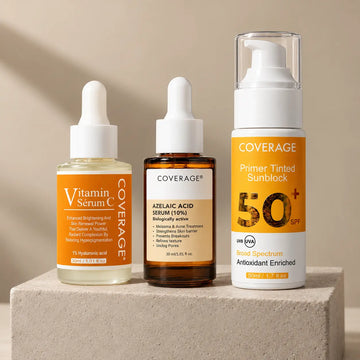
Azelaic Acid 10% at night, SPF 50+ every morning
The simplest routine for acne, acne marks and early chhaiyan on Pakistani skin. Rs.1,600 for the serum, cash on delivery across Pakistan.
Or get both together in the Acne Care & Sun Protection set.
Frequently asked questions
Is azelaic acid good for melasma?
Yes. It is one of the better-evidenced non-prescription options. The Baliña and Graupe trial of 329 women found 20% azelaic acid produced good or excellent results in 65% of patients over 24 weeks, comparable to 4% hydroquinone, and the 2023 systematic review of 43 trials supported its use in melasma. Most of our customers see a visible difference in 1 to 3 weeks. Every skin is different, so some people need more time, and melasma can keep improving over a longer period. Use it alongside daily sunscreen.
Does azelaic acid bleach the skin?
No. It acts on overactive pigment cells and largely leaves normal skin alone, so it does not lighten your natural skin tone. It also does not stain clothing or bedding.
Why choose the COVERAGE Azelaic Acid 10% Serum?
Biologically active azelaic acid at 10%, the gentle daily-use strength, on a barrier-supporting base of aloe vera, vitamin E and sodium hyaluronate. Works on acne, melasma, dark spots and redness. Rs.1,600 for 30ml, cash on delivery nationwide.
Can I use azelaic acid every day?
Yes, once your skin has adjusted. Start 2–3 times a week for two weeks, then build to once daily, then twice daily if comfortable.
Azelaic acid before or after moisturiser?
After cleansing, before moisturiser. Wait about two minutes so the serum absorbs. If your skin is sensitive, applying moisturiser first as a buffer is a reasonable way to reduce irritation while you build tolerance.
How long does azelaic acid take to work?
Most of our customers see a visible difference within 1 to 3 weeks of consistent daily use. Every skin type and every concern is different, so some people need more time. Deeper, older pigmentation can keep improving over 8 to 12 weeks with daily sunscreen.
Is azelaic acid safe in pregnancy?
It was classified Category B under the FDA's former system and is commonly considered one of the more suitable actives during pregnancy. Confirm with your doctor first.
Is 10% as strong as Skinoren 20%?
No, and it is not meant to be. 20% is prescription-strength and medicated. 10% is the cosmetic daily-use tier, which is gentler and better tolerated. Because deeper pigmentation can need months of consistent use, a gentler product you apply every day without interruption can be the more practical choice for many people.
Azelaic acid serum ka price in Pakistan kya hai?
The COVERAGE Azelaic Acid 10% Serum is Rs.1,600 on sale, regular price Rs.2,000. Locally available azelaic acid products range from roughly Rs.750 for a small medicated Skinoren tube up to Rs.5,000 or more for imported brands such as The Ordinary and Paula's Choice.
Can I use azelaic acid with niacinamide or vitamin C?
Yes. All three target pigmentation through different pathways and work well together. Vitamin C in the morning and azelaic acid at night is the simplest structure.
The bottom line
Azelaic acid is not the fastest option for daag dhabbe, chhaiyan or keel muhase. It is one of the few with real clinical evidence behind it that does not work by bleaching your skin, and one of the few gentle enough to use every day for the months that deeper marks can take.
The formula is only half of it. Daily sunscreen and consistency are the other half, and they are the part most people skip.
The COVERAGE Azelaic Acid 10% Serum is formulated for exactly this: daily use on Pakistani skin, in Pakistani weather, with aloe vera, vitamin E and sodium hyaluronate supporting your barrier while the azelaic acid does its work. Rs.1,600 on sale, with cash on delivery nationwide, so you pay only when the parcel is in your hands.

Pair it with the COVERAGE Primer Tinted Sunblock SPF 50+, because the sunscreen is what protects the progress you make.
Start slowly. Wear sunscreen. Take a photo today.
This article is for general informational purposes only and is not a substitute for professional medical advice. All information and claims referenced above are drawn from publicly available dermatological studies and expert sources. Always consult a dermatologist for advice specific to your skin.

Leave a comment
This site is protected by hCaptcha and the hCaptcha Privacy Policy and Terms of Service apply.