
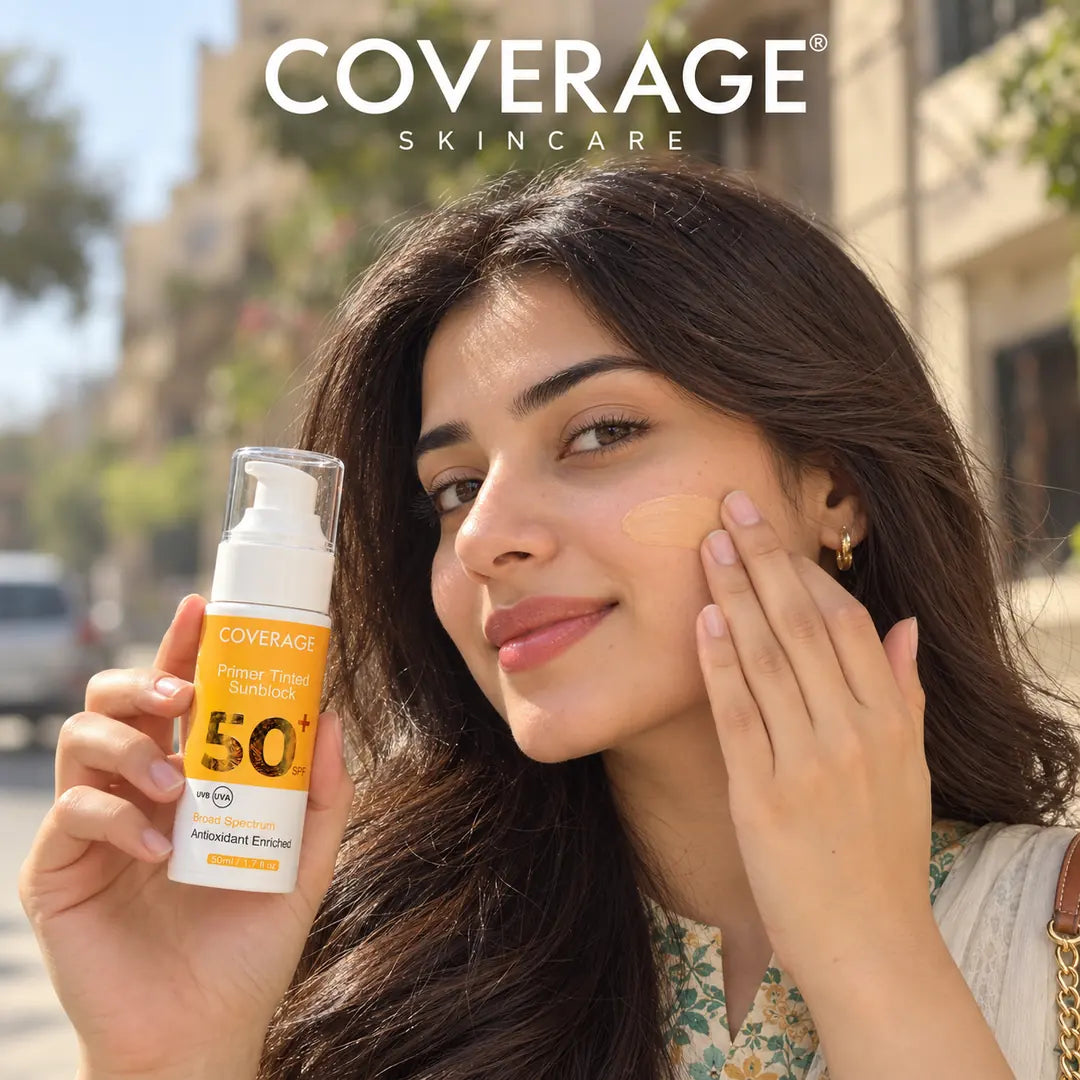
Is SPF 50 Enough in Pakistan? The Complete SPF Guide for Pakistani Skin
Every summer the same question comes up in Pakistan. You are standing in a shop or scrolling online, and there is SPF 30, SPF 50, SPF 50+, even SPF 100. The dhoop outside is brutal. So is SPF 50 enough, or do you need more?
The short answer is that SPF 50 is enough for almost everyone in Pakistan, and the number is not where most people go wrong. This guide explains what SPF 50 actually measures, what it does not measure, how much you need to apply, how often to reapply, and how to match your sunscreen to real Pakistani conditions: Lahore heat, Karachi humidity, bike commutes, university timetables and northern-area trips.
Quick answer: Yes. For most everyday users in Pakistan, a correctly applied broad-spectrum SPF 50 or SPF 50+ sunscreen provides excellent protection. SPF 50 filters roughly 98% of UVB compared with about 97% for SPF 30. But the number alone does not decide real protection. Apply about half a teaspoon for face and neck, choose broad-spectrum, and reapply every 2 hours during prolonged sun exposure.
What this guide covers
- Why sun protection matters so much in Pakistan
- What does SPF 50 actually mean?
- SPF 30 vs SPF 50 vs SPF 50+ vs SPF 100
- Is SPF 50 enough for Pakistani skin tones?
- SPF 50 for pigmentation, daag dhabbe and melasma
- SPF 50 for acne-prone and oily skin
- Is SPF 50 enough under makeup?
- How much SPF 50 should you apply?
- How often should you reapply SPF 50?
- Indoors, winter and cloudy days
- What UV index needs sunscreen, and when is UV strongest?
- Does SPF 50 prevent tanning, pigmentation and ageing?
- UVA vs UVB: why SPF alone is not everything
- What makes a good sunscreen for Pakistan
- Mineral vs chemical sunscreen
- Sunscreen for real Pakistani situations
- Common sunscreen mistakes
- How to apply sunscreen correctly
- Myths: vitamin D, hormones and waterproof claims
- Frequently asked questions
Why Sun Protection Matters So Much in Pakistan
Pakistan sits at a latitude where ultraviolet radiation is intense for most of the year, and daily life keeps people out in it. The World Health Organization advises sun protection whenever the UV Index reaches 3 or above. Across most of populated Pakistan, the summer UV Index climbs well past that into the very high and extreme bands, with Lahore, Karachi, Multan and Faisalabad regularly recording readings in the 8 to 12 range from roughly March through October.
That exposure is not evenly spread, and it is worth being honest about that. UV is stronger at midday than early morning, stronger in June than in December, and stronger at altitude in Gilgit-Baltistan or Murree than at sea level in Karachi. A student walking between departments at noon, a rider commuting on a bike, a shopkeeper in an open bazaar and someone sitting beside an office window all receive very different doses.
What is reliably true is that for most of the country, for most of the year, UV is high enough that daily broad-spectrum protection is sensible. Chronic exposure contributes to sunburn, tanning, uneven rangat, daag dhabbe, chhaiyan, premature ageing and skin cancer risk. Pakistan's heat adds a second problem: sweat removes sunscreen faster, which makes how much you apply and how often you reapply matter more than the number printed on the bottle.
What Does SPF 50 Actually Mean?
SPF stands for Sun Protection Factor. According to the US FDA and the American Academy of Dermatology, SPF measures how well a sunscreen protects against UVB radiation, the part of sunlight most responsible for sunburn. Think of it as filter strength, not a time allowance.
Here is what the common SPF levels filter when applied at the tested amount:
| SPF | UVB filtered | UVB let through | What it means in practice |
|---|---|---|---|
| SPF 15 | About 93% | About 7% | A bare minimum. Low for Pakistan's sun. |
| SPF 30 | About 97% | About 3% | The everyday minimum most dermatologists recommend. |
| SPF 50 | About 98% | About 2% | The sensible daily standard in a high-UV country. |
| SPF 50+ | Above 98% | Under 2% | Label used when tested SPF exceeds 50. Good for long exposure. |
| SPF 100 | About 99% | About 1% | A marginal gain over SPF 50, not double the protection. |

Two things this table is not saying. It is not saying SPF 50 blocks 100% of UV, because no sunscreen does. And it is not saying SPF 100 is twice as protective as SPF 50, because the real difference is roughly one percentage point.
That single point is not meaningless though. SPF 30 lets through about 3% of UVB while SPF 50 lets through about 2%, which means SPF 30 allows roughly 50% more UVB to reach your skin. In a country with this much sun, and given that almost everybody under-applies, starting at SPF 50 buys you a useful safety margin.
The bigger limitation is that SPF says nothing directly about UVA. For that you need a broad-spectrum label and ideally a PA rating, which we cover further down.
SPF 30 vs SPF 50 vs SPF 50+ vs SPF 100
Short answer: SPF 30 is the minimum, SPF 50 is the right daily standard for Pakistan, SPF 50+ suits long outdoor exposure, and SPF 100 offers so little extra that it is rarely worth paying for.
- SPF 30 is fine for short, mostly indoor days with limited sun. It is the floor, not the target.
- SPF 50 is the sensible everyday choice here: commuting, university, driving, office work and any regular time outdoors. Because people apply far less than the tested amount, an under-applied SPF 50 still leaves more protection on the skin than an under-applied SPF 30.
- SPF 50+ makes sense for prolonged intense exposure: outdoor work, beach trips, hiking, northern-area travel, or skin that is very sun-sensitive.
- SPF 100 is not twice SPF 50. Past SPF 50 you hit clear diminishing returns, and a heavier high-SPF formula you dislike wearing protects you less in practice than a comfortable SPF 50 you apply generously.
The price gap between SPF 30 and SPF 50 within the same brand is usually small, so in Pakistan's climate there is little reason to choose the lower number. If you want to see what the local market actually charges, our tinted sunblock price guide for Pakistan breaks down real listings across pharmacy, local and imported brands.
Is SPF 50 Enough for Pakistani Skin Tones?
Short answer: Yes. For wheatish, medium, brown and deeper skin tones, a broad-spectrum SPF 50 applied properly is an excellent daily choice. Melanin gives some baseline protection, but it does not make sunscreen optional.
Darker skin still tans, still develops pigmentation and dark spots, and can still be damaged by UV. The difference is in how the damage shows up. Pakistani skin often does not burn dramatically, which creates false confidence, but it is exactly the skin most prone to melasma, post-acne marks and stubborn uneven tone.
So the priorities for Pakistani skin are a comfortable broad-spectrum SPF 50 you will actually wear daily, genuine UVA protection, and for pigmentation-prone skin, consideration of visible-light protection too. The single biggest mistake is skipping sunscreen because "my skin is dark," which leaves pigmentation and photoaging completely unchecked.

SPF 50 for Pigmentation, Daag Dhabbe and Melasma
Short answer: A properly applied broad-spectrum SPF 50 is essential for managing pigmentation, but it does not erase existing marks, and for melasma it is one part of a plan rather than a cure.
Sunscreen is the step that stops UV from darkening pigmentation you already have and prevents new spots forming while your treatment products do their work. This is why every serious pigmentation routine pairs an active with daily sun protection. Without SPF, sun exposure undoes brightening progress faster than any serum can build it.
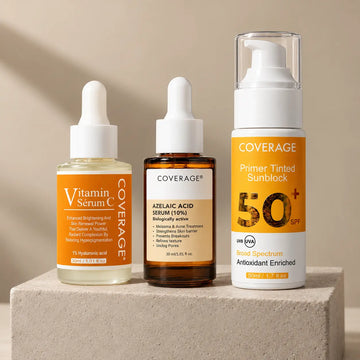
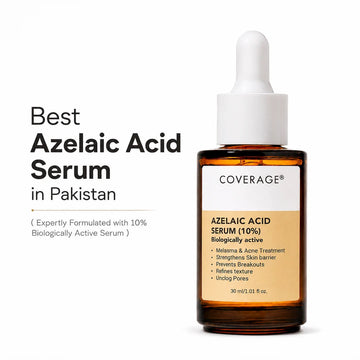
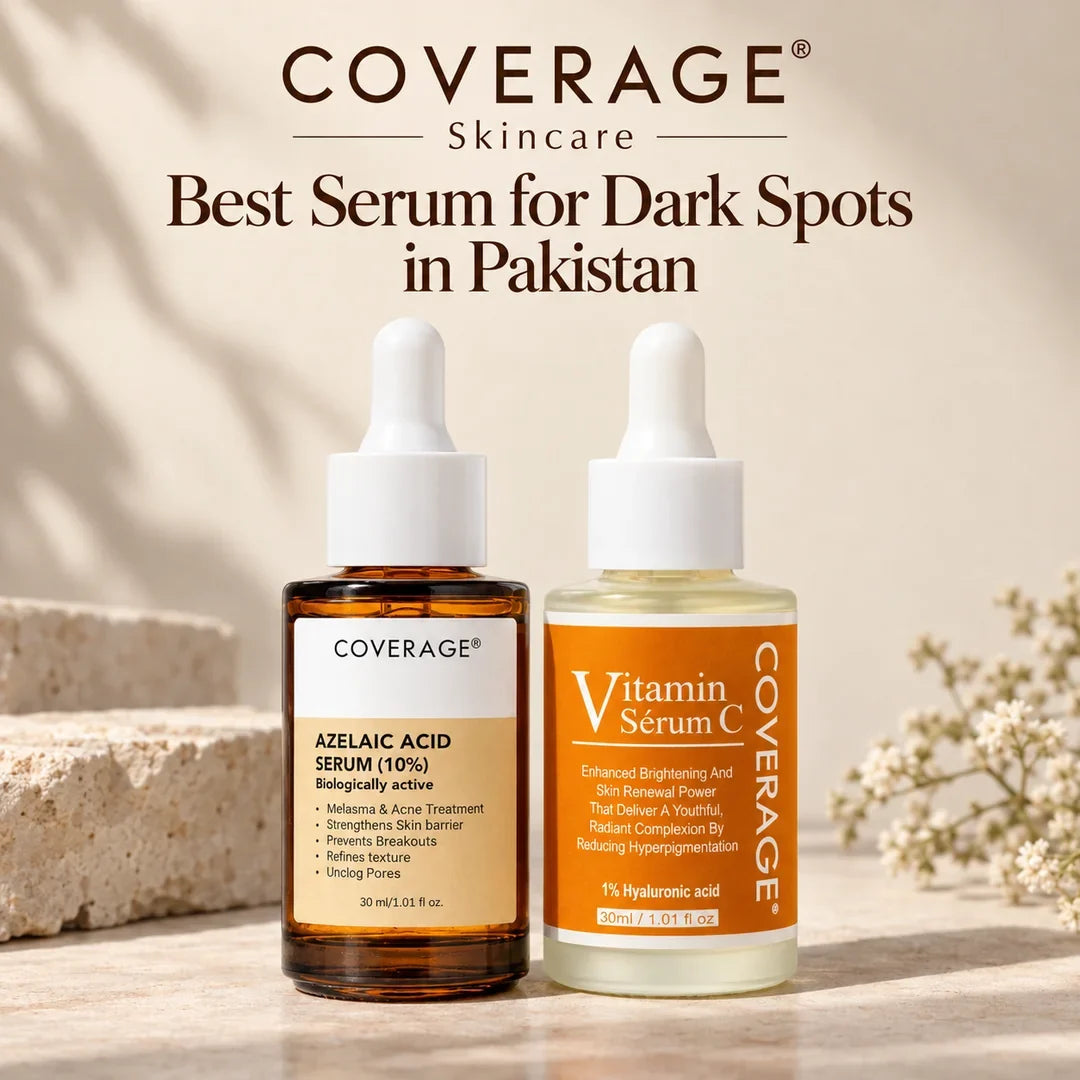
If you are using the Azelaic Acid 10% Serum or the Vitamin C + 1% HA Serum for daag dhabbe, daily SPF is what protects that investment. Our guide to the best serum for dark spots and pigmentation in Pakistan covers how to pair them.
For melasma specifically, there is an important limitation to understand. Standard broad-spectrum SPF filters UVA and UVB, but it does very little against visible light, which also drives pigmentation in medium and deeper skin tones. This is the gap iron oxides in tinted sunscreens close, and it is why a plain untinted SPF 50 can feel like it is not doing enough for chhaiyan. We explain the iron oxide science and the clinical evidence in full in our guide to tinted sunscreen for Pakistani skin, and the wider treatment picture in our chhaiyan ka ilaj guide.
The practical takeaway for melasma: use broad-spectrum SPF 50 or 50+, strongly consider a tinted formula, apply generously, reapply, and treat sunscreen as one part of a plan that may also include topical actives and, for stubborn dermal melasma, a dermatologist.
Is SPF 50 Enough for Acne-Prone and Oily Skin?
Short answer: Yes, provided the formula suits your skin. For acne-prone and oily skin the SPF level is not the problem. Texture and ingredients are.
Look for the word non-comedogenic, a lightweight texture, and a finish that does not feel slick by midday. Mineral filters such as zinc oxide are often well tolerated by reactive, breakout-prone skin.
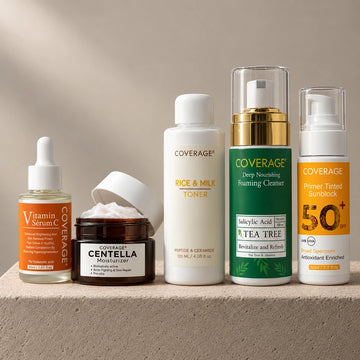
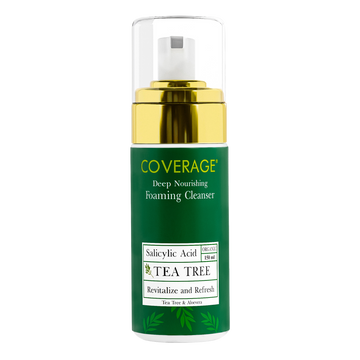
Sunscreen matters especially here because the marks acne leaves behind, known as post-inflammatory hyperpigmentation, are made worse by UV. Protecting skin daily helps those marks fade faster and stops new ones darkening. If breakouts are your main concern, the Deep Nourishing Foaming Cleanser and the rest of the acne range pair naturally with a non-comedogenic SPF 50, and our keel muhase ka ilaj guide covers the full routine.
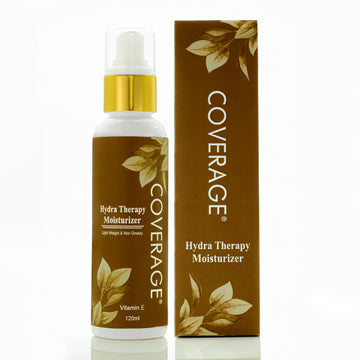
For oily skin in Pakistani heat and humidity, the challenges are shine, sweat and heaviness rather than the SPF number. Gel, fluid, matte and lightweight tinted textures tend to be far more wearable than thick creams, and because sweat breaks sunscreen down faster, reapplication deserves real attention. Blot the shine, then reapply a thin even layer. A light gel moisturiser such as the Hydra Therapy Moisturizer sits comfortably under SPF without adding weight.
Is SPF 50 Enough Under Makeup?
Short answer: Yes. Sunscreen goes on as the last step of skincare and before makeup, in a full even layer. Makeup with SPF in it is not a reliable substitute, because nobody applies foundation thickly enough to reach its labelled SPF.
This is where a tinted sunscreen that doubles as a primer earns its place in a Pakistani routine. You get protection and a smooth, makeup-ready base in one step, which also means you are far more likely to actually apply enough of it.

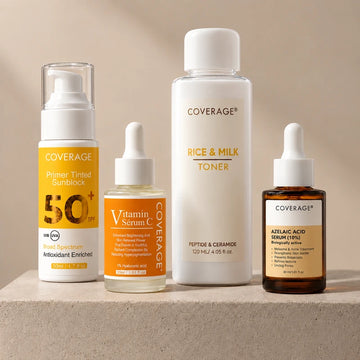
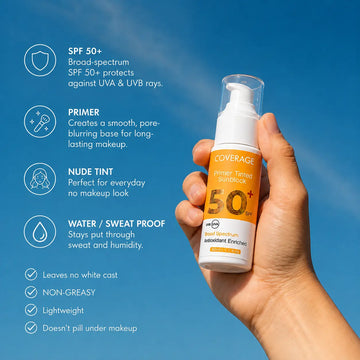
COVERAGE Primer Tinted Sunblock SPF 50+
If you want an SPF 50+ that fits a makeup-friendly routine, the Primer Tinted Sunblock SPF 50+ is built for exactly these conditions. It is a 100% mineral formula, using micronized zinc oxide and titanium dioxide with no chemical filters, and it carries iron oxides for both the natural nude tint and visible-light protection.
| Specification | Detail |
|---|---|
| Protection | Broad-spectrum SPF 50+, UVA and UVB |
| Filters | Micronized zinc oxide and titanium dioxide, 100% mineral |
| Tint | Iron oxides, natural nude, no white cast |
| Texture | Lightweight, non-comedogenic, doubles as a makeup primer |
| Resistance | Sweat and water resistant |
| Size | 50 ml pump |

It is sweat and water resistant for Pakistan's heat and humidity, non-comedogenic for oily and acne-prone skin, and includes hyaluronic acid, aloe vera, panthenol and vitamin E so skin stays hydrated rather than tight. It can be worn alone for a natural even finish at university or work, or under foundation as a primer step.
Shop the Primer Tinted Sunblock SPF 50+ or compare it against the wider market in our best tinted sunscreen in Pakistan buyer's guide.
How Much SPF 50 Sunscreen Should You Apply?
Short answer: About half a teaspoon, roughly 2.5 ml, for the face and neck. For the whole body, about one ounce, roughly a shot glass, with around a teaspoon per limb.
This is the single biggest reason real-world protection falls short of the label. The American Academy of Dermatology notes that many people apply only 20% to 50% of the amount needed to achieve the SPF on the bottle, and that using a high-SPF product helps compensate for this chronic under-application.

Practical ways to get it right:
- The two-finger rule: a strip of sunscreen along the length of your index and middle fingers, for face and neck.
- The half-teaspoon measure, which is more precise if you want to check yourself once.
- Do not skip the ears, the sides and back of the neck, the hairline, or the backs of your hands while driving.
One honest caveat about the two-finger rule: finger length and width vary between people, so treat it as a rough guide rather than a measurement. If in doubt, apply a generous visible layer. A simple reality check is bottle life. If a 50 ml bottle used daily on your face lasts you many months, you are almost certainly under-applying.
How Often Should You Reapply SPF 50?
Short answer: Every 2 hours during prolonged time outdoors, and always after swimming, heavy sweating or towel-drying, following your product's water-resistance instructions.
This is not because SPF 50 wears out faster than SPF 30. Higher SPF does not last longer. It is because sweat, water, rubbing and time physically remove sunscreen from your skin.
Match reapplication to your real exposure rather than following a timer mechanically. If you are indoors away from windows all afternoon, you do not need to jump up every 2 hours. If you are outdoors, riding a bike, sweating through a Lahore afternoon or at the beach, reapplying every 2 hours and after every swim genuinely matters.
Do You Need Sunscreen Indoors, in Winter, and on Cloudy Days?
Indoors
It depends on your situation, so be wary of absolute rules either way. UVA passes through glass while UVB is largely blocked by it. If you spend long stretches beside a sunny window, drive frequently, or are pigmentation-prone, daily sunscreen is worthwhile. If you are deep inside a room away from direct window light, the need is lower.
Winter
UV drops in winter but does not disappear, and in much of Pakistan winter middays still reach levels that warrant protection. If you are outdoors during the day, sunscreen remains worthwhile year round, not just in summer.
Cloudy days
A significant fraction of UV passes straight through light cloud, which is why people still burn on overcast days. If the UV Index is 3 or above, clouds do not remove the need for protection.
What UV Index Needs Sunscreen, and When Is UV Strongest?
Short answer: Sun protection is advised from UV Index 3 and upward. UV is strongest during the few hours around solar noon, not at one fixed clock time.
The WHO recommends protection at UVI 3 or higher, and as the index climbs through the high band of 6 to 7, the very high band of 8 to 10, and the extreme band of 11 and above, shade, clothing and timing matter more alongside sunscreen. Pakistani summers routinely sit in those upper bands.

| UV Index | Category | What to do |
|---|---|---|
| 0 to 2 | Low | Minimal protection needed for most people |
| 3 to 5 | Moderate | Apply sunscreen, seek shade at midday |
| 6 to 7 | High | Sunscreen, hat, sunglasses, shade |
| 8 to 10 | Very high | SPF 50+, reapply, limit midday exposure |
| 11+ | Extreme | Avoid midday sun where possible, full protection |
The WHO notes the daily maximum falls in roughly a four-hour window around solar noon, which in Pakistan generally means the middle of the day rather than a single universal hour. A phone-free check is the shadow rule: if your shadow is shorter than you are tall, UV is strong.
Does SPF 50 Prevent Tanning, Pigmentation and Ageing?
- Tanning. SPF 50 greatly reduces tanning but does not guarantee none. A tan is a sign the skin has already responded to UV. Visible light can also darken skin, and plain SPF does little about that.
- Pigmentation. It helps prevent and slow pigmentation by blocking most UVB and, when broad-spectrum, UVA. It does not permanently remove existing pigmentation.
- Premature ageing. Yes, and this is one of sunscreen's best-proven benefits. UVA penetrates deep and breaks down collagen, driving wrinkles and discoloration. Daily broad-spectrum protection is among the most effective anti-ageing steps available.
One thing sunscreen does not do is make you fairer. It protects your natural tone from darkening further, which is a different and more honest promise than the fairness claims that still circulate in this market.
UVA vs UVB: Why SPF Alone Is Not Everything
SPF measures UVB only, so the number on its own is an incomplete picture:
- UVB causes sunburn and drives the SPF rating. Largely blocked by glass.
- UVA penetrates deeper, drives photoaging and contributes to pigmentation. Passes through glass, present all day and all year.
- Visible light contributes to pigmentation and melasma, especially in richer skin tones, and is not meaningfully filtered by standard SPF.
So look beyond the number for two labels. Broad spectrum means the product is tested against both UVA and UVB. The PA rating, from PA+ to PA++++, is an Asian system indicating UVA protection strength, with more plus signs meaning stronger UVA defence.
The practical rule is simple: choose a broad-spectrum SPF 50 with strong UVA protection rather than chasing a higher SPF number with weak UVA cover.
What Makes a Good Sunscreen for Pakistan
- SPF 30 minimum, ideally SPF 50 or 50+ for strong sun
- Broad-spectrum UVA and UVB cover, ideally with a high PA rating
- A texture that stays comfortable in heat and humidity
- Non-comedogenic if you are oily or acne-prone
- Sweat and water resistance if you are outdoors or commuting
- Cosmetically acceptable enough that you apply it generously and reapply
- An iron oxide tint if pigmentation or melasma is your concern
- An authentic product from a legitimate seller, stored properly and within date
The most important item on that list is comfort. The best sunscreen is the one you actually use, in enough quantity, every single day. A theoretically excellent sunscreen you dislike and apply thinly protects you less than a comfortable one you apply properly.
Mineral vs Chemical Sunscreen
Both types form a protective layer that reduces how much UV reaches your skin. Neither category is universally better or dangerous, and the fearmongering online is not supported by the evidence.
| Mineral (physical) | Chemical (organic) | |
|---|---|---|
| Filters | Zinc oxide, titanium dioxide | Avobenzone, octinoxate, octocrylene and others |
| Regulatory status | FDA lists both as generally recognised as safe and effective | FDA has requested more safety data, has not declared them unsafe |
| Onset | Works immediately | Usually advised around 15 minutes before exposure |
| Common drawback | White cast, solved by micronized particles and iron oxide tints | Can sting sensitive skin or eyes for some people |
| Often suits | Sensitive, reactive and acne-prone skin | Those wanting a very light, invisible finish |
Hybrid formulas combine both. The honest bottom line is to pick the category that suits your skin and that you will wear consistently, and to ignore anyone telling you chemical sunscreen is toxic or that mineral is automatically safer for everybody.
Sunscreen for Real Pakistani Situations
| Situation | What to prioritise |
|---|---|
| Daily office routine | Lightweight broad-spectrum SPF 50, reapply if near windows or commuting |
| University student | Comfortable SPF 50 in the morning, a second application kept in the bag |
| Motorcycle commuter | SPF 50+, sweat resistant, plus visor, sleeves and gloves for exposed skin |
| Car driver | Broad-spectrum SPF 50 daily, UVA reaches you through the windscreen |
| Outdoor worker | SPF 50+, water resistant, plus hat, clothing, shade, frequent reapplication |
| Oily skin | Non-comedogenic lightweight or matte SPF 50, blot and reapply |
| Acne-prone skin | Non-comedogenic SPF 50, gentle mineral or lightweight formula |
| Pigmentation and daag dhabbe | Broad-spectrum SPF 50 plus an iron oxide tint |
| Melasma and chhaiyan | Broad-spectrum SPF 50+, tinted for visible light, generous reapplication |
| Makeup user | A tinted SPF 50+ primer that layers cleanly under foundation |
| Weddings and events | Tinted SPF as a base, reapply before outdoor functions |
| Beach, hiking, northern areas | SPF 50+, water resistant, reapply every 2 hours, plus hat and sunglasses |

Two situations deserve extra emphasis. Motorcycle riders receive direct, sustained exposure on the face, forearms and hands, often at the worst hours of the day, and sunscreen alone is not enough without covering up. Outdoor workers need protective measures beyond sunscreen entirely: a hat, long sleeves, scheduled shade breaks and eye protection, because no SPF can compensate for eight hours in an extreme UV index.
Common Sunscreen Mistakes
- Applying far too little, which is by far the most common
- Forgetting the neck, ears, hairline and backs of the hands
- Not reapplying during long outdoor exposure
- Judging a sunscreen by its SPF number alone and ignoring UVA
- Skipping sunscreen because the skin is dark
- Applying it only when it looks sunny
- Applying it after already going outside rather than before
- Assuming the SPF in makeup replaces real sunscreen
- Mixing sunscreen into moisturiser or foundation, which changes the applied amount
- Using expired sunscreen or leaving it in a hot car
- Buying counterfeit or grey-market sunscreen from unverified sellers
How to Apply Sunscreen Correctly
- Cleanse.
- Apply any treatment serum, such as vitamin C or azelaic acid, and let it absorb.
- Apply moisturiser if you use one, and let it settle.
- Apply sunscreen as the final skincare step, about half a teaspoon for face and neck, in a full even layer.
- Apply makeup on top if you wish, after a minute or two.
- Reapply through the day based on your actual exposure.

The order is cleanser, then treatment or serum, then moisturiser if needed, then sunscreen, then makeup. Product-specific instructions can vary, so follow the label. If you are building a routine around your SPF, browse our cleansers, brightening serums and moisturisers.
Can you mix sunscreen with moisturiser or foundation?
Better not to. Diluting sunscreen into another product changes how much protective film actually lands on your skin and can compromise the tested SPF. Apply it as its own even layer instead.
Myths: Vitamin D, Hormones and Waterproof Claims
Does SPF 50 let you stay out 50 times longer?
No. SPF is a filter strength, not a time multiplier. It measures how much more UVB energy is needed to burn protected skin, not how many hours you can stay in the sun. Higher SPF does not last longer on the skin either, because reapplication is driven by sweat, water and friction.
Is water-resistant SPF 50 waterproof?
No, and modern labelling standards do not permit the word waterproof, because water and sweat do wash sunscreen off. Water resistant is a tested claim meaning the product holds up for either 40 or 80 minutes of water or sweat exposure, after which you reapply.
Does sweat remove sunscreen?
Yes, which is exactly why sweat resistance and reapplication matter so much in Pakistani heat.
Does sunscreen cause vitamin D deficiency?
The evidence here is genuinely mixed and worth stating carefully. Most published studies and expert bodies have found that everyday sunscreen use does not cause vitamin D deficiency. However, a 2025 randomized controlled trial of daily SPF 50+ use over roughly a year did find a higher rate of deficiency in the daily-sunscreen group than in controls. The sensible reading is not to stop wearing sunscreen, but to address vitamin D through diet, sensible exposure or supplementation if you are at risk, with advice from a doctor.
Can sunscreen cause hormonal problems?
Some older chemical UV filters can be absorbed into the bloodstream, which is why the FDA has asked for more safety data. To date there is no proven finding that sunscreen causes hormonal disease in humans, and no regulator has declared these filters unsafe. If it concerns you, a fully mineral zinc oxide and titanium dioxide sunscreen is a well-established alternative.
Can sunscreen cause acne?
A heavy or comedogenic formula can, but a non-comedogenic lightweight one suited to oily skin should not. Daily SPF actually helps fade the dark marks acne leaves behind.
Does sunscreen reduce skin cancer risk?
Yes. Regular sunscreen use is associated with meaningfully lower rates of squamous cell carcinoma and melanoma, and this is one of the strongest pieces of evidence in favour of daily use.
Frequently Asked Questions
Is SPF 50 enough in Pakistan?
Yes, for most everyday use, if it is broad-spectrum, applied generously at about half a teaspoon for face and neck, and reapplied every 2 hours during prolonged sun exposure. For long outdoor hours, add shade, a hat and sunglasses.
Is SPF 50 enough for Pakistani skin?
Yes. Wheatish, medium, brown and deeper skin tones are well protected by a broad-spectrum SPF 50 applied correctly. Darker skin still tans, pigments and ages from UV, so sunscreen is not optional.
Is SPF 50 enough in summer?
Yes for daily use, but summer brings higher UV, more sweating and often longer exposure, so amount and reapplication matter more. Consider SPF 50+ for extended outdoor time.
Is SPF 50 enough for pigmentation?
It is essential and prevents pigmentation worsening, but standard SPF 50 offers limited visible-light protection. For pigmentation, broad-spectrum SPF 50 plus an iron oxide tint is better.
Is SPF 50 enough for melasma?
It is the most important single step but not a standalone cure. Melasma benefits from broad-spectrum SPF 50+ with visible-light protection, and often topical treatment and dermatologist guidance too.
Is SPF 50 enough for oily skin?
Yes, if it is non-comedogenic and lightweight. The SPF number is not the issue for oily skin. Texture and reapplication are.
Is SPF 50 enough for acne-prone skin?
Yes, with a non-comedogenic formula. Daily SPF also helps post-acne dark marks fade rather than darken.
Is SPF 50 better than SPF 30?
Slightly. SPF 50 filters about 98% of UVB against roughly 97% for SPF 30, and because people under-apply, SPF 50 leaves a bigger safety margin in Pakistan's sun.
Is SPF 100 better than SPF 50?
Only marginally, around 99% against 98% of UVB, and it is not double the protection. Correct application and reapplication matter far more than going past SPF 50.
How often should I reapply SPF 50?
Every 2 hours during prolonged outdoor exposure, and after swimming, heavy sweating or towel-drying. Indoors away from windows you do not need to reapply mechanically.
How much SPF 50 should I use on my face?
About half a teaspoon for face and neck, or a strip along two fingers as a rough guide. Most people use far too little, which lowers real protection substantially.
Do I need sunscreen indoors in Pakistan?
If you sit near sunny windows, drive often or are pigmentation-prone, yes, because UVA passes through glass. Deep inside a room away from window light the need is lower.
Do I need sunscreen in winter?
If you are outdoors during the day, yes. UV drops in winter but does not disappear, and Pakistani winter middays can still reach protective thresholds.
Can I wear makeup over SPF 50?
Yes. Let the sunscreen settle for a minute or two, then apply makeup normally. A tinted primer sunscreen makes this seamless.
Does SPF 50 prevent tanning?
It greatly reduces tanning but does not guarantee none. A tan reflects UV damage, and visible light can also darken skin, which plain SPF does not fully block.
Can darker skin tones get sun damage?
Yes. Melanin offers some protection but not immunity. Darker skin tans, pigments, ages and can develop skin cancer from UV exposure.
Is sunscreen necessary on cloudy days?
Yes, if the UV Index is 3 or above. A large share of UV passes straight through light cloud, which is why people burn on overcast days.
What UV index requires sunscreen?
Protection is advised from UV Index 3 upward, with increasing importance through the high, very high and extreme bands common in Pakistani summers.
What is the best SPF for Pakistan?
A comfortable broad-spectrum SPF 50 or 50+ that you will wear generously every day, with strong UVA protection and, for pigmentation, an iron oxide tint.
References and Sources
- American Academy of Dermatology: sunscreen labelling, SPF filtration percentages, application amount, reapplication and water-resistance guidance
- US Food and Drug Administration: sunscreen labelling rules, GRASE status of zinc oxide and titanium dioxide, requests for further filter safety data
- Skin Cancer Foundation: SPF as filter strength rather than time, UVA transmission through glass, skin cancer risk reduction with regular use
- World Health Organization: UV Index bands, protection from UVI 3 upward, timing of daily UV maximum around solar noon
- Peer-reviewed dermatology literature on visible light and pigmentation, iron oxide photoprotection, and sunscreen use and vitamin D status
This article is for general informational purposes only and is not a substitute for professional medical advice. All information and claims referenced above are drawn from publicly available dermatological studies and expert sources. Always consult a dermatologist for advice specific to your skin.


Leave a comment
This site is protected by hCaptcha and the hCaptcha Privacy Policy and Terms of Service apply.