
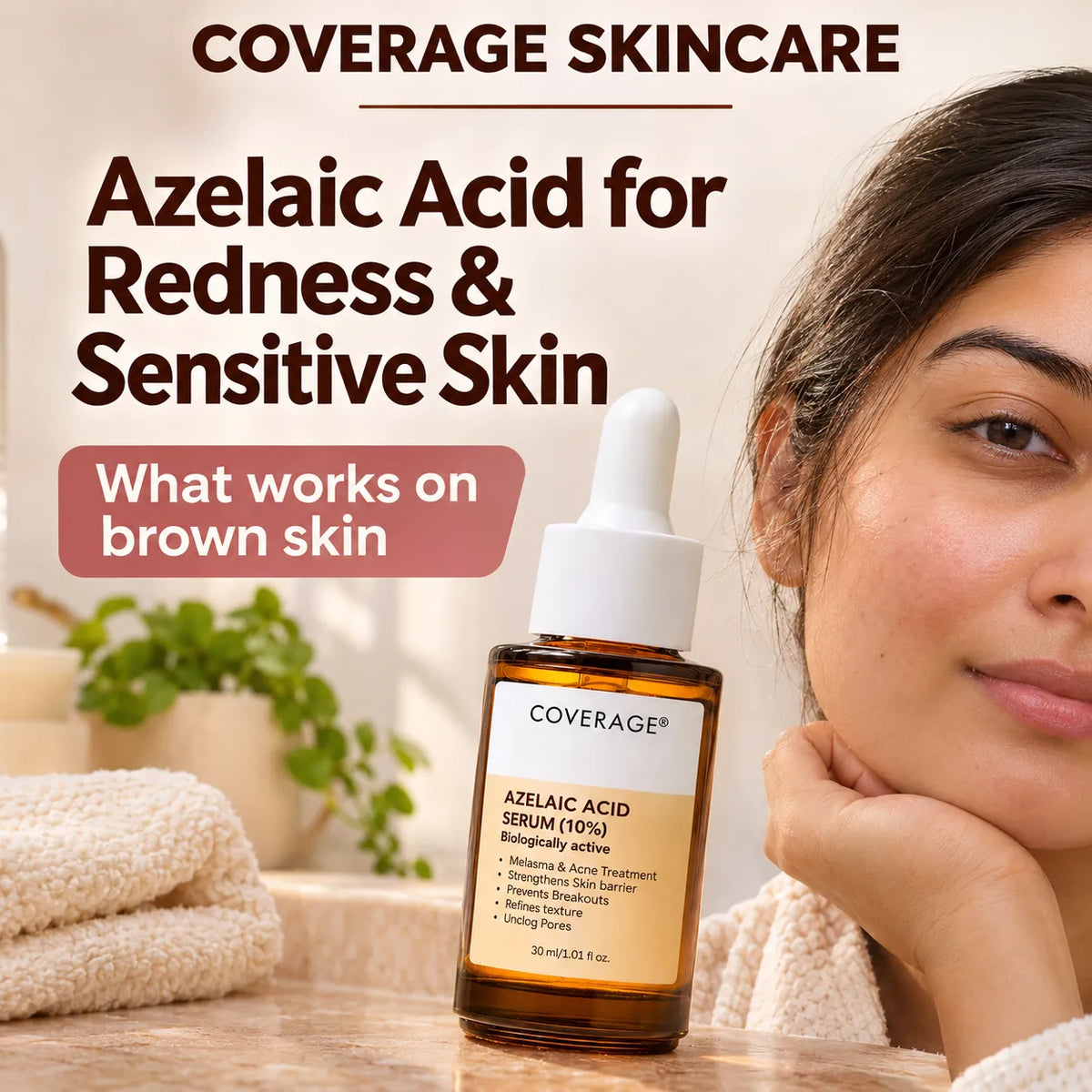
Azelaic Acid for Redness, Rosacea and Sensitive Skin: What Works on Brown Skin
The quick answer
Can azelaic acid help redness and rosacea on brown skin? Partly. Prescription azelaic acid 15% gel and foam are proven to reduce the red bumps and pus spots of papulopustular rosacea, and they modestly improve the redness that comes with those bumps. They have not been shown to stop flushing, remove visible blood vessels, or clear background redness on their own. Almost everyone in those trials had white skin, so there is no brown-skin-specific evidence yet. And cosmetic 10% serums, including ours, have not been tested in rosacea at all. Get unexplained redness diagnosed first, protect your skin barrier, and keep expectations of any active realistic.
If your cheeks turn warm and sting the moment you apply almost anything, or you get bumps that acne treatment never clears, you have probably searched for azelaic acid. It is often described as the “gentle” active for redness and rosacea.
The real picture is more useful than the marketing. This guide sets out what the research actually shows, how rosacea can look different on brown skin, why a 10% serum is not the same as a 15% prescription gel, and how to avoid the irritation that leaves dark marks on our skin. We wrote it for readers in Pakistan, but the science applies to brown skin anywhere.
At COVERAGE®, we make an Azelaic Acid 10% Serum in our own facility in Lahore, so we have a stake in this topic. That is exactly why we kept this honest: every medical claim links to its source, and we tell you clearly what our serum is, and is not, designed to do.
Looking for a gentle azelaic acid serum for uneven tone, marks and breakout-prone skin? Our COVERAGE Azelaic Acid 10% Serum is a lightweight, aloe-based serum with no fragrance, no alcohol and no propylene glycol, made in Lahore and delivered across Pakistan with cash on delivery. If you have diagnosed or suspected rosacea, read the full guide first and check with your dermatologist.
What rosacea is, and what it is not
Rosacea is a long-term inflammatory skin condition that mainly affects the centre of the face: cheeks, nose, chin and forehead. Its features can include flushing, lasting redness or colour change, acne-like bumps, visible small blood vessels (telangiectasia), skin thickening and eye irritation (Maliyar & Abdulla, 2022; American Academy of Dermatology).
A red or irritated face is not automatically rosacea. Several common conditions look similar:
- Normal flushing or blushing: a reaction to heat, exercise or emotion that fades. In rosacea, the colour lasts longer and becomes more noticeable when triggered (AAD).
- Acne: acne usually has blackheads and whiteheads (comedones). Rosacea bumps typically do not (National Rosacea Society). Our keel muhase ka ilaj guide covers acne in detail.
- Eczema and contact dermatitis: itchy, scaly or weepy rashes, often caused by an allergen or irritant in a product.
- Seborrhoeic dermatitis: greasy or flaky scaling around the eyebrows and sides of the nose, often with dandruff (DermNet).
- Steroid-induced rosacea-like dermatitis: redness, bumps and visible vessels caused by using strong steroid creams on the face, or by stopping them (DermNet).

These conditions can overlap, and some can happen together. That is why redness alone is not a diagnosis, and why this article cannot diagnose your skin.
How rosacea may look on brown skin
Rosacea is often called a fair-skin condition. Reviews show it is under-recognised and misdiagnosed in people with darker skin, not absent (Maliyar & Abdulla, 2022; Lohani et al., 2026). The AAD notes that early signs such as flushing can be missed, or mistaken for an allergic reaction or seborrhoeic dermatitis, in darker skin tones (AAD).
On brown skin, look for these signs rather than only “redness”:
- Colour change that looks brown, violet or dusky rather than pink or red
- A warm feeling on the cheeks, which may be the only sign of flushing
- Burning or stinging when you apply skincare, and a low tolerance for products
- Dry, swollen skin and patches of darker skin
- Acne-like bumps that acne treatment does not clear
- Yellowish-brown, firm bumps around the mouth or eyes
- Eye symptoms: gritty, burning, red or watery eyes, or swollen eyelids
Sources for this list: AAD; AAD symptoms; Lohani et al., 2026.
Why is redness harder to see? Melanin can mask the pink or red colour of dilated vessels, and post-inflammatory darkening can hide it further (National Rosacea Society). In a study of 206 rosacea patients, redness was not visible to the eye in 39% of people with darker phototypes, but vessel patterns showed up under dermoscopy, a magnified skin examination (dermoscopy study, 2025). In a South African series of 15 patients with phototype V to VI skin, those with the darkest skin mostly had skin-coloured bumps rather than redness (PubMed).
This does not mean all brown skin behaves the same way, or that everyone with a warm, sensitive face has rosacea. Pakistani skin covers a wide range of tones and reactions. It means your history matters: a dermatologist may ask about triggers, stinging and family history rather than judging by colour alone (Lohani et al., 2026).
A Pakistan-specific warning: steroid and mixed creams
A 2022 study of 300 patients with topical-steroid-induced skin problems, published in the Journal of Pakistan Association of Dermatologists, found that strong steroid creams were mostly being supplied and recommended by unqualified practitioners, pharmacists and others rather than dermatologists (JPAD, 2022). Facial use of “fairness” or mixed creams can cause redness, visible vessels and bumps that mimic rosacea (DermNet).
If you have used such a cream, tell your doctor. Stopping suddenly can trigger a rebound flare, so stop with medical guidance. Our article on whitening vs brightening explains why “rang gora” creams are the wrong tool for even tone.
What clinical research says about azelaic acid in rosacea
Azelaic acid is a dicarboxylic acid found in grains such as wheat, rye and barley. In rosacea it is used mainly for its anti-inflammatory effect. Here is what the research shows, and on which products.
Prescription 15% gel
Two identical phase III trials, published in the Journal of the American Academy of Dermatology in 2003, enrolled 329 and 335 people with moderate papulopustular rosacea (Thiboutot et al., 2003). After 12 weeks of twice-daily use:
- Inflammatory lesions fell by 58% vs 40% with the inactive gel in study 1, and by 51% vs 39% in study 2.
- Redness (erythema) improved in 44% vs 29% of patients in study 1, and 46% vs 28% in study 2.
The US prescribing information confirms these results but limits the approved use to the inflammatory papules and pustules of mild to moderate rosacea. It states that efficacy for redness without bumps “has not been evaluated”. Of the trial participants, 92.5% were Caucasian (US prescribing information, DailyMed).
Prescription 15% foam
A 961-patient trial across 48 US centres found that 32.0% of foam users reached “clear or minimal” vs 23.5% on the inactive foam after 12 weeks. Participants were 95.5% white (Draelos et al., Cutis, 2015).
Systematic reviews
A 2023 systematic review of 43 randomised trials, 20 of them in rosacea, found azelaic acid significantly better than placebo for redness severity, lesion counts and treatment success after 12 weeks (J Cosmet Dermatol, 2023). A network meta-analysis of topical treatments for moderate to severe papulopustular rosacea found azelaic acid 15%, metronidazole 0.75% and ivermectin 1% produced comparable effects, while azelaic acid 15% had the highest rate of side effects among them (network meta-analysis).
Maintenance
In a multicentre study, people who improved by at least 75% on azelaic acid 15% gel plus oral doxycycline were then given either the gel or an inactive gel for 24 weeks. The gel kept more people in remission, around 75% (Thiboutot et al., 2009).
Limitations to keep in mind: most trials ran 12 to 15 weeks, were manufacturer-sponsored, and enrolled mainly white adults with moderate papulopustular rosacea. The inactive gel groups also improved substantially, which shows how much gentle care and time contribute on their own.
Which rosacea symptoms may respond, and which may not
- Red bumps and pus spots (papules and pustules): the strongest evidence, with prescription 15% (Thiboutot, 2003; 2023 review).
- Redness that comes with bumps: modest improvement in trials.
- Persistent background redness without bumps: not evaluated for the approved product; reviews describe topical treatments as having little effect on redness from permanently dilated vessels (American Family Physician, 2015).
- Flushing episodes: not shown to prevent flushing.
- Visible blood vessels (telangiectasia): no clear effect (Am J Clin Dermatol drug profile, 2004).
- Skin thickening: not a target for azelaic acid; it needs specialist care.
- Eye (ocular) rosacea: facial azelaic acid does not treat it. See a doctor.

Azelaic acid is not a cure for rosacea. The prescription label advises reassessment if there is no improvement after 12 weeks (DailyMed).
Is 10% azelaic acid the same as prescription 15%?
No. A cosmetic 10% serum and a prescription 15% gel or foam differ in more than strength:
- Concentration: 10% is a lower dose, and we found no trial comparing 10% serums with 15% products in rosacea.
- Formula: azelaic acid dissolves poorly in water, about 0.24% at 20°C (DailyMed), so every product uses its own base and solubilisers to carry it. That changes how much reaches the skin and how it feels. Results from one formula cannot be assumed for another.
- Testing: prescription products went through controlled trials in diagnosed rosacea. Cosmetic serums generally have not been tested that way in rosacea.

A 10% serum can still have a place in a routine for uneven tone, marks or breakout-prone skin. It is not a substitute for rosacea treatment directed by a dermatologist. For the full strength comparison, see our 10% vs 20% guide.
Azelaic acid and sensitive skin: irritation, tolerance and precautions
Azelaic acid is often called gentle, but the data show it can sting, especially at first:
- With the 15% gel, the most common side effects were burning, stinging or tingling (29%), itching (11%), scaling or dryness (8%), and redness or irritation (4%) (DailyMed).
- With the 15% foam, local pain (burning, stinging, tingling) was reported in 6.2% and itching in 2.5% (FDA foam label).
- Irritation usually appears in the first few weeks. The label advises stopping and seeing a doctor if it is excessive or does not settle.
- Rare reports include allergic reactions, worsening asthma and lightening of skin colour (hypopigmentation). Because azelaic acid has not been well studied in people with dark complexions, the labels advise watching for early signs of lightening.
- An NHS rosacea guideline notes that azelaic acid can cause temporary stinging and may suit people without sensitive skin better (NHS Nottinghamshire, 2026).

Rosacea itself can make skin sting with almost any product. That makes it hard to predict whether a new active will be tolerated, which is why a slow start and stopping on persistent burning matter. Our azelaic acid side effects guide explains which tingling is normal and when to stop.
Brown skin and post-inflammatory hyperpigmentation
Post-inflammatory hyperpigmentation (PIH) is darkening left behind after inflammation or irritation. It is more common and longer-lasting in darker skin (Maliyar & Abdulla, 2022). Reviews of rosacea in skin of colour warn that irritating products and treatments can cause PIH, and that treatment should minimise irritation (Lohani et al., 2026).
That creates a real trade-off for us: an active that irritates may leave dark patches that last longer than the original redness. Gentle introduction is not just about comfort on brown skin. It protects your results.
Rosacea evidence is not acne-mark evidence
Azelaic acid is also studied for acne marks, but this is separate research:
- A 16-week open-label pilot of 20 adults with acne, PIH and Fitzpatrick skin types IV to VI found improvement with 15% gel. There was no control group (Kircik, 2011).
- A 2024 study assessed 15% gel for red and dark marks after acne (PubMed, 2024).
- A 2023 expert consensus on acne-related hyperpigmentation concluded that large randomised trials are still lacking (JAAD, 2023).
None of these studies treated rosacea. If your concern is acne marks and daag dhabbe rather than rosacea, see our guide on how long azelaic acid takes to work on acne marks.
How to approach a gentle routine
These principles come from AAD rosacea guidance and the prescribing information. They are general, not individual advice.
- Cleanse gently. Use a mild, non-soap cleanser with fingertips and lukewarm water, then pat dry. Avoid scrubs, rough cloths and astringents.
- Moisturise every day to support your skin barrier.
- Protect from the sun every day. The AAD recommends a gentle broad-spectrum sunscreen of SPF 30 or higher, and notes that a tinted mineral sunscreen helps darker skin avoid a white cast (AAD). Sun and heat are common triggers, which matters in Pakistani summers.
- Avoid known irritants such as fragrance, menthol, camphor and sodium lauryl sulfate.
- Track your triggers: sun, heat, stress, spicy food, hot drinks, wind, exercise and some skin or hair products (AAD).
- Introduce one active at a time, start slowly, and test new products before using them on your whole face.
- Keep steroid creams off your face unless a dermatologist prescribes and supervises them.

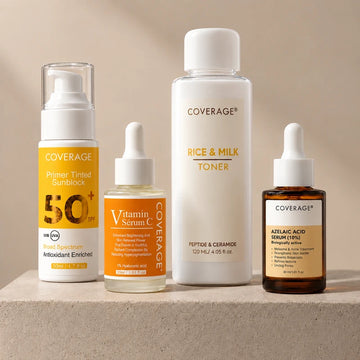
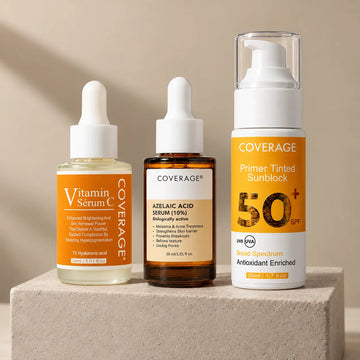
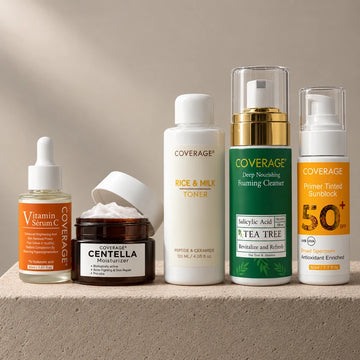
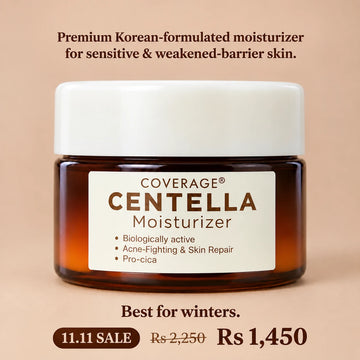
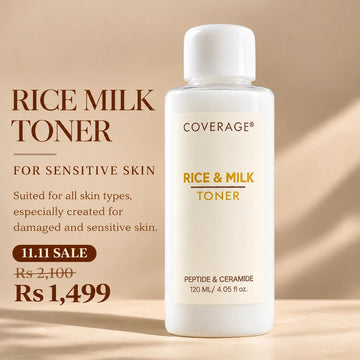
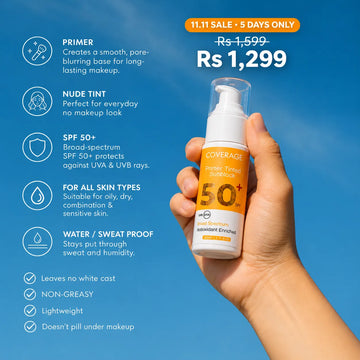
For the barrier step, our Centella Moisturizer combines centella asiatica, ceramide, niacinamide, panthenol and sodium hyaluronate in a light cream. For the sun step, our Primer Tinted Sunblock SPF 50+ is 100% mineral (micronized zinc oxide and titanium dioxide) with an iron oxide tint, so it protects without the white cast that makes so many people skip sunscreen. If you prefer everything together, the Repair & Protect Trio pairs our Rice & Milk Toner, Centella Moisturizer and Primer Tinted Sunblock. More detail is in our skin barrier repair guide and mineral tinted sunscreen guide.

Common mistakes and myths
- “All facial redness is rosacea.” Redness has many causes, including allergy, eczema, seborrhoeic dermatitis and steroid damage.
- “Brown skin can't get rosacea.” It can. It is often missed.
- “A 10% serum is a cheaper version of the prescription gel.” Different strength, different formula, different evidence.
- “More stinging means it's working.” Persistent burning is a reason to stop, not to push on.
- “Azelaic acid will remove my visible veins and flushing.” It has not been shown to do this.
- “Fairness or steroid creams will calm redness.” They can cause rosacea-like redness and rebound flares.
When to see a dermatologist
See a qualified dermatologist if:
- redness, warmth, stinging or bumps last for weeks, keep coming back, or are getting worse
- acne-like bumps do not respond to acne treatment
- you have eye symptoms: burning, grittiness, redness, light sensitivity or swollen eyelids (see a doctor promptly)
- skin is thickening on your nose, cheeks, chin or forehead
- you have used steroid or mixed creams on your face
- any product causes swelling, hives, persistent burning, or new lighter or darker patches
- you are pregnant or breastfeeding and want to use any active

Pregnancy and breastfeeding: what is and isn't known
The US prescribing information for the 15% gel states there are no adequate, well-controlled studies in pregnant women (DailyMed). For breastfeeding, the US National Library of Medicine's LactMed database notes that topical azelaic acid has not been studied directly, but because only about 4% of a topical dose is absorbed and azelaic acid occurs naturally in foods and breast milk, it is considered low risk to the nursing infant. It advises not applying it to the breast or nipple (LactMed). Always ask your doctor before using any active during pregnancy or breastfeeding. Our pregnancy and breastfeeding guide covers the evidence in detail.
What we still don't know about brown skin
- We found no published rosacea trial or subgroup analysis of azelaic acid in Fitzpatrick IV to VI or South Asian skin.
- How best to diagnose and grade rosacea when redness is hard to see.
- How often azelaic acid causes PIH or lightening in darker skin.
- Whether cosmetic 10% serums help rosacea at all.
- How common rosacea is in Pakistan.
We will update this guide when better evidence appears.
Where COVERAGE® Azelaic Acid Serum 10% fits
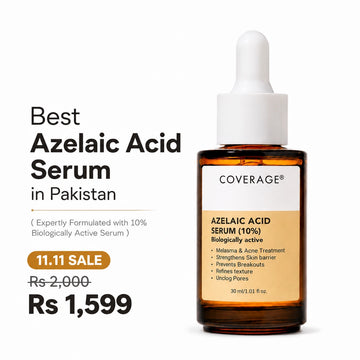
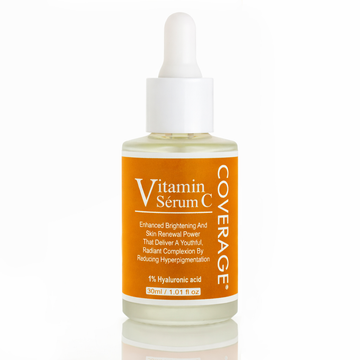
We made our Azelaic Acid Serum 10% for melasma, pigmentation, post-acne marks, breakouts and uneven tone on Pakistani skin. It is a cosmetic serum, not a rosacea treatment, and we have not tested it in rosacea. The prescription 15% results above do not apply to it. Here is exactly what it is, so you can decide whether it fits your routine.

What is in it:
- Azelaic acid 10% in a lightweight, water-based serum.
- Aloe vera leads the formula, ahead of water.
- Sodium hyaluronate for hydration and vitamin E (tocopheryl acetate) for antioxidant support.
- No fragrance, no alcohol and no propylene glycol in the ingredient list.
- Full ingredient list: Aloe Barbadensis Leaf Extract, Aqua (Water), Azelaic Acid, Propanediol, Bis-Ethoxydiglycol, Xylitylglucoside, Isohexadecane, Polysorbate 60, Sodium Hyaluronate, Tocopheryl Acetate, Phenoxyethanol, Triethylene Glycol.

Where it may sensibly fit:
- If your main concerns are uneven tone, marks or breakouts, and you do not have signs of rosacea, it can sit in a simple routine: gentle cleanser, serum, moisturiser and daily sunscreen.
- If you have diagnosed or suspected rosacea, ask your dermatologist first whether a cosmetic azelaic acid serum suits your plan. It does not replace prescribed treatment.
- If your skin is reactive, start every other night on dry skin, follow with moisturiser, and do not start any other new active at the same time.
How to start:
- Patch test on the inner forearm or jawline and wait 24 hours. Continue only if there is no reaction.
- Cleanse and pat dry, then apply 3 to 4 drops to the face, avoiding the eye area.
- Follow with moisturiser. New to actives? Start every other night and build up to once or twice daily.
- Every morning, finish with sunscreen.

A patch test helps, but it is not a guarantee. A 24-hour test can miss reactions that develop over several days or with repeated use. Our full routine guide is here: how to use azelaic acid serum, and our mixing guide covers what to pair it with.
Stop and get advice if you notice burning or stinging that does not settle, swelling, hives, new dark or light patches, or eye irritation.
Made by us, in Lahore. Our serum is made in our own manufacturing facility, which has been producing skincare for decades, and formulated by our in-house chemical engineers. The facility holds GMP and ISO 9001 certification, our products are Halal certified, and we never test on animals. We use the same high grade of raw materials Korean brands use, and we verify what goes into every product rather than relying on a label. We have now delivered over 72,000 orders across Pakistan.

See COVERAGE Azelaic Acid 10% Serum, available across Pakistan with cash on delivery. Pair it with daily sunscreen.
The bottom line
Azelaic acid is one of the better-studied topical treatments for the bumps of rosacea, and prescription 15% gel and foam have consistent trial support. But it is not a cure, it has not been shown to stop flushing or clear background redness and visible vessels, and the trials included very few people with brown skin. For readers in Pakistan, the most useful steps are simple: get unexplained redness properly diagnosed, keep steroid and fairness creams off your face, protect your skin barrier, use sunscreen daily, and keep realistic expectations of any 10% cosmetic serum.
Frequently asked questions
Can azelaic acid help rosacea on brown skin?
Prescription 15% azelaic acid reduces rosacea bumps in trials, but those trials included very few people with darker skin. It may help, but there is no brown-skin-specific evidence, and irritation can leave dark marks on brown skin.
Does azelaic acid reduce facial redness?
In trials it modestly improved the redness that came with rosacea bumps. It has not been evaluated for redness without bumps, and it does not remove visible blood vessels or stop flushing.
Is 10% azelaic acid strong enough for rosacea?
There is no rosacea trial evidence for cosmetic 10% serums. The rosacea studies used prescription 15% gel or foam. If you have rosacea, ask a dermatologist which treatment suits you.
Is azelaic acid good for sensitive skin?
It can sting, especially in the first weeks: burning or stinging affected 29% of people in prescription 15% gel trials. If your skin is reactive, start every other night, use moisturiser, introduce no other new actives, and stop if burning does not settle.
Can azelaic acid lighten my skin colour?
Isolated cases of skin lightening (hypopigmentation) have been reported, and the prescription labels advise monitoring people with darker skin for early signs. Azelaic acid does not bleach normal skin, but report any new light patches to your doctor.
How do I know if my redness is rosacea?
You cannot confirm it yourself. Persistent warmth, stinging, dusky colour change, or bumps that do not respond to acne treatment are reasons to see a dermatologist, who can rule out lookalikes such as eczema, seborrhoeic dermatitis and steroid damage.
What does rosacea look like on brown skin?
It may look brown, violet or dusky rather than pink, feel warm, sting with products, cause dry swollen patches, or show mainly as bumps. Redness can be hard to see because melanin masks it.
Can steroid creams cause rosacea-like redness?
Yes. Using strong steroid or mixed “fairness” creams on the face can cause redness, bumps and visible vessels that mimic rosacea, and stopping suddenly can trigger a rebound flare. Stop them with a dermatologist's guidance.
Is azelaic acid safe in pregnancy or breastfeeding?
There are no adequate pregnancy studies of the prescription gel. LactMed considers topical azelaic acid low risk during breastfeeding, but advises keeping it off the breast. Ask your doctor before using any active.
Which sunscreen is best for sensitive, redness-prone brown skin?
A gentle broad-spectrum sunscreen of SPF 30 or higher, used every day. Dermatologists note that tinted mineral sunscreens help darker skin avoid a white cast.
Related reading
- Azelaic Acid Side Effects: What's Normal, What's Not, and When to Stop
- Sensitive Skin Barrier Repair in Pakistan
- Sensitive-Skin-Safe Skincare in Pakistan
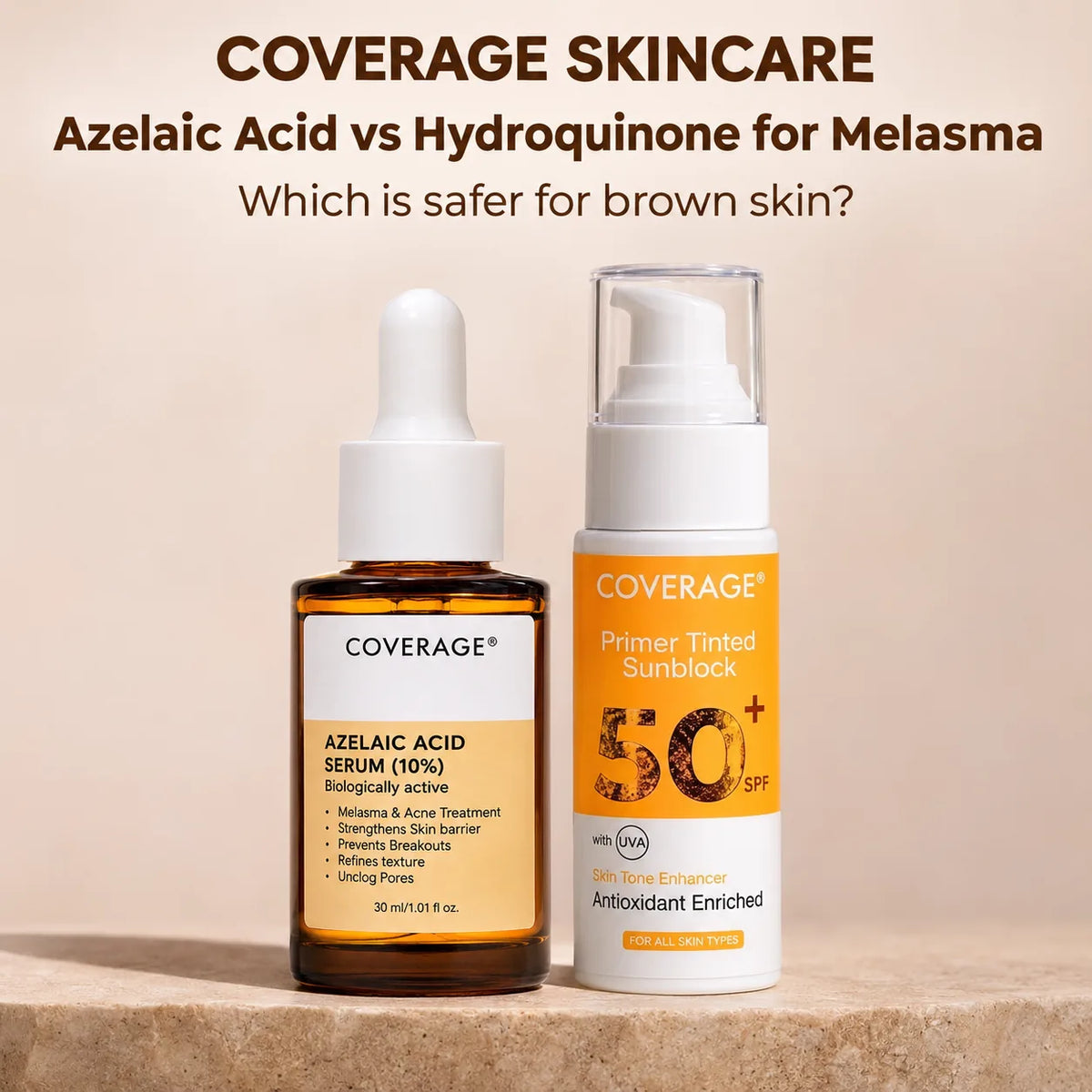
- Azelaic Acid vs Hydroquinone for Melasma
- Does Azelaic Acid Lighten Skin?
- Azelaic Acid Serum in Pakistan: Acne, Melasma & Daag Dhabbe
References
- Thiboutot D, et al. Efficacy and safety of azelaic acid (15%) gel as a new treatment for papulopustular rosacea: two vehicle-controlled, randomized phase III studies. J Am Acad Dermatol, 2003. PubMed
- US prescribing information: azelaic acid gel 15%, revised 2020. DailyMed
- Draelos ZD, et al. A phase 3 randomized, double-blind, vehicle-controlled trial of azelaic acid foam 15% in papulopustular rosacea. Cutis, 2015. PDF
- US FDA. Prescribing information: azelaic acid foam 15%, 2015. FDA
- King S, et al. A systematic review to evaluate the efficacy of azelaic acid in acne, rosacea, melasma and skin aging. J Cosmet Dermatol, 2023. PubMed
- Efficacy and safety of minocycline, metronidazole, ivermectin and azelaic acid in moderate-to-severe papulopustular rosacea: systematic review and network meta-analysis. PMC
- Thiboutot DM, et al. Azelaic acid 15% gel with oral doxycycline as initial therapy and azelaic acid 15% gel as maintenance monotherapy. 2009. PubMed
- Rosacea: diagnosis and treatment. American Family Physician, 2015. AAFP
- Azelaic acid 15% gel in the treatment of papulopustular rosacea. Am J Clin Dermatol, 2004. Springer
- Maliyar K, Abdulla SJ. Dermatology: how to manage rosacea in skin of colour. Drugs in Context, 2022. PMC
- Lohani D, Marson JW, Baldwin HE. Rosacea in patients with skin of color: diagnosis and management. Am J Clin Dermatol, 2026. Springer
- Dermoscopy of rosacea: a cross-sectional study comparing dark and light phototypes. PMC
- Rosacea in black South Africans with skin phototypes V and VI. PubMed
- American Academy of Dermatology. People with darker skin tones can get rosacea. AAD
- American Academy of Dermatology. Rosacea: signs and symptoms. AAD
- American Academy of Dermatology. How to prevent rosacea flare-ups. AAD
- National Rosacea Society. Rosacea looks different in skin of color, 2023. NRS
- National Rosacea Society. Underdiagnosis of rosacea common in skin of color, 2019. NRS
- DermNet. Rosacea; Steroid rosacea. Rosacea · Steroid rosacea
- Kircik LH. Azelaic acid gel 15% in post-inflammatory hyperpigmentation and acne: a 16-week baseline-controlled study. J Drugs Dermatol, 2011. PubMed
- Effects of 15% azelaic acid gel on post-inflammatory erythema and hyperpigmentation in acne vulgaris, 2024. PubMed
- Treatment recommendations for acne-associated hyperpigmentation: Delphi consensus. J Am Acad Dermatol, 2023. JAAD
- National Library of Medicine. LactMed: Azelaic acid. NCBI
- Nottinghamshire Area Prescribing Committee (NHS). Rosacea guidelines, 2026. PDF
- The study on clinical pattern of topical steroid induced dermatoses. J Pak Assoc Dermatol, 2022. PDF
Medical note: This article is for education and is not a diagnosis or treatment plan. Facial redness has several possible causes. See a dermatologist for persistent, worsening, painful or eye-related symptoms, before stopping a steroid cream, and before starting any active during pregnancy or breastfeeding. Stop any product that causes persistent burning, swelling, rash or new patches of colour change.
This article is for general informational purposes only and is not a substitute for professional medical advice. All information and claims referenced above are drawn from publicly available dermatological studies and expert sources. Always consult a dermatologist for advice specific to your skin.

Leave a comment
This site is protected by hCaptcha and the hCaptcha Privacy Policy and Terms of Service apply.