
Article: Tinted Sunscreen in Pakistan: The Complete Guide to SPF 50 Protection, No White Cast & Even Skin Tone
Tinted Sunscreen in Pakistan: The Complete Guide to SPF 50 Protection, No White Cast & Even Skin Tone
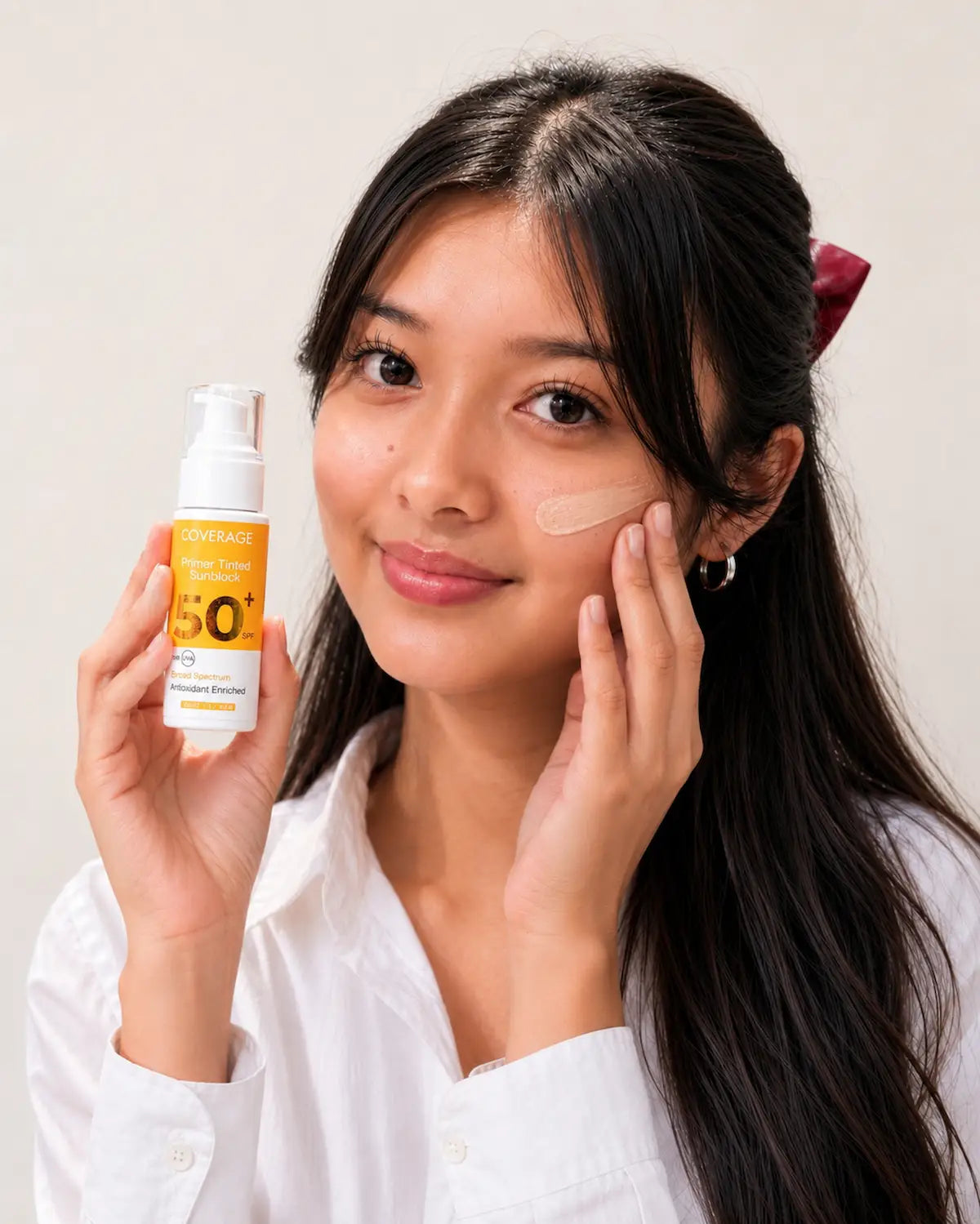
If you live in Pakistan, your skin is fighting a battle most sunscreen labels never mention. We all know about UV rays and sunburn. But for Pakistani skin, usually medium to deep and highly prone to dark spots, melasma, and post-acne marks, a huge amount of daily damage comes from something ordinary sunscreen doesn't even block: visible light. This is the science behind why pigmentation keeps coming back even when you "wear sunscreen every day," and why tinted sunscreen has quietly become the smartest upgrade to any Pakistani skincare routine. Products like COVERAGE® Primer Tinted Sunblock SPF 50+ are designed specifically to solve this problem for Pakistani skin, and below is exactly why that matters, and what to look for in a tinted sunscreen in Pakistan.
What Is Tinted Sunscreen?
Tinted sunscreen is a mineral sunscreen that contains iron oxide pigments in addition to the usual UV filters (zinc oxide and/or titanium dioxide). The iron oxides give the formula a natural skin-tone color, which does two things at once: it cancels out the chalky white cast that plain mineral sunscreen leaves on brown and wheatish skin, and it blocks visible light, which regular SPF doesn't touch at all.
In short: tinted sunscreen isn't a cosmetic upgrade to regular SPF 50 sunscreen in Pakistan. It's a functional one.
Why Regular Sunscreen Isn't Enough
Sunlight is made of several kinds of radiation. Only about 5% is ultraviolet (UV). Nearly half, around 45%, is visible light: the light you can actually see. The rest is infrared (heat).
Sunscreen has traditionally focused only on UV, split into two types:
- UVB (the shorter rays): burns skin and triggers tanning. This is what the SPF number measures.
- UVA (the longer, deeper rays): breaks down collagen and drives pigmentation and ageing. UVA passes through glass, including car windows, home and office windows, so you're exposed indoors and while driving too. UVA protection is measured by the PA rating.
"Broad-spectrum" sunscreen covers UVA and UVB. That's the baseline every SPF 50 sunscreen in Pakistan should meet. But broad-spectrum SPF does almost nothing against visible light, and that's the gap tinted sunscreen closes.
If your question is really about the SPF number itself, how much protection SPF 50 gives, how it compares to SPF 30 and SPF 100, how much to apply and how often to reapply, we cover all of that separately in Is SPF 50 Enough in Pakistan?
Why Pakistani Skin Needs Tinted Sunscreen
Research shows visible light, especially the blue-violet, high-energy visible (HEV) portion, directly stimulates pigment production. Skin cells can sense blue light through a receptor called opsin-3, which switches on melanin synthesis.
The critical detail: this effect is far stronger in deeper skin tones, the Fitzpatrick IV–V range most Pakistani skin falls into. Three local realities make this urgent:
- Extreme UV, most of the year. Karachi, Lahore, Islamabad, Multan, and Faisalabad regularly hit UV index readings of 8–12 ("very high" to "extreme") from roughly March through October.
- Skin that marks instead of burning. Pakistani skin rarely burns visibly, creating false confidence, but it's exactly the skin most prone to melasma, post-acne dark marks, and stubborn pigmentation from both UVA and visible light.
- Heat and humidity push people to skip sunscreen for acne-prone or oily skin, and older mineral formulas leave an ashy cast on medium-to-deep tones, which is the single biggest reason SPF gets skipped here altogether.
This is why so many people say, "I use sunscreen for pigmentation every day and it's still not improving." If the formula only blocks UV, visible light is still quietly driving melasma and dark spots.
Tinted Sunscreen vs Regular Sunscreen

| Regular (clear) sunscreen | Tinted mineral sunscreen | |
|---|---|---|
| UVB protection | Yes | Yes |
| UVA protection | Yes (if broad-spectrum) | Yes (if broad-spectrum) |
| Visible light protection | No | Yes, via iron oxides |
| White cast on brown/wheatish skin | Common with mineral formulas | Cancelled out by the tint |
| Doubles as makeup primer | No | Often, yes |
| Best for | General daily use | Pigmentation, melasma, dusky/wheatish skin, no-white-cast preference |
At the same SPF, both give equal UVB protection. The difference is entirely in the visible-light layer and the finish.
Benefits of Iron Oxides

Iron oxides (labeled as CI 77491, CI 77492, CI 77499) are the mineral pigments responsible for tinted sunscreen's color, and its extra protection. They do two jobs:
- Block visible light, including the HEV blue light that triggers pigmentation. Dermatologists note iron oxide can reduce visible-light transmission by up to 90% when properly formulated.
- Provide the skin-toned tint that cancels white cast on dusky, wheatish, and deeper skin tones.
Clinical evidence backs this up:
- A randomized trial (Boukari et al., JAAD, 2015; 40 patients, 6 months) found melasma severity rose by a median of +2.43 in the UV-only sunscreen group, versus only +0.45 in the iron-oxide tinted group.
- A double-blind trial (Castanedo-Cazares et al., 2014; 68 patients) found melasma improved ~75% with combined UV + visible-light protection versus ~60% with UV protection alone.
- A 2025 study (Grimes et al., JDD) found 36% of melasma participants using SPF 50 plus iron oxide showed superior radiance improvement at 12 weeks, versus 0% using SPF 50 alone.
Dermatologists commonly cite around 3% iron oxide concentration as an effective target, though most brands (a 2026 JDD analysis found over 97%) don't disclose their concentration at all.
Tinted Sunscreen for Oily Skin and Acne-Prone Skin
A common concern: does sunscreen for acne-prone or oily skin work with a tint? Yes, as long as the formula is non-comedogenic and lightweight. Heavy, greasy tinted sunscreens can clog pores and increase breakouts; a well-formulated mineral tinted sunscreen sits closer to a lightweight primer and won't aggravate oily or combination skin, which is especially relevant in Pakistan's heat and humidity.
Best Tinted Sunscreen in Pakistan: Where COVERAGE Fits

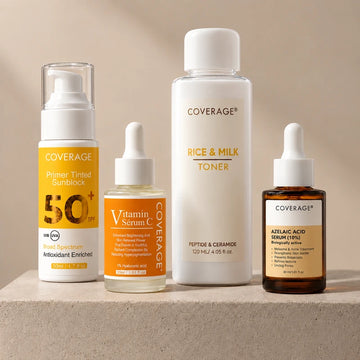
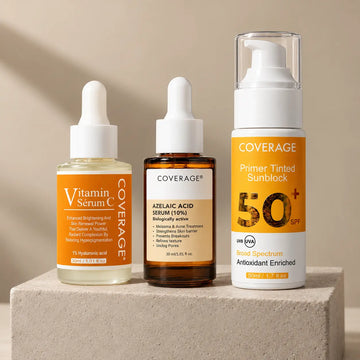
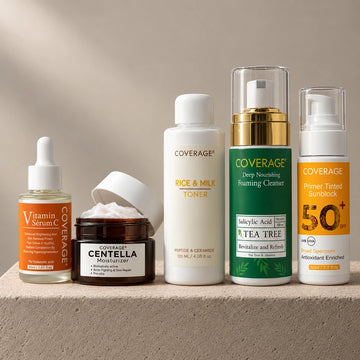
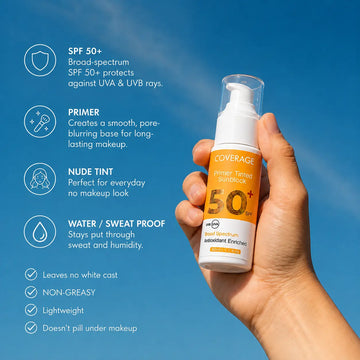
Everything above is the checklist for pigment-prone Pakistani skin: broad-spectrum SPF 50, mineral filters, real iron oxides for visible-light defense, no white cast, non-comedogenic, and lightweight enough to wear daily in the heat. This is exactly how COVERAGE® Primer Tinted Sunblock SPF 50+ is built.
It's a 100% mineral sunscreen: the only UV filters are micronized zinc oxide and titanium dioxide (no chemical filters), paired with iron oxides for both the natural nude tint and visible-light protection. It delivers broad-spectrum SPF 50+ with zero white cast on Pakistani skin tones, while doubling as a makeup primer for a natural finish alone or as a base under makeup.
Built for local conditions, it's sweat- and water-resistant for Pakistan's heat and humidity, non-comedogenic for oily and acne-prone skin, and infused with hyaluronic acid, aloe vera, panthenol, and vitamin E to keep skin hydrated rather than tight. On medium-to-fair tones it blends in immediately; on deeper tones, any brief cast settles within about ten seconds.
Tinted sunscreen price in Pakistan for imported mineral tinted SPFs typically runs Rs 6,500–9,500. COVERAGE's Primer Tinted Sunblock SPF 50+ comes in a 50ml pump at Rs 1,399: full mineral, iron-oxide protection at a fraction of the cost.
Shop the Primer Tinted Sunblock SPF 50+ · Explore the Pigmentation & Melasma collection
How to Apply Tinted Sunscreen
Even the best sunscreen fails if under-applied, and tinted formulas are especially easy to under-apply since people blend them thin like foundation.
- Use enough: about two finger-lengths (roughly half a teaspoon) for face and neck.
- Apply last in your morning routine, after moisturizer, before makeup.
- Don't forget ears, neck, and the backs of your hands (especially while driving).
- Reapply every 2 hours during prolonged sun exposure, and after sweating or swimming.
FAQs
Does tinted sunscreen prevent tanning and dark spots?
It helps more than untinted sunscreen, since it addresses both UV and the visible light that darkens skin. Sunscreen doesn't "make you fair." It protects your natural tone from darkening further.
Will tinted sunscreen leave a white cast?
A well-formulated tinted mineral sunscreen is designed specifically to avoid the grey/ashy cast common on brown, wheatish, and dusky skin.
Can I use tinted sunscreen as a primer instead of foundation?
Yes. It gives light, even coverage and works as a makeup base or a wear-alone finish for daily use. For full-coverage looks, you can still layer foundation on top.
Is tinted sunscreen good for oily and acne-prone skin?
Yes, if it's labeled non-comedogenic and lightweight, ideal for Pakistan's humidity.
Do I need sunscreen indoors in Pakistan?
Yes. UVA passes through window glass, so sitting near windows or driving still exposes skin.
Sourcing note: The claims in this article are drawn from publicly available dermatological research and expert sources, including peer-reviewed studies in the Journal of the American Academy of Dermatology, the Journal of Drugs in Dermatology, and Photodermatology, Photoimmunology & Photomedicine, along with guidance from recognized dermatology and skin-health organizations. This article is for general educational purposes and is not a substitute for personalized medical advice; consult a qualified dermatologist for concerns specific to your skin.
This article is for general informational purposes only and is not a substitute for professional medical advice. All information and claims referenced above are drawn from publicly available dermatological studies and expert sources. Always consult a dermatologist for advice specific to your skin.

Leave a comment
This site is protected by hCaptcha and the hCaptcha Privacy Policy and Terms of Service apply.