
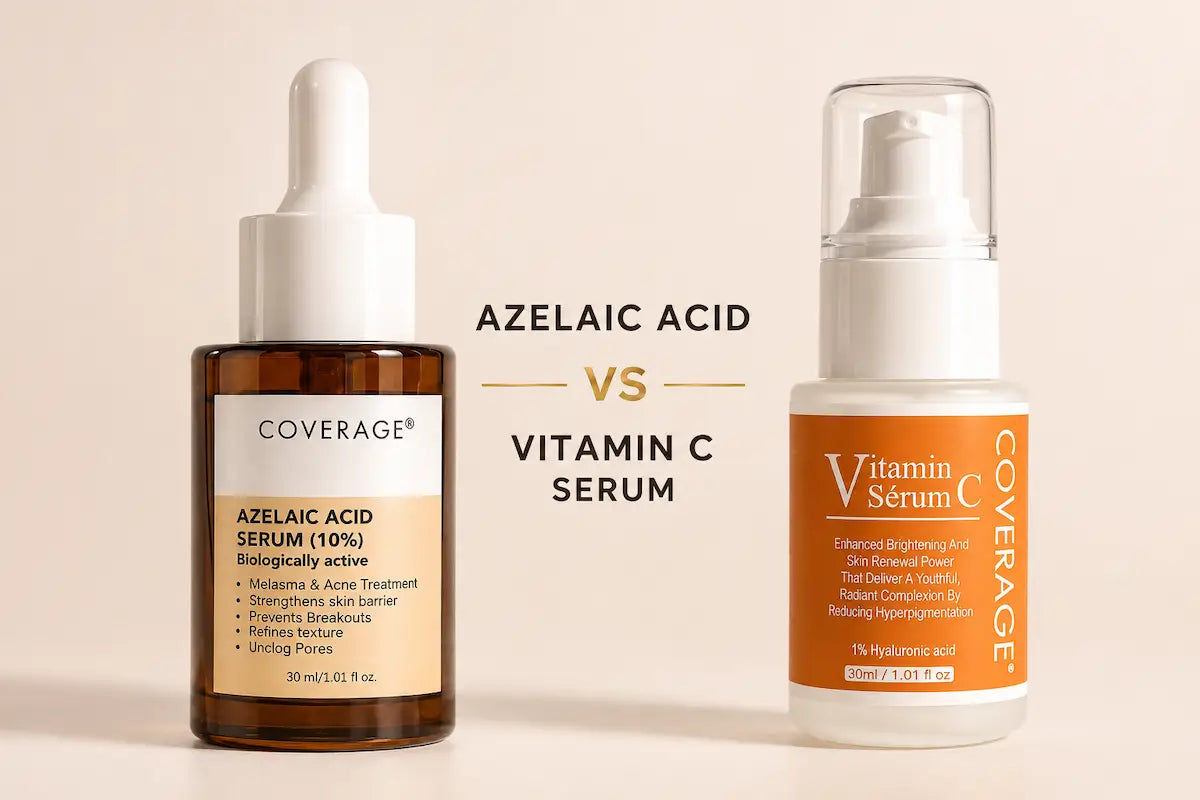
Azelaic Acid vs Vitamin C: Which Is Better for Pigmentation on Pakistani Skin?
You have two serums in the shop and one problem on your face. The pigmentation is not shifting, and every article you read tells you a different ingredient is the answer.
So here is the honest version, including the part that does not flatter us.
Azelaic acid has the stronger direct evidence for established pigmentation and melasma. Vitamin C is the better antioxidant and the better daily defence. They are not rivals competing for the same job. They are two different jobs, and which one you need first depends entirely on what is actually on your skin right now.
This article works out which one that is.
The short answer
Marks already there, sitting for months, worse every summer? Start with Azelaic Acid 10%. This is where the clinical evidence is strongest.
Skin dull, tone uneven, wanting to stop new spots forming? Start with Vitamin C + 1% HA.
Pregnant or breastfeeding? Azelaic acid, and confirm with your doctor.
Neither works without daily sun protection. That part is not optional and it is not a sales line.
First: what kind of pigmentation do you actually have?
This is the step everyone skips, and it is the reason so many routines fail. Three different things get called daag dhabbe in conversation, and they do not respond the same way.

| What you see | What it is | How it behaves |
|---|---|---|
| Symmetrical brown or grey-brown patches, both cheeks, forehead, upper lip | Melasma (chhaiyan) | Darkens April to September, lightens in winter, returns. Hormone and light driven. |
| Individual dark marks exactly where a pimple was | Post-acne marks | Fades on its own over months. Responds fastest of the three. |
| Overall dullness, tired grey tone, no distinct patches | Oxidative dullness | Sun, pollution and stress driven. Improves fastest with antioxidants. |
Most people have two of these at once. That is normal. But the dominant one decides which serum you buy first, and buying in the wrong order is how people conclude "nothing works for me" after six weeks.
What azelaic acid does, and why the evidence is stronger
Azelaic acid is a dicarboxylic acid found naturally in grains like wheat, barley and rye. In skin, it works on pigment through a few mechanisms at once.
It inhibits tyrosinase, the enzyme melanocytes need to manufacture melanin. Less enzyme activity, less new pigment. It is also anti-inflammatory, which matters more than it sounds, because inflammation is one of the signals keeping pigment production switched on in the first place. And it normalises the way skin cells shed, which is why the same ingredient also helps with acne.
The detail that matters most for Pakistani skin is selectivity. Azelaic acid acts mainly on overactive melanocytes and largely leaves normal ones alone. It is not a bleach. It does not lighten your natural tone, and it does not leave pale patches around the dark ones.
The evidence, specifically on skin like ours
Most pigmentation research is done on skin that is nothing like Pakistani skin. Azelaic acid is a rare exception.
Lowe and colleagues, Clinical Therapeutics, 1998. A randomised, double-masked, 24-week trial of 20% azelaic acid against vehicle, run specifically in patients with Fitzpatrick IV to VI skin. Azelaic acid produced significantly greater reductions in pigmentary intensity than vehicle, measured both by investigator assessment and by chromometer, with significantly greater global improvement at week 24.
Baliña and Graupe, International Journal of Dermatology, 1991. A 24-week double-blind study on 329 women comparing 20% azelaic acid against 4% hydroquinone, both with broad-spectrum sunscreen. Azelaic acid produced good or excellent results in 65% of patients, with no significant difference against hydroquinone on overall rating, lesion size or pigment intensity, and no cases of exogenous ochronosis.
Albzea and colleagues, Cureus, 2023. A meta-analysis pooling six randomised controlled trials and 673 melasma patients, finding azelaic acid favourable against hydroquinone on MASI reduction, the standard clinical melasma score.
The caveat we have to give you. All of that evidence sits at 15% and 20%. There is no equivalent trial library at 10%, which is the cosmetic strength our serum uses. What the formulation research does show is that azelaic acid's performance depends heavily on the base it is delivered in, because the acid dissolves poorly and undissolved crystals do not penetrate. A well-solubilised 10% is a reasonable daily-use option, but it is an extrapolation from higher-strength data, not a proven equal. Anyone telling you 10% has been proven equal to 20% is guessing.
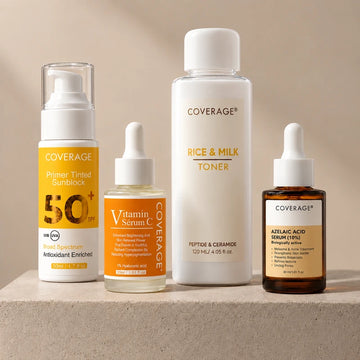
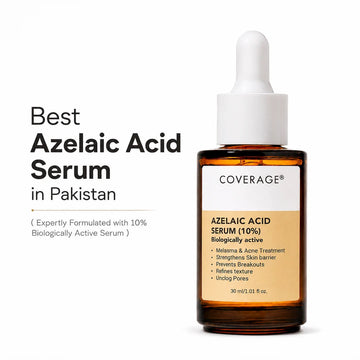
COVERAGE Azelaic Acid 10% Serum

Why this formulation. Two decisions, both about whether you are still using it in month four. The concentration is 10% rather than 20% because the single most common reason people fail with azelaic acid in Pakistan is that they buy a 20% cream, react in week two and abandon it. Pigmentation takes three to six months. A product you tolerate for six months beats one you quit in fourteen days.
The base is aloe and water rather than wax and oil, because a thick cream in Lahore heat gets skipped. Sodium hyaluronate and vitamin E keep the barrier comfortable, which matters because irritated skin produces more pigment, not less.
Rs.1,600 for 30ml. No prescription needed.
Established marks are your main concern?
Azelaic Acid 10% Serum, the night correction step
What vitamin C does, and where it genuinely wins
Vitamin C is not primarily a pigment-fader. It is an antioxidant, and understanding that is what makes it useful.
When UV and visible light hit your skin, part of the damage is oxidative. That oxidative stress is itself one of the messages telling melanocytes to produce more pigment. An antioxidant applied in the morning intercepts some of that stress before it becomes a message. Vitamin C also has its own milder tyrosinase-inhibiting effect, and it is an essential cofactor for the enzymes that build collagen.
So vitamin C's real strength is prevention: stopping tomorrow's pigment from forming, rather than removing the pigment from last summer.
That matters in Pakistan for a specific reason. Research on traffic-related air pollution has found associations between nitrogen dioxide exposure and facial pigment spots, with roughly 25% more spots on the cheeks per 10 µg/m³ increase in NO2. Those cohorts were German and Chinese women, not Pakistani, so we cannot claim the same numbers apply here. But Lahore's particulate levels are among the world's highest, and the biological mechanism is not specific to any one population.
The honest counterweight. A 2023 systematic review in the Journal of Cosmetic Dermatology examined topical vitamin C across melasma and photoaging and included seven studies with 139 participants in total. Of the five studies reporting hyperpigmentation outcomes, vitamin C was favoured over placebo in only one. The authors flagged small samples, heterogeneous methods and the need for further research. Vitamin C is well worth using. It is not the stronger pigment-corrector, and we are not going to pretend otherwise.
Why our vitamin C uses ethyl ascorbic acid
This is the part that is specific to living here, and it is the reason so many Pakistani women decide vitamin C "does not work for me."
Most vitamin C serums use L-ascorbic acid. It is the form with the most human research behind it. It is also chemically unstable: it oxidises on exposure to air, light and heat, turning yellow then orange-brown, and losing potency as it goes. The classic research on it also found it needs a pH below about 3.5 to penetrate skin at all, which is a low pH that can sting.
Now trace the journey a serum makes in Pakistan. A warehouse in summer. A delivery bike in forty-degree heat. Then a bathroom shelf. That is a difficult environment for an unstable molecule.

Ethyl ascorbic acid is a vitamin C derivative with an ethyl group attached at the 3-carbon position, which shields it from oxidation. It is stable at higher temperatures, works at a gentler pH closer to skin's own, and is both water and oil soluble, which helps it penetrate without needing an aggressive low-pH base.
Where the evidence actually stands. Ethyl ascorbic acid's stability advantage is well documented. Its brightening evidence is thinner than L-ascorbic acid's and comes mostly from laboratory and reconstructed-skin studies rather than large human trials. One frequently cited study used a 30% concentration in a lab tissue model, which is far above any consumer serum, so it cannot be read as proof of what a normal serum does on a face.
The fair summary: we chose ethyl ascorbic acid because it survives Pakistani conditions and irritates less. That is a trade of some proven potency for real-world stability. We think it is the right trade here. We are not claiming it outperforms L-ascorbic acid.
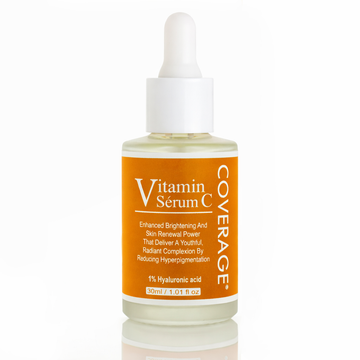
COVERAGE Vitamin C + 1% HA Skin Serum

Ethyl ascorbic acid as the lead active, niacinamide supporting it, and 1% hyaluronic acid so it layers comfortably under sunblock instead of leaving skin tight. Lightweight and non-comedogenic, which matters if you are oily or breakout-prone and have been put off vitamin C by heavy formulas.
Rs.1,399 for 30ml.
Dullness and prevention are your main concern?
Vitamin C + 1% HA Serum, the morning defence step
Side by side

| Azelaic Acid 10% | Vitamin C + 1% HA | |
|---|---|---|
| Main job | Slows pigment production | Neutralises oxidative stress |
| Best for | Melasma, post-acne marks, established patches | Dullness, uneven tone, preventing new spots |
| Evidence on pigmentation | Stronger, including trials in Fitzpatrick IV–VI skin | Weaker and more mixed |
| Also does | Acne, redness, texture | Collagen support, antioxidant defence |
| When to use | Night | Morning, under sunblock |
| In pregnancy | Widely considered compatible, ask your doctor | Generally considered fine, ask your doctor |
| Irritation | Mild tingling early on, settles | Low with ethyl ascorbic acid |
| Time to visible change | 8–12 weeks, melasma 3–6 months | 6–8 weeks for brightness |
| Price | Rs.1,600, 30ml | Rs.1,399, 30ml |
A note on pregnancy, because it comes up constantly
Melasma is often called the mask of pregnancy, so this question matters here.
Azelaic acid is one of very few pigment-active ingredients widely regarded as compatible with pregnancy. Systemic absorption from topical use is around 4%, and it is not a retinoid. Retinoids and hydroquinone are the two categories most commonly avoided.
You will still see azelaic acid described online as "FDA Pregnancy Category B." That letter system was retired in 2015 and replaced with narrative labelling, so anyone still quoting it is working from outdated information. The underlying position has not changed, but the label has.
Confirm with your own doctor before starting anything during pregnancy or breastfeeding. We are giving you the published position, not clearance for your specific case.
Using both: the routine

If you can afford both, the sensible structure is vitamin C in the morning and azelaic acid at night. Different jobs, different times, no competition for the same slot.
Morning
- Gentle cleanse. Lukewarm water, no scrubbing.
- Vitamin C + 1% HA. Defend.
- Moisturiser if your skin wants it.
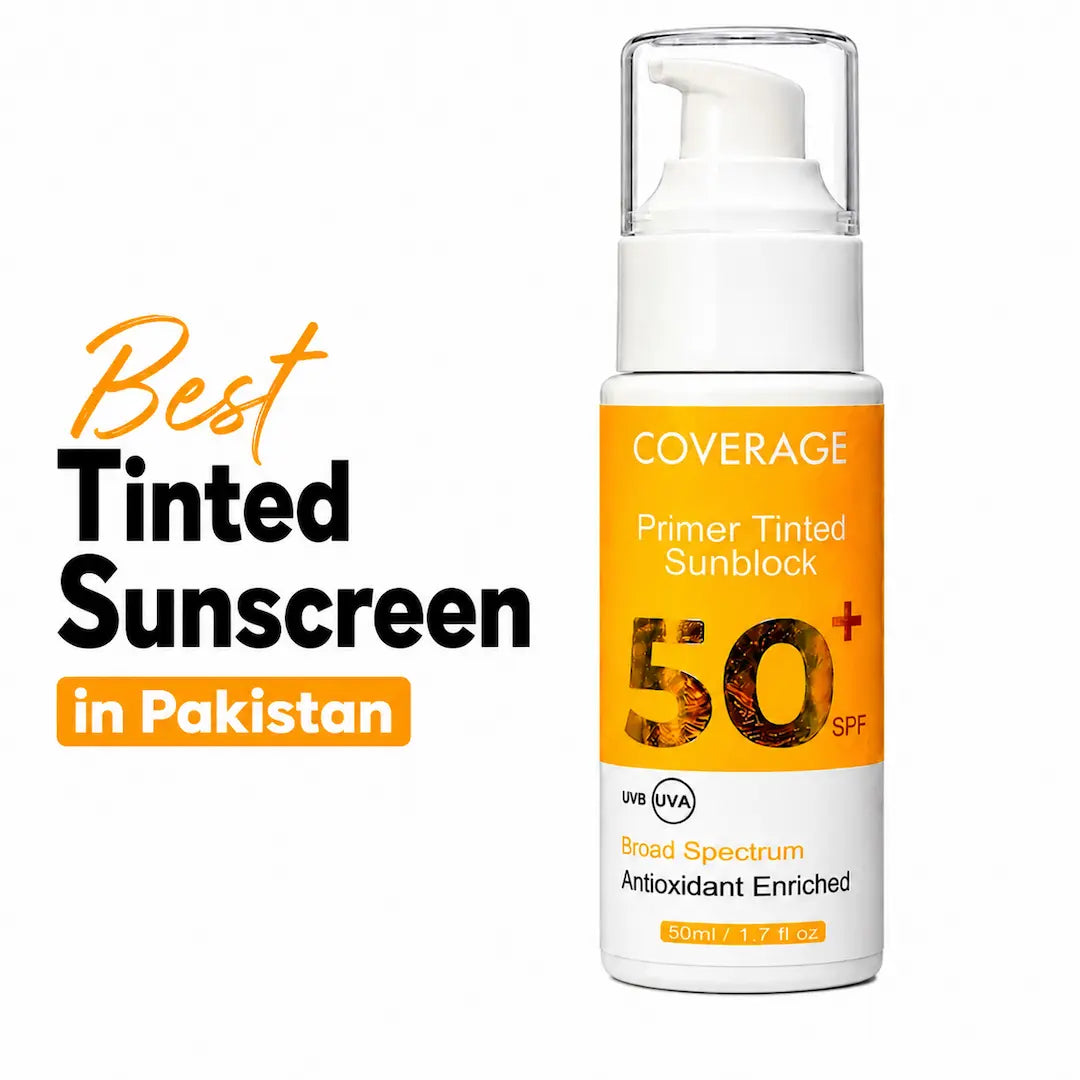
- Primer Tinted Sunblock SPF 50+. Protect.
Night
- Cleanse properly. Sunblock has to come off.
- Azelaic Acid 10%. Correct.
- Moisturiser to seal.
One honesty note on this: no clinical trial has tested these two ingredients used together as a routine. There is no documented chemical conflict between them, and splitting them across morning and night is standard dermatological advice, but it is expert consensus rather than trial-proven synergy.
If you are buying one at a time, start with whichever matches your dominant concern from the table at the top, give it eight weeks, then add the second.
Want both?
Bright Shield Duo pairs Vitamin C with the Tinted Sunblock at Rs.2,750
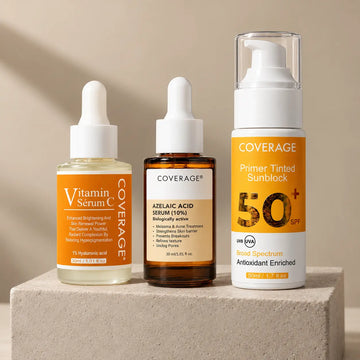
Pigmentation & Melasma Bundle pairs Azelaic Acid with the Tinted Sunblock at Rs.3,850
The step that decides whether either one works
You can buy the best serum in Pakistan and watch your pigmentation darken every June anyway. Here is why.
Sunlight is not only UV. Roughly 45% of what reaches your skin is visible light, and it is not harmless. Melanocytes sense blue-violet light through a receptor called Opsin-3, which switches on melanin production. The research on this found the effect produces a sustained pigment response mainly in Fitzpatrick III and above, which covers most Pakistani skin. That is why visible-light pigmentation lasts longer on brown skin than on fair skin.
Clear sunscreen is transparent to visible light by design. Transparent means it passes straight through to the cells you are trying to calm.

The fix is iron oxides, the mineral pigments that give tinted sunscreen its colour. A 2014 randomised trial found that adding visible-light protection to a UV sunscreen produced meaningfully better melasma improvement than UV protection alone, roughly a 15% greater relative reduction in MASI score. Worth knowing: every participant in that study was also using 4% hydroquinone, so it measured the added benefit of visible-light protection on top of treatment, not the sunscreen working alone.
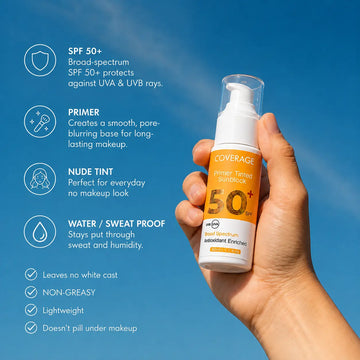
Our Primer Tinted Sunblock SPF 50+ is 100% mineral, zinc oxide and titanium dioxide only, with iron oxides doing the visible-light work. Rs.1,399 for 50ml. Full detail in our tinted sunscreen guide.
How long this actually takes
- Weeks 1–4: Vitamin C users often notice brightness first. Azelaic acid users usually notice texture before pigment. This is where most people quit.
- Weeks 4–8: Post-acne marks start visibly fading. Overall tone evens out.
- Months 3–6: Melasma results show, fading inward from the edges rather than disappearing at once.
- Ongoing: Melasma is chronic. Stop protecting and it returns, usually by the next summer.
Starting without wrecking your skin
Azelaic acid: three nights in the first week, then alternate nights, then nightly once comfortable. Mild tingling for the first fortnight is normal. Burning, sustained redness or peeling is not, and means slow down.
You will read that azelaic acid causes "purging." Be aware this is largely anecdotal rather than something trials have documented, and controlled studies mostly report mild transient stinging instead. If you are breaking out in places you never normally do, that is more likely irritation than purging.
Vitamin C: every morning from the start. Ethyl ascorbic acid is gentle enough that a build-up period usually is not necessary.
Do not start both in the same week. Give one a fortnight before adding the other.
Frequently asked questions
Azelaic acid or vitamin C, which is better for dark spots?
For established dark spots and melasma, azelaic acid has the stronger direct evidence, including a 24-week trial run specifically in Fitzpatrick IV to VI skin. Vitamin C is better at preventing new pigment and improving overall dullness. They do different jobs.
Can I use azelaic acid and vitamin C together?
Yes. There is no documented conflict between them. The usual approach is vitamin C in the morning under sunblock and azelaic acid at night. Note that this pairing is based on expert consensus rather than a clinical trial testing the two together.
Which one is safe in pregnancy?
Azelaic acid is widely regarded as one of the few pigment-active ingredients compatible with pregnancy, with roughly 4% systemic absorption from topical use. Vitamin C is also generally considered acceptable. Confirm with your own doctor before starting either.
Does vitamin C oxidise in Pakistan's heat?
L-ascorbic acid does, which is why serums turn orange-brown. Ethyl ascorbic acid is far more stable in heat and light, which is why our serum uses it.
Is ethyl ascorbic acid as good as L-ascorbic acid?
Not in terms of published human evidence. L-ascorbic acid has more clinical data. Ethyl ascorbic acid's advantage is stability and tolerability, which matters a great deal in a hot climate but is a different claim from proven superiority.
Is 10% azelaic acid strong enough?
The controlled trials sit at 15% and 20%, so 10% is an extrapolation. Formulation research shows azelaic acid's performance depends heavily on how well it is dissolved in the base, so a well-formulated 10% is a sensible daily-use option, particularly for people who cannot tolerate higher strengths. For moderate to severe acne, prescription strength has the deeper evidence.
Which should I buy first if I can only afford one?
If you have established patches or marks, azelaic acid. If your main complaint is dullness or you are trying to stop new pigmentation, vitamin C. If you have neither serum and no sunblock, buy the sunblock first, because without it neither serum can hold its progress.
Does azelaic acid make skin sensitive to the sun?
No. Unlike AHAs, azelaic acid is not photosensitising. You still need daily sun protection, because sun exposure undoes pigmentation progress regardless of which product you use.
How long before I see results?
Brightness from vitamin C usually shifts in six to eight weeks. Post-acne marks with azelaic acid often fade in eight to twelve weeks. Melasma is slower, three to six months, and it fades unevenly rather than all at once.
The bottom line
Azelaic acid corrects. Vitamin C defends. Sunblock decides whether any of it holds.
If you have to choose, choose by what is actually on your face. Established patches and marks point to azelaic acid, and that is where the clinical evidence is strongest even though it is the more expensive of our two serums. Dullness and prevention point to vitamin C.
Give it three months rather than three weeks, and if six honest months change nothing, see a dermatologist. Dermal melasma is real, and no serum on earth fixes it.
More detail on each: the full azelaic acid guide, our melasma and chaiyan routine, and the Skinoren comparison.
Start the routine
Pigmentation & Melasma Bundle, Rs.3,850
This article is for general informational purposes only and is not a substitute for professional medical advice. All information and claims referenced above are drawn from publicly available dermatological studies and expert sources. Always consult a dermatologist for advice specific to your skin.


Leave a comment
This site is protected by hCaptcha and the hCaptcha Privacy Policy and Terms of Service apply.