
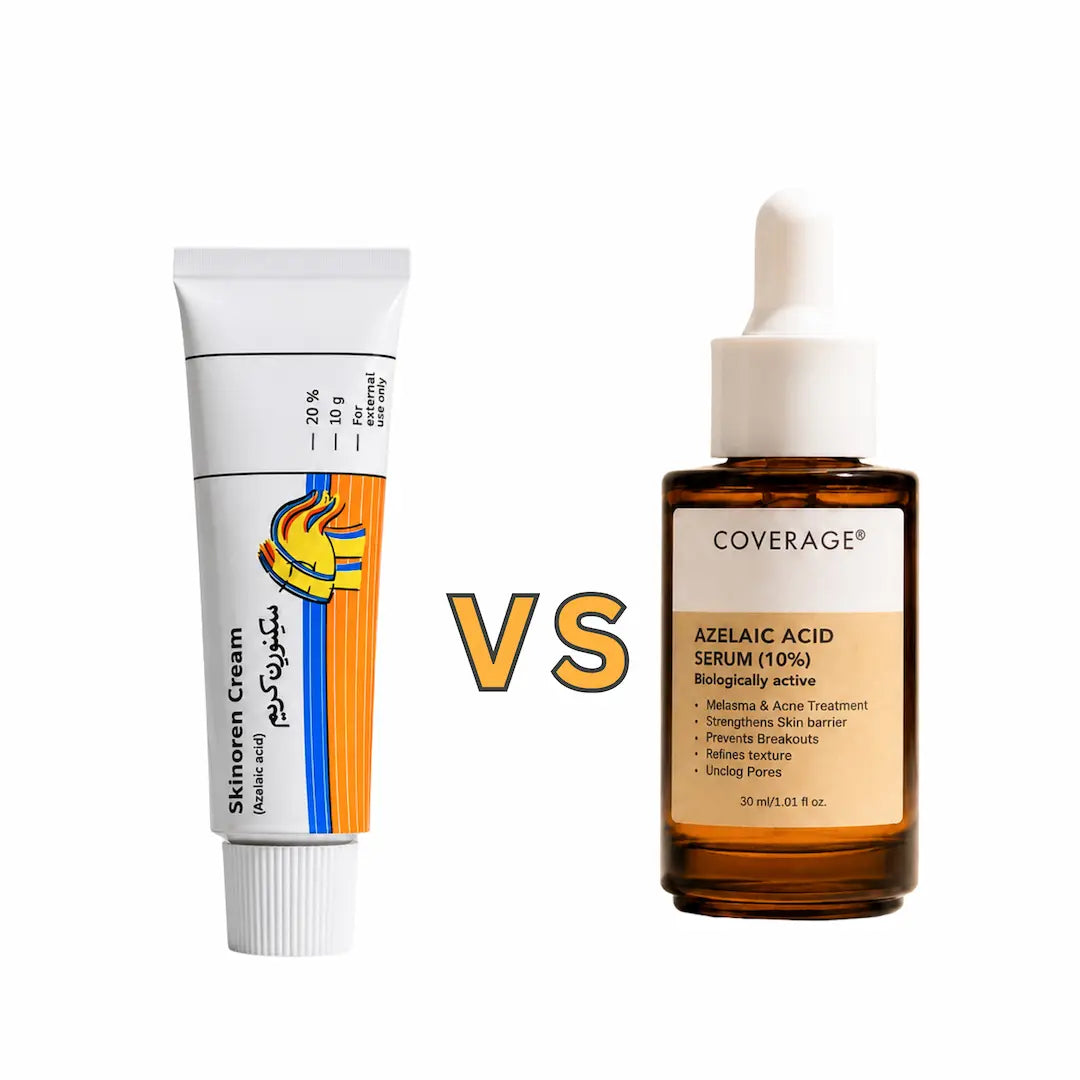
Skinoren vs COVERAGE Azelaic Acid 10%: Which Is Better for Pakistani Skin?
If you have searched for a way to fade daag dhabbe, chaiyan or stubborn acne marks in Pakistan, two names keep coming up. One is Skinoren, the 20% azelaic acid cream sold in pharmacies from Lahore to Karachi. The other is a newer generation of azelaic acid serums, including the COVERAGE Azelaic Acid 10% Serum.
They share the same active ingredient. They are not the same product, and they are not built for the same person. This guide compares them honestly: strength, base, ingredients, price, prescription rules, and which one actually suits Pakistani skin in Pakistani weather.
Quick answer
- Skinoren is a prescription medicine containing 20% azelaic acid in a thick cream base. It has the longest clinical trial history and is the stronger option for moderate acne under a doctor's supervision.
- COVERAGE Azelaic Acid 10% Serum is a cosmetic serum with 10% azelaic acid in a lightweight, water based formula. It is gentler, needs no prescription, layers under sunscreen, and is designed for daily long term use in hot, humid weather.
- Higher percentage does not automatically mean better results. The base a product is delivered in matters as much as the number on the label.
- For most people with oily or combination skin, mild acne, post acne marks, early pigmentation or melasma, the product you can comfortably use every day for months is the one that delivers, which is why a lighter 10% serum often suits this group better in day to day use.
COVERAGE Azelaic Acid 10% Serum: Rs.1,600, 30ml, no prescription needed, cash on delivery across Pakistan.
Skinoren vs COVERAGE Azelaic Acid 10%: side by side
| Skinoren 20% Cream | COVERAGE Azelaic Acid 10% Serum | |
|---|---|---|
| Active | Azelaic acid 20% | Azelaic acid 10% |
| Product type | Registered medicine | Cosmetic serum |
| Prescription in Pakistan | Yes, prescription only | No prescription needed |
| Texture | Thick, waxy cream | Light, fast absorbing serum |
| Base | Oil and wax emollient cream | Aloe and water based |
| Pack size | 10g and 20g tubes | 30ml bottle |
| Typical price | Around Rs.760 to Rs.810 for 10g | Rs.1,600 for 30ml |
| Approx cost per unit | Around Rs.78 per gram | Around Rs.53 per ml |
| Made by | OBS Pakistan, under Bayer licence | COVERAGE, Korean formulated |
| Official indication | Acne vulgaris | Acne, pigmentation, melasma, uneven tone |
| Best for | Moderate acne, dry to normal skin, doctor supervised courses | Oily and combination skin, sensitive skin, daily long term use, humid weather |
| Sits under sunscreen | Can feel heavy and pill | Yes, designed to layer |

What is Skinoren cream?
Skinoren is a topical medicine containing 20% azelaic acid. In Pakistan it is marketed by OBS Pakistan under licence from Bayer, and it is sold in 10g and 20g tubes at roughly Rs.760 to Rs.810 for the smaller tube depending on the pharmacy.
Its registered indication is acne vulgaris. Dermatologists in Pakistan also prescribe it off label for melasma and post inflammatory hyperpigmentation, and there is good evidence behind that practice. A classic six month study of a 20% azelaic acid cream in melasma reported an average reduction in pigmentation of just over half, with none of the leukoderma risk associated with older depigmenting agents. Later randomised trials compared 20% azelaic acid directly against 4% hydroquinone and found it performs in the same league.
Two things people in Pakistan often miss:
- Skinoren is prescription only. Many pharmacies hand it over the counter, but legally it requires a valid prescription, and reputable online pharmacies will ask for one.
- It is a medicine, not a skincare product. It is designed for a treatment course under supervision, not as a forever step in a daily routine.
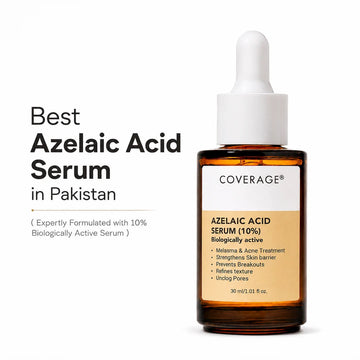
What is the COVERAGE Azelaic Acid 10% Serum?
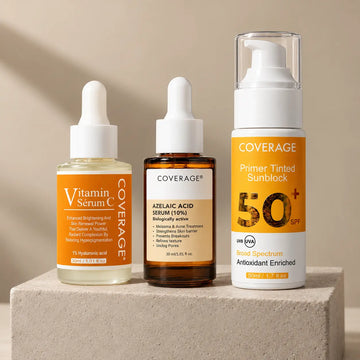
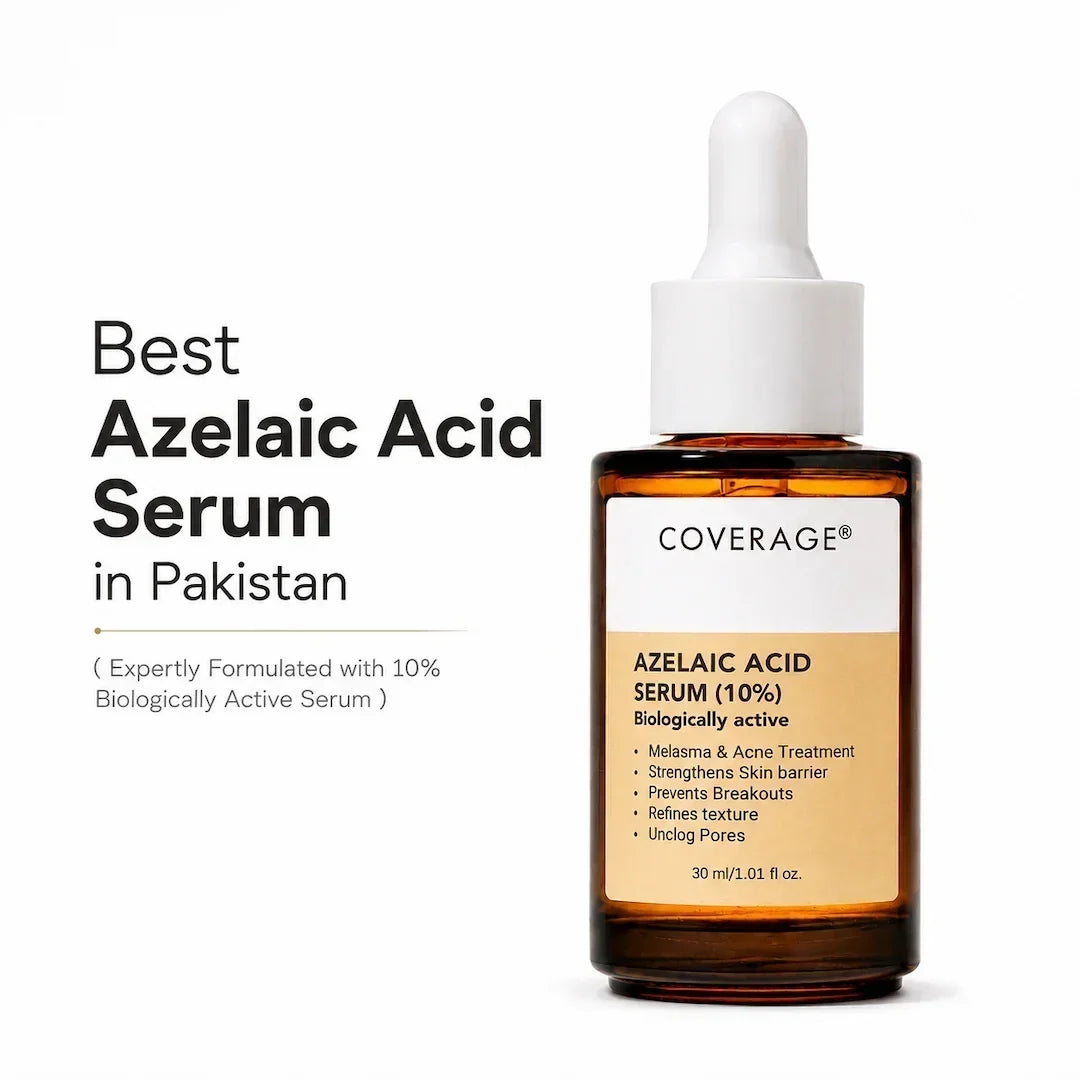
The COVERAGE Azelaic Acid 10% Serum is a Korean formulated cosmetic serum built around 10% biologically active azelaic acid, delivered in a light aloe and water base rather than a wax cream.
The full ingredient list is short and readable: Aloe Barbadensis Leaf Extract, Aqua, Azelaic Acid, Propanediol, Bis-Ethoxydiglycol, Xylitylglucoside, Isohexadecane, Polysorbate 60, Sodium Hyaluronate, Tocopheryl Acetate, Phenoxyethanol, Triethylene Glycol.
Three of those matter a lot for how the product performs. Propanediol and Bis-Ethoxydiglycol are solubilisers that help dissolve azelaic acid, which is notoriously hard to keep in solution, and help carry it into the skin. Sodium Hyaluronate holds water in the upper layers so the active does not leave skin feeling tight. This is the practical answer to the question people ask most: how can 10% do a real job when 20% exists.
Want to skip the theory? The COVERAGE Azelaic Acid 10% Serum is Rs.1,600 for 30ml, no prescription required, cash on delivery nationwide. Order the Azelaic Acid 10% Serum

Difference 1: strength, and why 20% is not automatically twice as good
This is the question we get asked most, so here is the straight answer.
The controlled trial evidence for azelaic acid sits at 15% and 20%. Those are the concentrations tested in the acne, rosacea and melasma studies. There is no equivalent trial library for 10%. Anyone telling you 10% has been proven superior to 20% is selling you something.
What the formulation science actually shows is more interesting. Azelaic acid dissolves poorly in water, so a lot of the active sitting in a basic 20% cream is suspended rather than dissolved, and suspended crystals do not penetrate. Reviews of azelaic acid formulation consistently conclude that its performance is strongly vehicle dependent, and that modern delivery systems let lower concentrations achieve comparable biological effects with better tolerance. In laboratory melanocyte testing, a well engineered 10% delivery system inhibited melanin production and tyrosinase activity about as effectively as a 20% cream, while leaving cells in better condition.
The honest summary:
- For moderate to severe acne, 20% under a dermatologist is the option with the deepest evidence.
- For mild acne, post acne marks, early pigmentation, redness and daily maintenance, a well formulated 10% is a sensible and widely used starting point.
- The percentage you can use consistently for three months beats the percentage you quit in week two.
Difference 2: the base, and why this matters more in Pakistani heat
This is the difference nobody talks about, and in our climate it may be the most important one.
Skinoren is formulated as a rich emollient cream. Alongside azelaic acid, the base includes cetearyl octanoate with isopropyl myristate, glyceryl stearate, cetearyl alcohol, cetyl palmitate and cocoglycerides. That is a genuinely good base for dry skin in a cold, dry climate.
Now picture Lahore in June. Forty five degrees, high humidity, a face that is already producing oil, and a rich cream applied twice a day under sunscreen. Some users with oily and acne prone skin report that the cream base feels heavy in these conditions and prefer the lighter gel format where it is available. This is a question of texture and climate rather than a flaw in the formula, and in a cooler, drier climate that same emollient base is a genuine advantage.
The COVERAGE serum is built the other way round. Aloe and water lead the list, there are no heavy waxes or fatty esters, and it absorbs in seconds. In practice that means it sits comfortably under a moisturiser and sunscreen instead of fighting them.
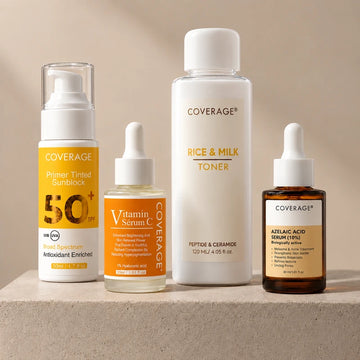
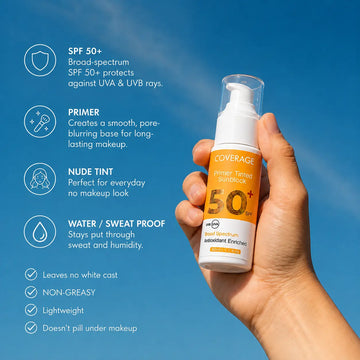
If you are treating pigmentation, sunscreen is not optional. Azelaic acid slows melanin production, but Pakistani sun puts it straight back. Pair whichever active you choose with a daily SPF such as the COVERAGE Primer Tinted Sunblock SPF 50+, and read our guide on choosing a tinted sunscreen for Pakistani skin.

Difference 3: what else is in the tube or bottle
Active ingredients get the attention. Reactions usually come from everything else.
Like most medicated creams, the Skinoren patient information leaflet lists its excipients transparently, and three carry standard advisory notes: benzoic acid, which may cause local irritation, propylene glycol at 125mg per gram, and cetostearyl alcohol, which the leaflet notes may cause local skin reactions. These notes appear on a great many topical products and are not unique to Skinoren. They are simply worth knowing, because when people react to a product they often assume the active is to blame when the base may be the reason.
The COVERAGE serum uses propanediol rather than propylene glycol, contains no benzoic acid, no cetostearyl alcohol and no fatty alcohols or waxes at all. It is fragrance free. That is a meaningfully shorter list of common irritants for anyone with sensitive or reactive skin.
Difference 4: prescription, access and honesty
Skinoren requires a prescription in Pakistan. That is a feature, not a flaw: a dermatologist assessing your skin before you start a 20% active is the ideal path, and if you have moderate or severe acne you should be seeing one anyway.
In practice, some people skip that step, buy it at a pharmacy counter, apply it twice daily across the whole face from day one, find the first week uncomfortable, and give up early. That is not the product underperforming. It is what happens when a prescription medicine is used without the guidance it was designed to come with, and it is exactly the reason the prescription requirement exists.
The COVERAGE serum sits in the cosmetic tier. It is a lower concentration, it needs no prescription, and it is meant to be used the way skincare is used: start slow, build up, keep going. If your acne is severe, cystic or scarring, see a dermatologist first. No serum, ours included, is a substitute for that.
Difference 5: what you actually pay
On the shelf, Skinoren looks far cheaper. A 10g tube at around Rs.780 versus Rs.1,600 for 30ml of serum.
Look at it per unit and the gap narrows sharply. Skinoren works out to roughly Rs.78 per gram. The COVERAGE serum works out to roughly Rs.53 per ml. Grams and millilitres are not identical units, so treat this as an approximation rather than an exact ratio, but the direction is clear: a 10g tube used twice daily across a full face empties quickly, and pigmentation treatment usually continues for months.
Add the consultation fee for the prescription, and the real cost of a proper Skinoren course is higher than the sticker suggests.
No prescription, no clinic fee. 30ml of COVERAGE Azelaic Acid 10% Serum is Rs.1,600 and lasts for weeks of full-face use. Cash on delivery across Pakistan.
Which one should you choose?
Choose Skinoren 20% if:
- You have moderate to severe inflammatory acne
- You are already under a dermatologist and can get a prescription
- Your skin is dry to normal and tolerates strong actives
- You want the concentration with the deepest clinical trial history
- You are treating a defined course rather than looking for a long term routine step
Choose the COVERAGE Azelaic Acid 10% Serum if:
- Your skin is oily or combination and heavy creams congest you
- You are dealing with post acne marks, daag dhabbe, early pigmentation or mild melasma
- You are sensitive, reactive, or new to actives
- You want something you can layer under sunscreen every single morning
- You do not have a prescription and are not going to get one
- You are maintaining results after a dermatologist led course
Can you use both?
Yes, and some people do it well. The usual approach is the medicated cream at night on affected areas only, and the lighter serum in the morning under sunscreen. Do not start both in the same week, and do not use both at full frequency from day one.
The safer sequence: introduce one, give it four weeks, then decide whether you need the second at all. Most people find they do not.
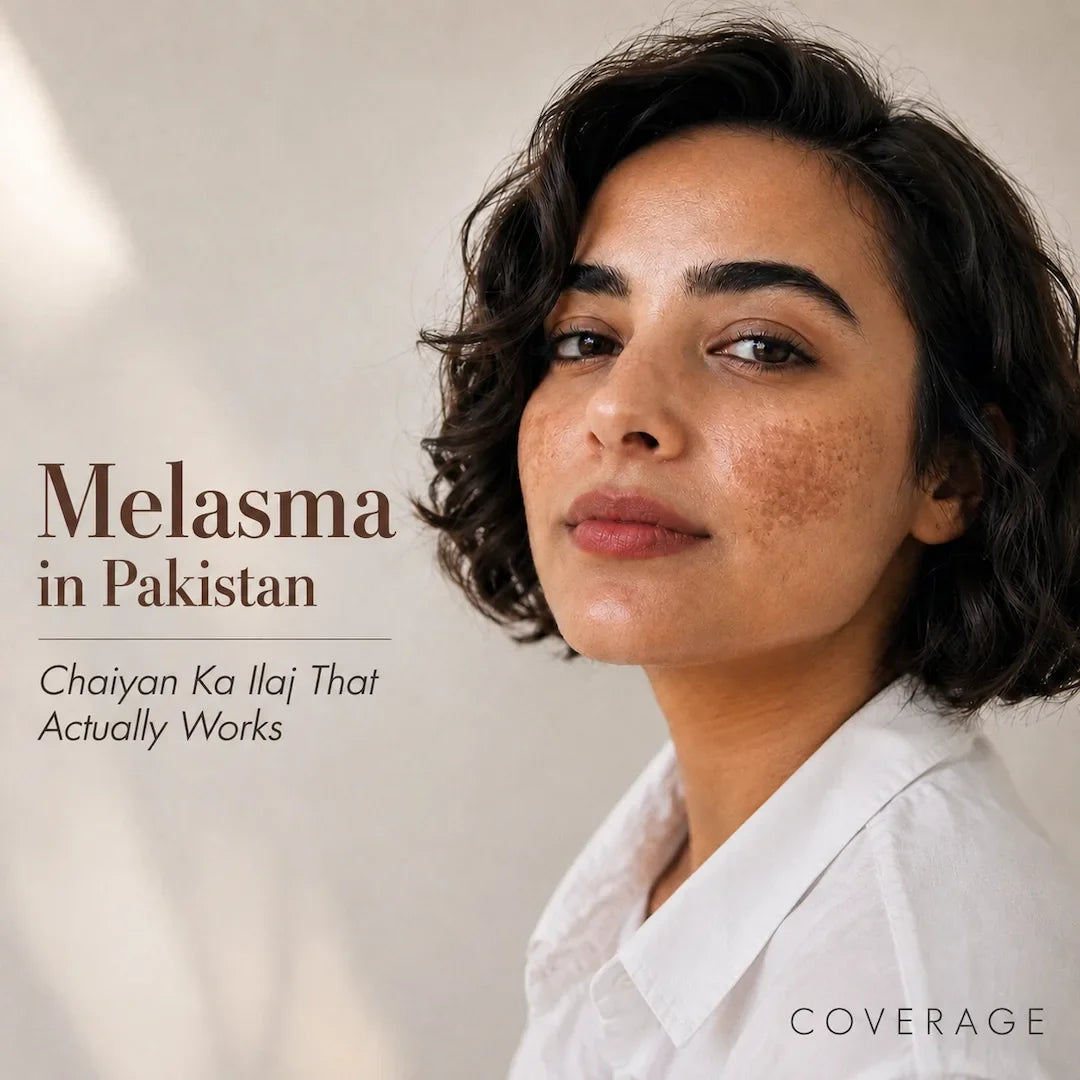
Azelaic acid for melasma and chaiyan in Pakistan
Melasma is not a vanity problem in this country, it is a mass one. Roughly nine in ten cases occur in women, and field studies of outdoor workers in India and Pakistan have recorded prevalence as high as 41 to 46 percent. Pakistani hospitals have run their own randomised trials on it: dermatology departments in Gujranwala and Abbottabad have both compared 20% azelaic acid against 4% hydroquinone in local patients.
Azelaic acid earns its place here because it competitively inhibits tyrosinase, the enzyme that starts melanin production, and it does so selectively on overactive melanocytes rather than bleaching skin indiscriminately. That is why it does not carry hydroquinone's risk of permanent white patches with long term use.
Two hard truths, whichever product you pick:
- Without daily sunscreen, neither one will work. Melasma is driven by light, including visible light through a window.
- Melasma comes back. Recurrence rates in dermatology surveys commonly sit in the 41 to 60 percent range. This is a condition you manage, not one you cure. That reality alone favours a product you can afford and tolerate indefinitely, which is the case for a daily azelaic acid serum you can keep using for months without a repeat prescription.
Azelaic acid for acne and kil muhase
Azelaic acid does four jobs at once, which is unusual. It is antibacterial against acne causing bacteria, anti inflammatory, comedolytic so it keeps pores clear, and it inhibits tyrosinase so it fades the marks left behind. Most acne actives do one of these.
That fourth action is why it suits Pakistani and South Asian skin so well. Deeper skin tones mark heavily after a spot heals, and post inflammatory hyperpigmentation often bothers people more than the original pimple. An active that treats the spot and the mark together saves you a step.
Pregnancy and breastfeeding
This is one of the most searched questions in Pakistan, because melasma is nicknamed the mask of pregnancy for a reason.
Azelaic acid is one of the few brightening actives widely considered compatible with pregnancy and breastfeeding. Under the older FDA system it was classified Category B, systemic absorption from topical use is under about 4 percent, and it is not a retinoid. Retinoids and hydroquinone are the two categories most commonly avoided during pregnancy.
Some clinical guidance still advises limiting azelaic acid to affected areas only and preferring to avoid it in the first trimester. Ask your own doctor before starting anything during pregnancy. We are giving you the published position, not medical clearance for your specific case.
Side effects and how to start without wrecking your barrier
Skinoren's leaflet lists burning, itching and redness at the application site as very common, meaning more than one in ten users, with scaling, dryness and pain as common. That is the labelled reality of a 20% medicine, and it usually settles over two to three weeks.
A lower concentration serum in a lighter base is generally better tolerated, but no active is guaranteed for every skin. Whichever you choose:
- Patch test first. Inner forearm or behind the ear, small amount, wait 24 hours.
- Start every other night for two weeks, not twice daily.
- Apply to dry skin. Applying actives to damp skin increases stinging.
- Moisturise after, not before.
- Sunscreen every morning, without exception.
- Do not stack new actives in the same fortnight.
- If irritation is still bad after three weeks, reduce frequency. If it persists, stop and see a doctor.
How long until you see results?
Here is the honest answer.
- Weeks 1 to 3: most of our customers see a visible difference with our serum. Every skin is different, so some people need more time. Possible tingling and adjustment early on. Sometimes a purge as congestion surfaces.
- Weeks 4 to 6: active breakouts usually keep calming. Skinoren's own leaflet points to a distinct improvement around four weeks.
- Weeks 8 to 12: older and deeper post acne marks and pigmentation keep fading.
- Months 3 to 6: the window in which melasma studies measured meaningful change. Melasma is the slowest of all of them.
If a product in Pakistan promises to clear chaiyan in seven days, it is either a temporary surface effect or it contains something it should not. Fast whitening creams sold in local markets have repeatedly been found to contain mercury and unlabelled steroids, and the rebound pigmentation afterwards is worse than what you started with.
What our customers say when they have used both
We get this comparison a lot in DMs, because most people who buy our serum are not new to azelaic acid. They are coming off something else.
"Skin Oren sy ye serum to buhat behtar he. Meri skin kafi had tak recover hugyi he is serum sy, sirf spots rehte hen, I hope wo bhi theek hujayegay regular use sy."
Rubab Yousaf, verified review on our store
"I have used this serum for only 7 days and literally my acne is gone. Unbelievable product."
Palvasha Shah, verified review on our store
Individual results vary, and acne fully clearing in one week is faster than most people should expect. We publish the middling reviews alongside the glowing ones, because a brand that only shows five stars is hiding something.

Conclusion
Skinoren remains an excellent dermatologist prescribed treatment with strong clinical evidence, particularly for moderate acne and persistent pigmentation. However, because it is prescription only in Pakistan and comes in a richer cream base, it may not be the most practical choice for everyone.
If you are looking for an over the counter option that is lightweight, easy to layer into your routine, and suitable for oily or combination skin, the COVERAGE Azelaic Acid 10% Serum is a convenient alternative. It helps target acne, post acne marks, uneven skin tone, and daag dhabbe while fitting comfortably into daily skincare.
Whichever product you choose, consistency is what delivers results. Use azelaic acid regularly, wear a broad spectrum sunscreen every morning, and give it time. Most of our customers see a visible difference within 1 to 3 weeks of consistent daily use. Every skin type and every concern is different, so some people need more time. Deeper pigmentation and melasma keep improving over a longer period. If you have severe acne, widespread melasma, or your skin is not improving, consult a qualified dermatologist for personalised treatment.
COVERAGE Azelaic Acid 10% Serum
10% biologically active azelaic acid with Sodium Hyaluronate, Aloe Vera and Vitamin E. Lightweight, non greasy, fragrance free. 30ml, Rs.1,600. Cash on delivery across Pakistan.
Order the Azelaic Acid 10% Serum
New to the ingredient? Start with our full guide: Azelaic Acid Serum in Pakistan: Acne, Melasma and Daag Dhabbe
Frequently asked questions
Is Skinoren better than an azelaic acid serum?
Skinoren is stronger at 20% and has more clinical trial data behind it, so for moderate acne under a dermatologist it is the more powerful option. A 10% serum in a lighter base is better tolerated, needs no prescription, and suits oily skin in hot weather. Better depends on your skin and your concern, not on the number alone.
What is the price of Skinoren cream in Pakistan?
A 10g tube typically sells for around Rs.760 to Rs.810 depending on the pharmacy. It is also available in a 20g tube. The COVERAGE Azelaic Acid 10% Serum is Rs.1,600 for 30ml.
Do I need a prescription for Skinoren in Pakistan?
Yes. Skinoren is a prescription only medicine in Pakistan and licensed pharmacies will ask for a valid prescription. The COVERAGE Azelaic Acid 10% Serum is a cosmetic product and does not require one.
Can I use Skinoren for chaiyan and melasma?
Dermatologists commonly prescribe it off label for melasma, and studies of 20% azelaic acid in melasma support that use. Its registered indication in the leaflet is acne vulgaris, so this is a doctor's judgement call rather than a labelled use.
Which is better for oily skin in Pakistan?
A water based serum generally suits oily and combination skin better in Pakistani heat. Skinoren's cream base contains waxes and fatty esters that some acne prone users find congesting, which is why many people prefer lighter formats.
Is 10% azelaic acid strong enough to work?
For mild acne, post acne marks and early pigmentation, yes, particularly when the formula uses solubilisers that keep the acid dissolved and help it penetrate. Azelaic acid performance is strongly dependent on the base it is delivered in, not on percentage alone. For moderate to severe acne, prescription strength has the stronger evidence.
Can I use azelaic acid during pregnancy?
Azelaic acid is generally regarded as one of the safer brightening actives in pregnancy and breastfeeding, with low systemic absorption, and it is not a retinoid. Some guidance advises limiting it to affected areas and avoiding the first trimester. Always confirm with your own doctor first.
Does azelaic acid make skin sensitive to the sun?
No. Unlike AHAs, azelaic acid does not increase photosensitivity. You still need daily sunscreen, because sun exposure will undo pigmentation progress regardless of which product you use.
Can I use azelaic acid with Vitamin C or niacinamide?
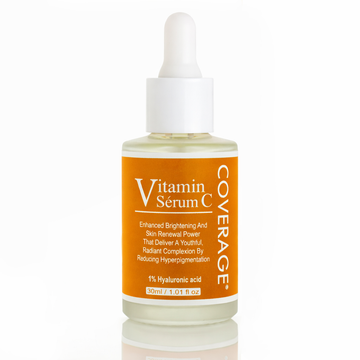
Yes. Azelaic acid layers well with both. Apply the lighter, more watery product first and let it absorb. Many people prefer Vitamin C in the morning and azelaic acid at night, but both in one routine is fine once your skin has adjusted.
How long does azelaic acid take to fade dark spots?
Most of our customers see a visible difference within 1 to 3 weeks of consistent daily use. Every skin type and every concern is different, so some people need more time. Older and deeper marks take longer to fade fully, and melasma is slower and was measured over three to six months in clinical studies. Daily sunscreen is what determines whether you keep the progress.
Is Skinoren available without a prescription on Daraz or local pharmacies?
Some sellers list it, but it is legally a prescription medicine, and product sourced outside licensed pharmacy channels carries a real risk of being counterfeit or badly stored. If you want a no prescription option, choose a product that is designed to be sold as a cosmetic.
What is the difference between Skinoren cream and Skinoren gel?
The cream contains 20% azelaic acid in a rich emollient base. The gel contains 15% in a lighter base and is the format studied specifically for rosacea. The gel is not widely distributed in Pakistan, which is why the cream is what most people encounter here.
This article is for general informational purposes only and is not a substitute for professional medical advice. All information and claims referenced above are drawn from publicly available dermatological studies and expert sources. Always consult a dermatologist for advice specific to your skin.

Leave a comment
This site is protected by hCaptcha and the hCaptcha Privacy Policy and Terms of Service apply.