
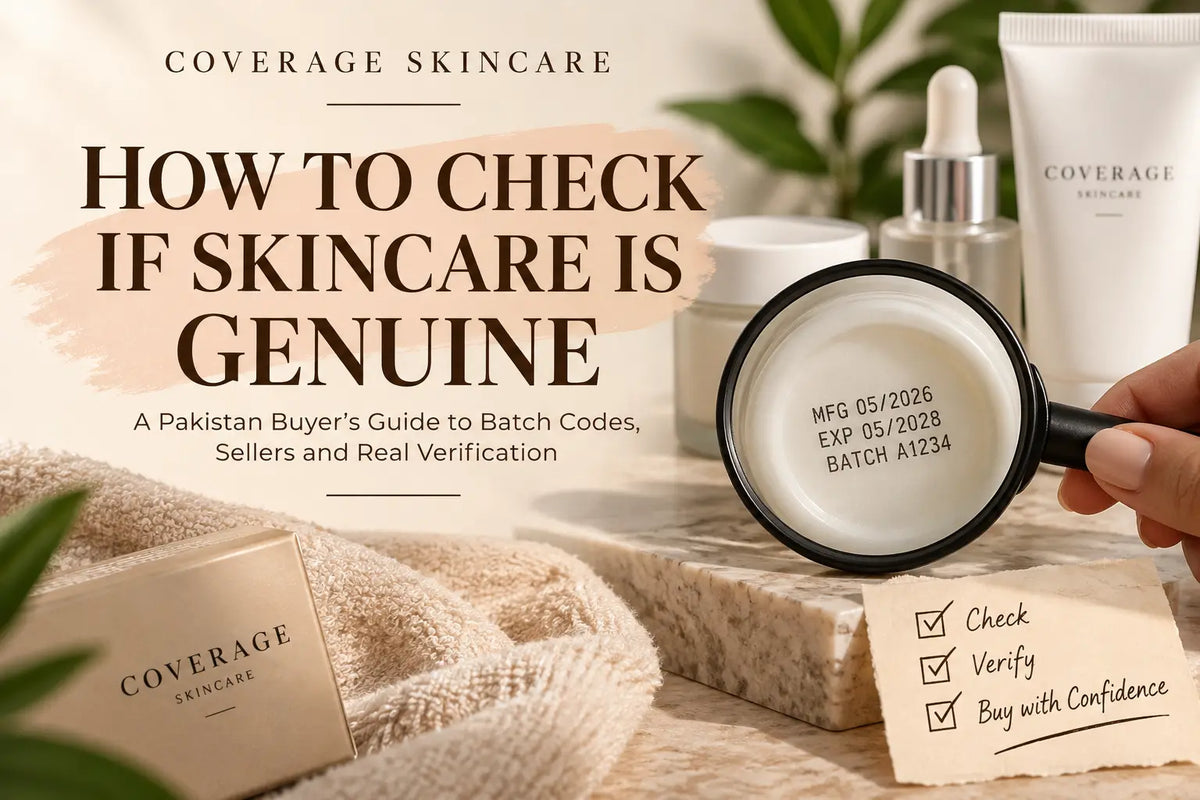
How to Check if a Skincare Product Is Genuine in Pakistan (2026)
If you have ever opened a skincare parcel in Pakistan and thought yeh asli hai ya naqli, you are asking the right question. Between Instagram sellers, WhatsApp catalogues, marketplace resellers and cash on delivery parcels that arrive sealed in plain tape, most people here buy skincare with no reliable way to check what they are actually getting.
This guide gives you a real method. Not "if it smells different, it is fake," which is the advice you will find on most pages, and which is wrong often enough to be useless. Instead: what each authenticity signal can actually prove, what it cannot, how cosmetics are really regulated in Pakistan, and where the only genuine confirmation comes from.
The short answer
You can almost never prove a single bottle of skincare is genuine from one clue. Batch codes, packaging, seals, smell, texture and price give you red flags, which tell you when to be careful. They do not give you proof. The only reliable confirmation comes from the supply chain: buying from the brand's own store or an authorised seller, and asking the manufacturer directly when you have doubt. Everything else in this guide is about knowing when to stop and check.

Why this is harder in Pakistan than almost anywhere else
Three things stack up here that do not stack up in most markets.
Cash on delivery removes the paper trail. Most Pakistani skincare is bought COD. There is no card statement, often no invoice, sometimes not even a business name on the parcel. If something turns out wrong, you frequently have nothing to trace it back with.
Social selling outnumbers formal retail. An enormous share of skincare here moves through Instagram and Facebook pages. Many of those sellers are completely legitimate. Some are resellers buying from unknown sources. A few are moving straight counterfeit. From the outside, all three look identical: a grid of nice photos and a DM.
Imported product moves through grey channels. Korean, Japanese and European skincare arriving in Pakistan often comes through informal import rather than an appointed distributor. That product is not necessarily fake, but nobody in the chain is accountable for how it was stored, how old it is, or whether it is what the box says.
Counterfeiting is not a small or local problem either. In Mapping Global Trade in Fakes 2025, the OECD and EUIPO estimated global trade in counterfeit goods at roughly USD 467 billion in 2021, around 2.3% of total world imports, and identified cosmetics as one of the categories where fakes carry real safety risk rather than just lost revenue.
The shortest version of this guide
If you do not want to learn a checklist, do this instead: buy from the brand's own website. When you order from coverageskincare.com, the product goes from our own manufacturing facility to our own warehouse to you. There is no reseller in the middle, no repackaging step, no question about where the stock came from. That single decision removes almost every risk this article describes.
What can actually go wrong with a counterfeit or unregulated product
The risk from fake skincare is not mystical. It comes from four concrete failures in how the product was made.
- Unknown actives at unknown concentrations. If the label says 10% azelaic acid and the bottle contains 2%, you get nothing. If it contains 25%, you get burned. Either way you cannot dose or predict anything.
- Undisclosed substitutions. Expensive actives swapped for cheap ones. In the worst cases, prohibited ingredients such as high dose steroids or mercury added to force a fast visible result.
- Failed or absent preservation. Water based cosmetics need a functioning preservative system or they grow bacteria, yeast and mould. A counterfeit operation is not running microbiological challenge testing.
- Uncontrolled hygiene, packaging and storage. Product filled in an unclean environment, packed in unsuitable containers, and stored in Pakistani summer heat behaves nothing like the original.
In practice the outcomes are irritation, stinging, unexpected breakouts, and allergic contact dermatitis. If a product has left you with breakouts you are now trying to clear, our keel muhase ka ilaj guide covers what actually works. Contact dermatitis from cosmetics is well documented in the dermatology literature, and fragrances and preservatives are consistently among the most common cosmetic allergens identified by the American Academy of Dermatology and in patch testing series.
Important nuance
A reaction does not prove a product is fake. Genuine products irritate sensitive skin all the time, and active ingredients such as retinoids, acids and vitamin C cause predictable stinging in the first weeks. What matters is a change: a product that suited you for months and suddenly does not is worth investigating. A new active that tingles is usually just a new active.
Mercury and steroids: the one risk that is not exaggerated
Most "fake skincare will poison you" content online is scaremongering. One category is not.
The World Health Organization notes that inorganic mercury is a common ingredient in some skin lightening products, that these products are hazardous to health, and that despite bans in many countries they remain widely advertised and sold, including over the internet. The Minamata Convention on Mercury sets a limit of 1 mg/kg, which is 1 part per million, for mercury in cosmetics.
This is not a distant problem. A 2025 X-ray fluorescence study of 134 online skin lightening products sourced from seven Asian countries, published in Regulatory Toxicology and Pharmacology, found that over 58% of samples exceeded the permissible mercury limit. In Pakistan, PSQCA sets the national safety limits for cosmetics under PS 3228:2025.
Be precise about this
This applies to specific unregulated or flagged whitening and fairness creams. It does not mean every counterfeit contains heavy metals, and it does not mean skincare in general is dangerous. If you have any doubt about a whitening or fairness product you are using, stop, and see a doctor if you have symptoms. If you want lasting results on pigmentation without any of this, the evidence backed route is a tolerated active plus daily sun protection, which we cover in our guide to melasma and chhaiyan ka ilaj.

The checklist: eight authenticity signals, and what each one actually proves
Work through these in order. Each entry tells you what to look at, and, more importantly, where the signal stops being evidence.
1. The batch or lot code
What it is: a short stamped, embossed or inkjet printed code on the base of the bottle, the crimp of a tube, the tube seam or the carton. It is separate from the long barcode. Formats differ between manufacturers, which is normal.
Why it exists: traceability. Under the EU Cosmetics Regulation (EC) No 1223/2009, Article 19, a batch number is mandatory precisely so a product can be identified in a complaint, a non-compliance investigation or a recall. Most serious manufacturers worldwide follow the same practice whether or not they sell into the EU.
What it proves: that the product came from a controlled production run with records behind it, if the brand can confirm the code.
What it does not prove: anything on its own. A code can be copied. Third party checkers such as CheckFresh can estimate a manufacture date only when the brand's coding format is publicly documented, which for most brands it is not. A code that will not decode usually means a proprietary format, not a fake.
Red flag level: high. A missing, smudged beyond reading, or hand written code is genuinely worth stopping over.

2. Packaging print quality and tamper seals
What to look at: sharpness of small text, font consistency, spelling, alignment of printed panels, quality of the label adhesive, condition of the shrink band or induction seal, and whether the pump or dropper matches what the brand shows on its own site.
What it proves: genuinely poor printing is a strong signal, because counterfeit operations rarely match commercial print quality on small type.
What it does not prove: the reverse. Brands update artwork, change pump suppliers, switch carton printers and revise claims between production runs constantly. A difference from the photo you saw last year is not evidence of anything. Counterfeiters also copy packaging extremely well, and sometimes fill genuine recovered cartons.
3. Texture, colour and scent
What to look at: a major and unexplained change from a unit you know.
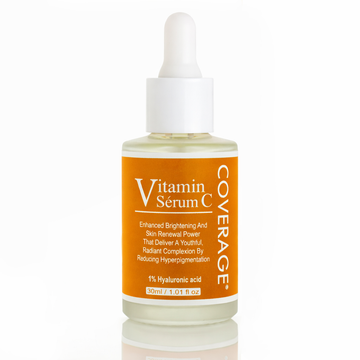
What it does not prove: a great deal, because legitimate variation is enormous. Vitamin C serums darken as they oxidise, which is chemistry, not counterfeiting. Emulsions thicken or thin with temperature. Natural extracts vary batch to batch. Heat in transit changes texture. Our own Vitamin C + 1% HA Serum is built on a stabilised derivative rather than L-ascorbic acid for exactly this reason, and we explain the difference in azelaic acid vs vitamin C.
Use it as: an early alert that tells you to verify, never as a verdict.
4. The ingredient list and mandatory labelling
What to check: that a full INCI ingredient list is present and coherent, that the net quantity is stated, and that the name and address of the manufacturer, packer or distributor appears. The US FDA requires exactly this on cosmetic labels, and it is standard practice internationally. Missing manufacturer identity is a serious gap.
If you want to see what a complete, honestly ordered ingredient list looks like, every COVERAGE product page carries its full INCI, and we break down a formula line by line in our guide to Korean toners.
A useful tell: INCI lists run in descending order of concentration down to 1%. A list where water appears sixth, or where the headline active sits near the end after the preservative, is a list written for marketing rather than for accuracy. That is a formulation and honesty problem even when the product is authentic.
What it does not prove: do not try to authenticate a product by recognising individual ingredient names. This is a labelling integrity check, not an authenticity test.
5. Price against the legitimate market
The principle: imported skincare carries duty, freight, storage, currency exposure and distributor margin. A price far below the normal range for that product in Pakistan means something in the chain is different, and you should find out what.
What it does not prove: that a discounted product is fake. Genuine sales, bundles, clearance and locally manufactured pricing all exist. A Pakistani made product at half the price of an import is not suspicious, it is the absence of import cost. Treat "too good to be true" as a prompt to check the seller, not a conviction.

6. The seller and the platform
This is the strongest early signal on the whole list, because it is the one you can assess before you spend anything.
| Lower risk | Verify before buying |
|---|---|
| The brand's own website | Account with no business name or address |
| Brand's verified official social account | Seller who will not answer questions about batch or sourcing |
| Named authorised retailer or established pharmacy | Listing with no stated return policy |
| Daraz Mall listings | General marketplace listing from an unnamed third party |
| Seller who states where stock is sourced from | Product photos copied from the brand's own site with no original imagery |
On Daraz specifically, Daraz Mall is the authorised channel, with a stated returns window and an authenticity guarantee, while general marketplace listings carry far more variability. Policies change, so check the current terms on daraz.pk rather than relying on any article, including this one.
7. Official verification channels
The reality: most legitimate skincare brands, worldwide, do not operate a consumer authentication portal. There is no QR scan, no hologram database, no serial lookup. This is normal and is not a red flag.
What actually works: contacting the brand directly with photographs and the batch code and asking them to confirm. A real manufacturer can check a batch against its own production records. That is the single most reliable verification available to an ordinary buyer.
8. Where the product was manufactured, and by whom
This is the signal almost nobody checks, and it is the one that matters most. Everything above is about detecting a problem after it has already reached your hands. This one is about not being in that position. We come back to it in detail below.

How cosmetics are actually regulated in Pakistan
This is the part that almost no other page explains, and it is why there is no single "is this genuine" lookup you can use.
Oversight in Pakistan is split between two bodies:
- DRAP, the Drug Regulatory Authority of Pakistan. Its Medical Devices and Medicated Cosmetics Division handles assessment, enlistment and registration of medical devices and medicated cosmetics, including medicated shampoos and soaps. Its cosmetic remit is essentially the medicated category, not ordinary skincare.
- PSQCA, the Pakistan Standards and Quality Control Authority. It sets and enforces standards for ordinary cosmetics, including PS 3228:2025 on safety limits, and runs the Pakistan Standards Quality Mark certification scheme.
The practical consequence: there is no public consumer portal where you can type in a product name and confirm that an ordinary cosmetic is registered. DRAP's online product index primarily covers drugs and is explicitly provisional. So for everyday skincare, your usable tools are the seller, the packaging, the batch code, and above all the manufacturer.

The Pakistan red flag list
These are the situations, specific to how skincare is sold here, that most often warrant a pause:
- An Instagram or Facebook seller with no business name, no address and no other way to reach them
- Prices far below the normal range for that product in Pakistan
- A seller who will not tell you where their stock comes from
- No return policy, and no answer when you ask about one
- Product photography copied directly from the brand's own website with no original images at all
- Product descriptions that contradict each other between the caption and the packaging
- Imported product with no importer details, no English or Urdu labelling, or a sticker covering the original label
- "First copy", "replica", "original quality" or "same as original" in the listing, which is usually a direct admission
- A seller who will not photograph the batch code for you before you order
Fair warning
Not every Instagram or Facebook seller is fraudulent, and it would be dishonest of us to imply that. A large number of genuine Pakistani brands, including ones we respect, sell primarily through social media and cash on delivery. Treat the list above as reasons to verify, not as accusations.
What "genuine" actually depends on, upstream of the box
Here is the part that reframes the whole question.
Everything in the checklist above is downstream detection. You are examining an object that has already been made, shipped, resold and delivered, trying to reverse engineer whether the chain behind it was sound. It is a weak position to be in, because most of what determines whether a product is trustworthy happened long before it reached you.
A genuinely trustworthy product requires:
- Controlled manufacturing in a facility with documented processes, not a rented mixing room
- Good Manufacturing Practice principles governing production, cleaning, personnel and equipment
- Laboratory testing on both incoming raw materials and finished batches
- Controlled raw material sourcing, so the extract on the label is the grade the formula was designed around
- A functioning preservative system, validated rather than assumed
- Batch traceability, so any unit can be traced back to its production record
- Appropriate storage and distribution, particularly in a climate like Pakistan's
What GMP and ISO certification actually mean
Since these terms are used loosely in Pakistani skincare marketing, here is what they really are.
| Term | What it actually is | What it does not tell you |
|---|---|---|
| GMP | Good Manufacturing Practice. A framework of rules covering how a product is produced, controlled, stored and shipped. | Nothing about whether a specific formula works for you. |
| ISO 22716 | The international standard giving GMP guidelines specifically for cosmetics: production, control, storage, shipment. | Whether one individual unit on a shelf is authentic. |
| ISO 9001 | A general quality management systems standard. Not cosmetics specific. | Anything about product safety or formulation quality on its own. |
| PSQCA licence | A Pakistani licence to certify against a national standard such as PS 3228:2025. | That every individual batch was tested. |
Certification is a signal about processes. It is a real and meaningful signal, and a brand that has it is operating at a different level from one that does not. But it is not a per item authenticity stamp, and any brand telling you otherwise is overselling it.

Why COVERAGE can answer the genuine question differently
A large share of skincare brands worldwide do not manufacture their own products. They brief a contract manufacturer, approve a sample, and sell the result under their own name. That model is completely legitimate and can produce very good products. It also means that when a customer asks "is this genuine, and what is actually inside it", the brand is relaying an answer rather than giving one.
COVERAGE is built the other way round.

Skincare and cosmetics manufacturing has been our family's business for roughly forty years, starting with my grandfather. My father and my brother are both chemical engineers. We own our manufacturing facility, it holds GMP and ISO certification, and it runs its own laboratory testing. Formulation, raw material sourcing, production and quality control all happen through a formal, structured channel inside the company rather than through white label outsourcing.

That has two consequences that matter to you as a buyer.
We can trace any unit back to its batch

Because production happens in house, a batch code on a COVERAGE bottle corresponds to a production record we hold. If you send us a photograph of your bottle and its code, we can tell you whether it is ours. Very few brands selling in Pakistan can do that without going back to a contract manufacturer first.

We control what actually goes into the formula
This is the part of "genuine" that never gets discussed, because it is invisible at the point of purchase. An ingredient name on a label tells you almost nothing about the grade or the concentration of that ingredient. Centella is on hundreds of product labels. Whether it is a properly standardised extract at a meaningful percentage, or a trace amount included so the word can appear on the box, is a completely different question, and one no customer can check from the outside.

Our standard is that when a COVERAGE product names an ingredient, it uses the same grade of that raw material as the Korean brands the formula is benchmarked against. Manufacturing is our family's livelihood, so cutting the formula to save cost is not a trade we are willing to make. You can see the full INCI list on every product page, and we will answer questions about any of it.

Where to start
If you are replacing something you no longer trust, these are the three that do the most work:
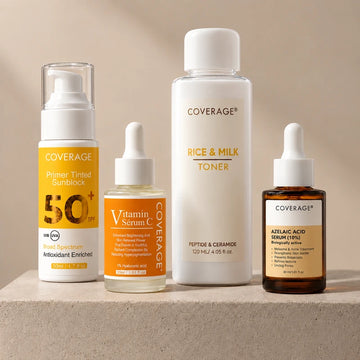
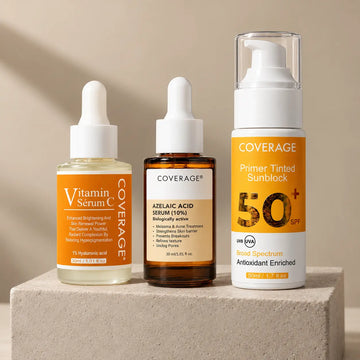
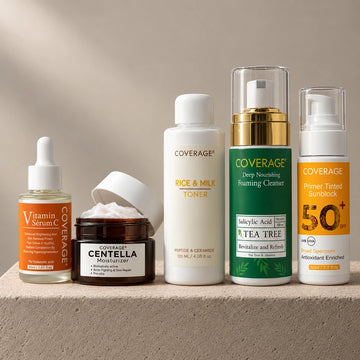
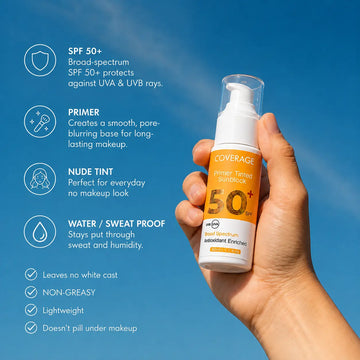
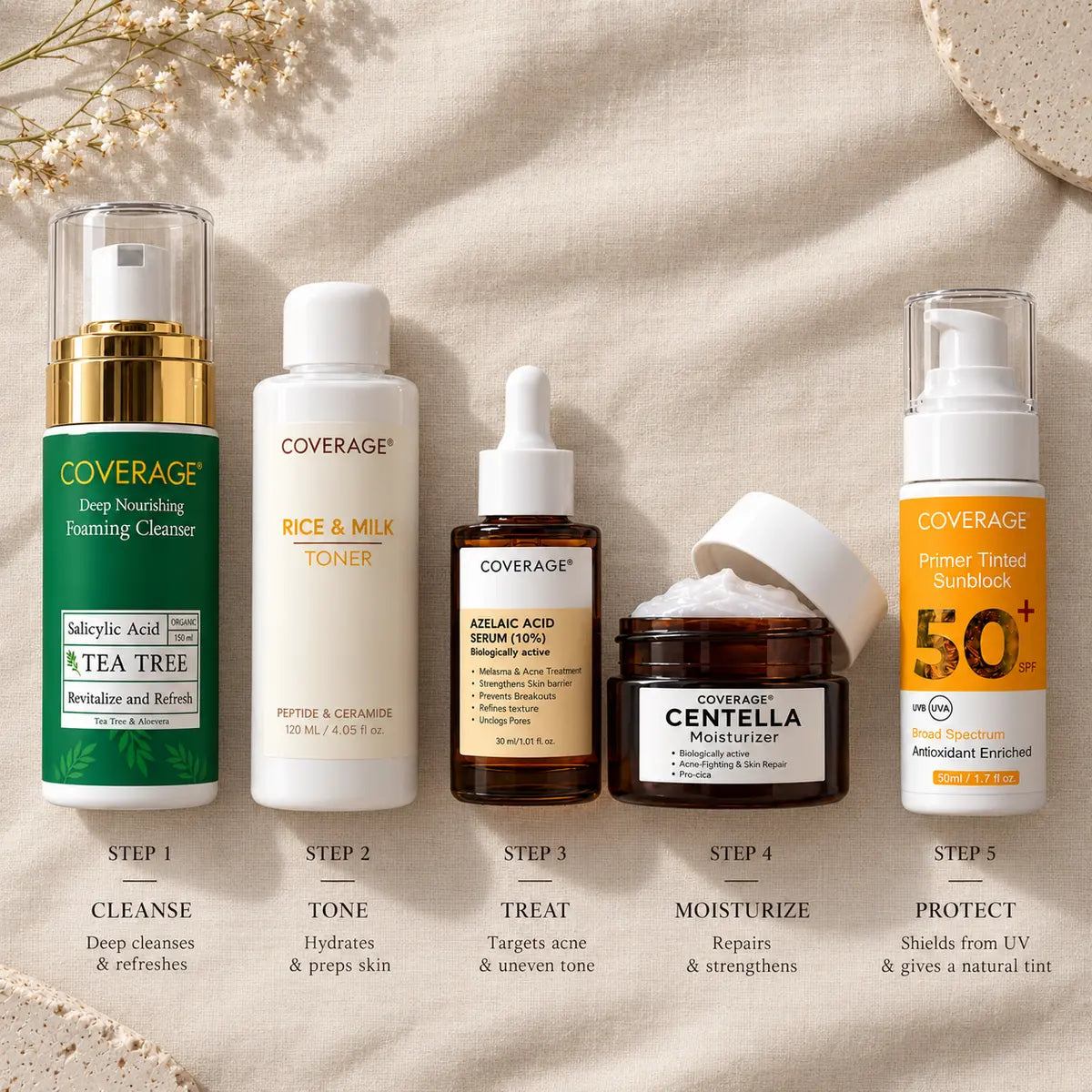
- Primer Tinted Sunblock SPF 50+ at Rs. 1,399. A 100% mineral filter system using zinc oxide and titanium dioxide, with a tint that removes the white cast. Sun protection is the single highest value step for pigmentation, and we explain why in is SPF 50 enough in Pakistan.
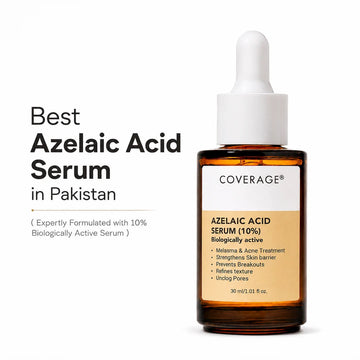
- Azelaic Acid 10% Serum at Rs. 1,600. For acne, daag dhabbe and melasma, formulated at a strength Pakistani skin tolerates rather than the 20% prescription cream most people quit within two weeks. Compared in full in Skinoren vs COVERAGE azelaic acid.
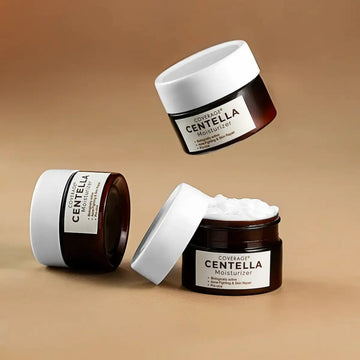
- Centella Moisturizer at Rs. 1,630. Real standardised centella for a barrier that has been stripped by harsh products.
All orders ship from our own stock with cash on delivery across Pakistan.
How to verify a COVERAGE product specifically
We do not operate a QR code, hologram, scratch panel or serial number portal, and we are not going to pretend otherwise. Most legitimate brands do not have one, and a QR sticker is trivially copied anyway. What we do have is direct contact with the people who made the product.
- Photograph the product and the packaging, including a clear, in focus shot of the batch or lot code.
- Note where and when you bought it, the seller's name, and your order number if you have one.
- Message us through the official Instagram @coverage.intl, our Facebook page, or the contact details on coverageskincare.com, and ask us to confirm the item and the batch.
- If it is not ours, we will tell you. That is more useful to us than pretending otherwise, because a counterfeit circulating under our name damages us more than it damages anyone else.
The simplest way to never need any of this is to order from the official store. Every order placed on coverageskincare.com comes from our own inventory.
Asli ya naqli: the quick version in plain language
If you remember nothing else from this page, remember these six lines.
- Sasti price hamesha naqli nahi hoti. A low price is a reason to check the seller, not proof of a fake. Locally made costs less than imported for obvious reasons.
- Batch code zaroori hai. No batch code, no purchase. A code that will not decode online is fine. A code that does not exist is not.
- Seller sab se bada signal hai. Who you buy from matters more than every physical check combined.
- Packaging match karna proof nahi hai. Counterfeiters copy packaging well. Matching boxes prove nothing.
- Smell ya texture change hone ka matlab fake nahi. Heat, age and oxidation all do this to genuine product.
- Shak ho to brand se poocho. Direct contact with the manufacturer is the only real confirmation available to you.

What to do if you think you bought a counterfeit
- Stop using it. Not because it is certainly harmful, but because you do not know what it is.
- Do not throw the packaging away. The carton, the bottle and the batch code are your only evidence.
- Photograph everything before anything else, including the seller's listing and your chat with them.
- Contact the brand. Give them the batch code and the seller details. Brands act on this, because counterfeits hurt them directly.
- Raise it with the seller or platform. Marketplace platforms have dispute windows; social sellers often do not, which is itself the lesson.
- If you have a skin reaction, see a qualified doctor or dermatologist, and take the product with you.
- If you have a safety concern about a product, it can be reported to PSQCA.
Expired is not the same as counterfeit
These get confused constantly, and they are different problems.
Expired means a genuine product past its shelf life or past its period after opening. The PAO symbol, the small open jar marked 6M, 12M or 24M, tells you how long the product stays good once you open it. An expired product may have lost potency, separated, or had its preservative system exhausted.
Counterfeit means an unauthorised imitation, which may be fresh or may be old. It was never the real product at any point.
The practical difference: expiry is mostly within your control through storage and buying habits. Counterfeiting is about where you buy. In a hot climate, storage matters more than most people think. Keep actives away from windows and bathroom heat, which is genuinely why some vitamin C serums fail early in Pakistan rather than because anything was wrong with them.

The bottom line
Use the checklist to spot red flags, but keep the line between suspicion and proof. Most of what circulates online as "how to spot a fake" collapses that distinction and turns ordinary batch variation into an accusation.
The honest answer is that a buyer cannot reliably authenticate a cosmetic from the outside. What you can do is stack the odds: buy from the brand or an authorised seller, check that a batch code exists, ask questions the seller should be able to answer, and confirm with the manufacturer when it matters. Verify, inspect, prefer sources with something to lose. That habit protects your skin and your money better than any single trick.
Related reading
If this guide sent you looking for something specific, these go deeper:
- Best products for acne in Pakistan, a dermatology-backed buyer's guide
- Best serum for dark spots and pigmentation in Pakistan
- Melasma in Pakistan: chaiyan ka ilaj that actually works
- Best tinted sunscreen in Pakistan, the 2026 buyer's guide
- Is SPF 50 enough in Pakistan?
- Azelaic acid 10% price in Pakistan, what it actually costs
- Skinoren vs COVERAGE azelaic acid 10%
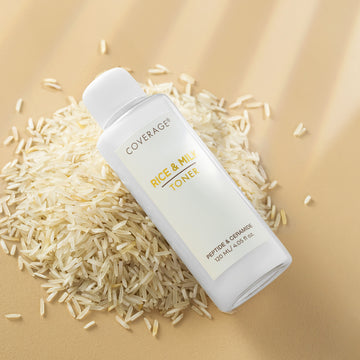
- What is a Korean toner, and why rice and milk?
- Rice & milk toner in Pakistan, benefits, price and how to use it
- Best shampoo for hair fall in Pakistan
- Keel muhase ka ilaj, the complete acne treatment guide
Frequently asked questions
How can I tell if skincare is fake?
How do I check a skincare batch code?
Does a batch code prove skincare is original?
Can fake skincare have the same packaging as the original?
Is very cheap skincare always fake in Pakistan?
Can fake skincare cause acne?
Can counterfeit skincare cause an allergic reaction?
How can I tell if imported skincare is genuine in Pakistan?
Is buying skincare from Instagram safe in Pakistan?
How can I check if a skincare seller is authorised?
What should I do if my skincare smells different?
What should I do if the texture has changed?
Can fairness and whitening creams contain harmful substances?
How do I verify a skincare product with the manufacturer?
What information should I send a brand when asking for authentication?
Is a QR code proof that skincare is genuine?
What is the difference between expired and counterfeit skincare?
What does GMP mean for skincare?
Does DRAP register ordinary skincare in Pakistan?
How do I know COVERAGE products are genuine?
Is Korean-formulated skincare made in Pakistan genuine?
This article is for general informational purposes only and is not a substitute for professional medical advice. All information and claims referenced above are drawn from publicly available dermatological studies and expert sources. Always consult a dermatologist for advice specific to your skin.

Leave a comment
This site is protected by hCaptcha and the hCaptcha Privacy Policy and Terms of Service apply.