
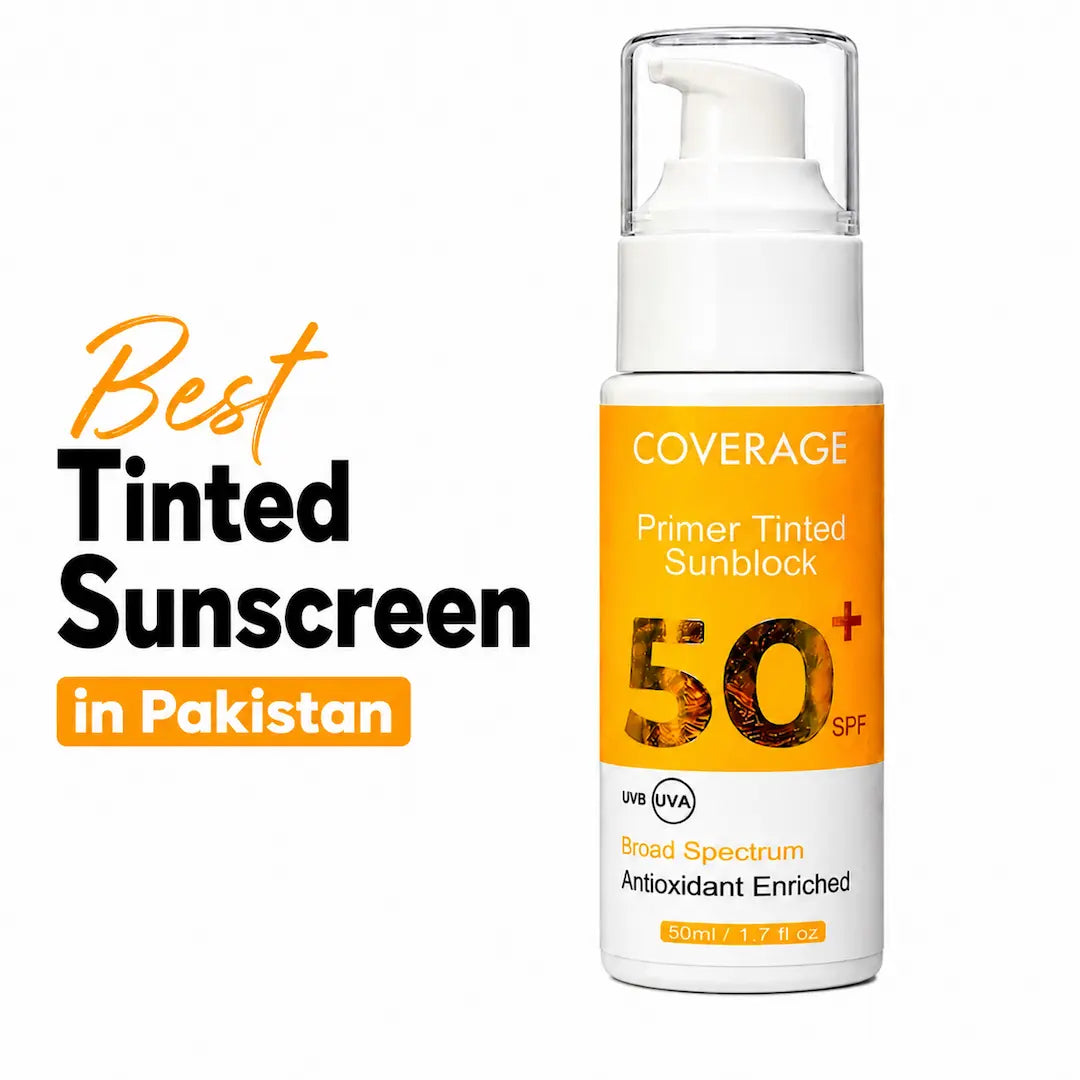
Best Tinted Sunscreen in Pakistan: The 2026 Buyer's Guide
Ask ten people in Pakistan to name the best tinted sunscreen and you will get ten answers, most of them the product that person happens to sell. The honest answer is that "best" is not a single product. It is a set of specifications, and once you know what they are, you can judge any tinted sunscreen on the shelf yourself.
This guide gives you those specifications. By the end you will be able to pick up any tinted SPF in Pakistan, read the label, and know within thirty seconds whether it is worth your money.
Quick answer: the best tinted sunscreen for most people in Pakistan is SPF 50+, broad spectrum, and contains iron oxides listed on the ingredient list as CI 77491, CI 77492 or CI 77499. Iron oxides matter most on brown skin, because they are the main cosmetic ingredient shown to attenuate visible light, and visible light is a well documented contributor to melasma and dark spots on deeper skin tones. Everything after that (finish, texture, shade) is about whether you will actually wear it every day.
How we evaluated tinted sunscreens for this guide
Before the criteria, here is how they were arrived at and what we did and did not do. If a buyer's guide will not tell you this, treat the guide with suspicion.
What we assessed against. Seven criteria, listed in the next section. They are weighted toward things that are objectively checkable on a label or pack (SPF, broad spectrum, iron oxides, size) ahead of things that are subjective (finish, texture), because the checkable ones are where most products quietly fail.
What we used as evidence. Peer reviewed dermatology literature for every scientific claim, listed by journal and year in the text so you can look them up. Published ingredient lists for anything about what is in a product. We did not treat any brand's marketing page, including our own, as scientific evidence.
What we did not do. We did not run laboratory testing. We have not independently SPF tested any product, ours included. Where we describe how a formula behaves, we are describing what the manufacturer publishes, not an independent measurement.
Why there is no ranked list of named products. Two reasons, both honest. First, a genuine ranking would need verified iron oxide content and tested visible light attenuation for every product, and most brands in Pakistan do not publish either. A 2026 review in the Journal of Drugs in Dermatology found this labelling gap across the category internationally, so it is not only a local problem. Ranking products on marketing copy would be guessing with a table around it. Second, we do not think a brand ranking its competitors is worth much to you anyway. So we have published the criteria instead, which you can apply to any product on any shelf, including ours.
Our disclosure. COVERAGE makes and sells one of the products discussed in this article. We have written the criteria first and placed our own product against them at the end, using only what is on our published ingredient list. You should hold it to exactly the same seven checks as anything else. If it fails one, that is worth knowing, and we have said where it is not the right choice.
The seven checks that separate a good tinted sunscreen from a bad one

| What to check | Why it matters | What good looks like |
|---|---|---|
| SPF level | Measures UVB protection, the burning and tanning rays | SPF 50 or higher for Pakistan |
| Broad spectrum / PA rating | Measures UVA, the ageing and pigmenting rays that pass through glass | Broad spectrum stated, or PA+++ and above |
| Iron oxides | The main cosmetic ingredient shown to attenuate visible light | CI 77491, CI 77492 or CI 77499 on the INCI list |
| Shade and undertone | A tint that does not match reads as grey, ashy or orange | Blends within seconds, no oxidation by afternoon |
| Finish and texture | Decides whether you keep wearing it in 40 degree heat | Light, non greasy, comfortable to reapply |
| Skin type compatibility | Wrong filters and heavy bases cause breakouts | Non comedogenic, filters your skin tolerates |
| Size and value | You need roughly 1.25ml per application, daily | Enough product that you are not rationing it |
Nearly every "best tinted sunscreen in Pakistan" article you will find online skips checks three, four and seven entirely. Those are the three that decide whether the product actually works on Pakistani skin.
What a tinted sunscreen actually is
A tinted sunscreen is a broad spectrum sunscreen with cosmetic pigments blended into the base. The pigments are usually iron oxides in red, yellow and black, sometimes combined with pigmentary titanium dioxide. Mixing those three iron oxides in different ratios is how brands create different shades.
The pigments are not UV filters. They do not raise the SPF. What they do is block a completely different part of the solar spectrum, and that is where the whole argument for tinted sunscreen lives.
If you want the full science on SPF, UVA, UVB and how sun damage works on Pakistani skin, we cover it properly in our complete guide to tinted sunscreen for Pakistani skin. This article stays focused on choosing between products.
Why iron oxides are the single most important thing on the label
Sunlight reaching the earth's surface is only about 5 to 7 percent ultraviolet. Roughly 45 percent of it is visible light, the part you can actually see.
For years sunscreen science ignored visible light entirely, because on fair skin it does very little. On brown and deeper skin it does a great deal. Research on Fitzpatrick skin types IV to VI indicates that visible light, particularly the high energy blue and violet end around 400 to 500 nanometres, can induce pigmentation that tends to be more persistent than pigmentation from comparable UVA exposure in darker skin. The effect is well documented in deeper skin tones and minimal in fair skin.
That single fact is why a sunscreen recommendation written for American or European skin can be actively wrong for Pakistan.
Here is what the evidence shows:
- A 2020 study in the Journal of Drugs in Dermatology tested two iron oxide containing formulations against an SPF 50+ mineral sunscreen without iron oxides, using a small back-skin model in Fitzpatrick type IV participants. The iron oxide formulations reduced visible light induced pigmentation in that model; the SPF 50+ without iron oxides did not. It was a small study at specific iron oxide concentrations, so it supports the mechanism rather than proving a result for every tinted product.
- A 2014 randomised trial in Photodermatology, Photoimmunology & Photomedicine followed 68 melasma patients over eight weeks. The group using a sunscreen with UV plus visible light protection saw better results from their hydroquinone treatment than the group using a UV only sunscreen at the same SPF.
- A 2021 in vitro analysis in the Journal of Cosmetic Dermatology found that formulations combining iron oxides with zinc oxide and titanium dioxide blocked roughly 72 to 86 percent of high energy visible light in the 415 to 465 nanometre range.
- A 2025 randomised, investigator blinded study in the Journal of Cosmetic Dermatology followed melasma patients through one summer. Pigmentation worsening was significantly reduced in the group using a visible light protective tinted sunscreen, and was not in the group using an untinted sunscreen of the same SPF. It was published as a research letter and run at a single centre in southern France, so it is directionally useful rather than definitive for Pakistani conditions.
The practical translation: if you have melasma, chhaiyan, post acne marks or any kind of stubborn pigmentation, an untinted SPF 50 is doing half the job. This is not a marketing position. It is the current consensus in dermatology literature, and it is why a 2026 review in the Journal of Drugs in Dermatology concluded that patients with hyperpigmentation should specifically look for a sunscreen containing zinc oxide and iron oxides.

The white cast paradox, and why most Pakistani advice gets it backwards
Here is the part almost nobody explains, and it changes how you should shop.
Mineral sunscreens leave a white cast because zinc oxide and titanium dioxide are white and sit on the skin surface. To fix that, formulators grind those minerals down into micronized or nano particles. Smaller particles scatter less visible light, so the white cast disappears.
But that is the trade-off. As a 2021 review in the Journal of the American Academy of Dermatology explains, for a sunscreen to attenuate visible light it has to be visible on the skin. The finer the mineral particles, the less visible light they scatter, so the same engineering that removes the white cast also reduces visible light protection.
To be precise, this is a reduction rather than a total loss, and how much remains depends on particle size and concentration. The direction is clear even where the exact figure varies by formula: solving the white cast through particle size costs you visible light defence.
Iron oxides are what puts it back. They are visible on the skin, they are tinted rather than white, and they match skin rather than fighting it. That is why a tinted mineral sunscreen is not simply a mineral sunscreen with makeup added. The tint is the functional part.
This is also why the most common piece of Pakistani sunscreen advice, "if you get a white cast, switch to a chemical sunscreen," is incomplete. It will solve your white cast. It will also leave you with zero visible light protection, which is the opposite of what pigmentation prone skin needs.
How to check whether a tinted sunscreen really contains iron oxides
This is the most useful thing in this article, and it takes fifteen seconds.
Flip the pack and read the ingredient list. You are looking for any of these:
- CI 77491 (red iron oxide)
- CI 77492 (yellow iron oxide)
- CI 77499 (black iron oxide)
They may also appear written as "Iron Oxides." Ideally you want more than one, because each covers a different slice of the visible light band, and a combination gives both better protection and a more natural shade.
A word of caution that applies globally, not just in Pakistan. A 2026 product analysis in the Journal of Drugs in Dermatology reviewed 37 commercially available tinted sunscreens marketed at people with hyperpigmentation concerns and found that labelling of visible light attenuating ingredients was inconsistent and often absent. The authors specifically called on the industry to report iron oxide content properly.
So: a product calling itself "tinted" is a marketing word. CI 77491 on the ingredient list is a fact. If a brand will not show you a full ingredient list at all, that tells you something on its own.

Getting the shade right on Pakistani skin
Most tinted sunscreens sold here use a single universal shade. That works better than it sounds, because a sheer tint adapts more than a foundation does, but it has real limits.
Three things to watch:
Undertone, not depth. Pakistani skin runs from fair to deep, and undertones run olive, golden, neutral and warm. A tint mixed for a neutral or pink undertone will read grey on olive skin even when the depth is right. Test on your jawline in daylight, not on the back of your hand under a shop light.
The first thirty seconds are misleading. Almost every tinted mineral sunscreen looks slightly light or grey on application. It settles as it warms to skin temperature. Judge it after a couple of minutes, not immediately.
Oxidation by afternoon. Some tints darken or turn orange over the day as they react with sebum. This is more noticeable on oily skin in humidity, which describes most of Pakistan for most of the year. If a product looks right at 9am and orange by 3pm, that is oxidation, and no amount of blending fixes it.
On deeper skin tones specifically, be realistic. A universal tint that disappears on medium brown skin may still leave a faint cast on deep skin. If you are at the deeper end, look for brands offering more than one shade, and accept that this is currently a genuine gap in the Pakistani market rather than something any single product has solved.
Choosing by skin type
| Skin type | What to prioritise | What to avoid |
|---|---|---|
| Oily | Light fluid or lotion texture, matte or natural finish, non comedogenic | Thick cream bases, heavy occlusive oils |
| Combination | A light base you can layer, natural finish | Anything that makes the T zone shine by midday |
| Dry | Formulas with glycerin, panthenol or hyaluronic acid built in | Strongly mattifying alcohol heavy formulas |
| Sensitive | Mineral filters (zinc oxide, titanium dioxide), fragrance free where possible | Chemical filters if you have reacted to them before, added fragrance |
| Acne prone | Non comedogenic, mineral filters, lighter textures | Heavy foundation style tints, thick bases in humidity |
One honest caveat. "Non comedogenic" is not a regulated term anywhere, including Pakistan. It is a formulator's claim, not a certification. Treat it as a useful signal rather than a guarantee, and patch test for a week on a small area if your skin breaks out easily.
Tinted sunscreen for pigmentation and melasma
This is where tinted SPF earns its reputation, and also where the most exaggeration happens.
What the evidence supports. In the trials run so far, adding visible light protection to daily sun protection has produced better melasma outcomes than UV only sunscreen at the same SPF, and has been associated with fewer relapses through high sun seasons. The studies are small and mostly short, but they point consistently in the same direction, which is why a tinted SPF 50+ with iron oxides is a sensible baseline for anyone with melasma or chhaiyan rather than an optional upgrade.
What the evidence does not support. No sunscreen treats melasma. Sunscreen is the maintenance layer that stops your actual treatment from being undone. Melasma is driven by hormones, genetics and heat as well as light, it relapses, and dermal melasma in particular needs a dermatologist rather than a shopping decision.
If pigmentation is your main concern, the sunscreen is one of three pieces, and we lay out the full routine in our melasma and chhaiyan treatment guide for Pakistani skin.

Tinted sunscreen versus everything it gets confused with
| Product | Protects from UV? | Protects from visible light? | Coverage |
|---|---|---|---|
| Regular sunscreen | Yes | Little to none | None |
| Tinted sunscreen | Yes | Yes, if it contains iron oxides | Sheer to light |
| Tinted moisturiser | Only if it states an SPF | Possibly, if tinted with iron oxides | Sheer |
| BB cream | Usually a low SPF | Possibly | Light to medium |
| Foundation | Rarely, and rarely enough | Possibly, if it contains iron oxides | Medium to full |
The trap here is foundation with SPF 15 or SPF 20 printed on the bottle. Nobody applies foundation at the thickness sunscreen is tested at, so the real world protection is a fraction of the number. Foundation is not sun protection. Tinted sunscreen is sun protection that happens to have coverage.
Can tinted sunscreen replace foundation? For a lot of people in Pakistan, yes, on ordinary days. It evens tone, blurs texture and looks like skin. It will not cover active acne, deep marks or anything you would normally reach for concealer for. Treat it as replacing your everyday base, not your full face.
SPF 30 or SPF 50 in Pakistan?
SPF 50. The price difference within the same brand is usually small, most people apply less than the tested amount anyway, and sun exposure across most of Pakistan stays high enough for most of the year that there is little reason to choose the lower number.
The more useful point is that SPF only describes UVB. A product can be SPF 50 and still be weak on UVA, which is the wavelength that passes through car and office windows and drives both ageing and pigmentation. Look for "broad spectrum" or a PA rating alongside the SPF number, not the SPF number alone.
How much to apply, and reapplying without ruining your face
The standard guidance is roughly a quarter teaspoon, about 1.25ml, for the face. The easiest way to measure it is the two finger rule: squeeze a line along the length of your index and middle fingers, and that is your face and neck.
Most people apply between a quarter and a half of that, which is how an SPF 50 becomes an effective SPF 15 or so on real skin.
For reapplication, the honest position is that reapplying a tinted sunscreen over makeup is awkward. The practical options in Pakistan are a light second layer patted on rather than rubbed, or accepting one solid morning application plus shade and timing if you are indoors most of the day. Reapplication matters most if you are commuting on a bike, driving in afternoon sun, or outdoors for extended periods.
Do not skip the neck and ears. Pigmentation on the neck is one of the most common complaints we see and it is almost always a coverage gap rather than a product failure.
Buying tinted sunscreen in Pakistan: a practical checklist
- Read the INCI for iron oxides. CI 77491, CI 77492, CI 77499.
- Confirm SPF 50+ and broad spectrum or PA+++ minimum.
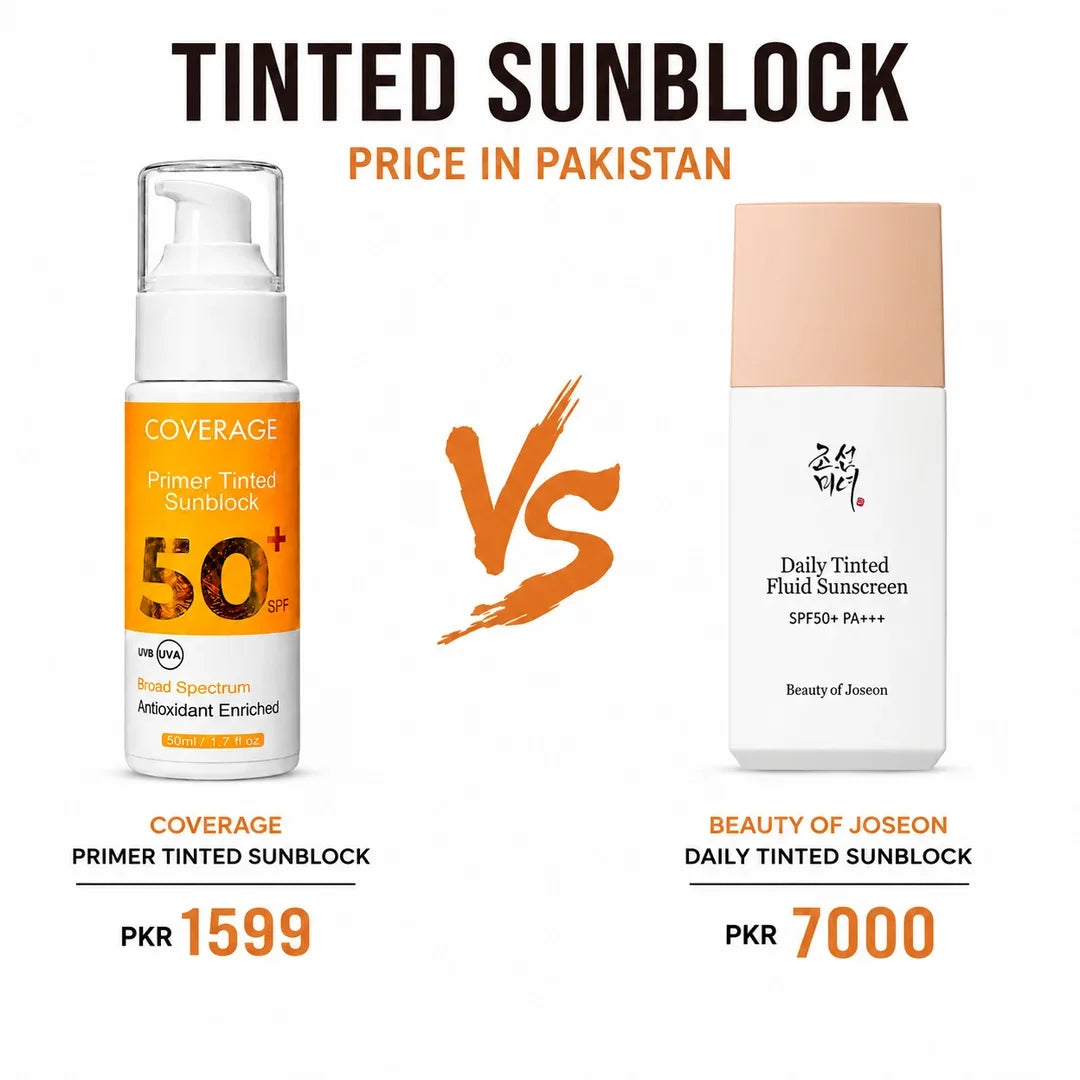
- Check the pack size against the price. A 30g tube and a 50ml bottle are not comparable, so convert both to a price per ml before you decide.
- Buy from the brand or an authorised retailer. Counterfeit imported sunscreen is a real problem here, and an imported SPF at half the going rate is a warning sign.
- Check the shade in daylight before committing to a full size if you can.
- Prefer cash on delivery from sellers who accept returns if the shade is wrong.
COVERAGE Primer Tinted Sunblock SPF 50+

Here is how our own Primer Tinted Sunblock SPF 50+ measures against the seven checks above. We have kept this to what is verifiable on the product page.
| Check | COVERAGE Primer Tinted Sunblock |
|---|---|
| SPF | SPF 50+ |
| Broad spectrum | Yes |
| UV filters | 100 percent mineral: micronized zinc oxide and micronized titanium dioxide, no chemical filters |
| Visible light | Iron Oxides, listed on the published ingredient list as CI 77491, CI 77492 and CI 77499 |
| Finish | Primer finish, wears alone or under foundation |
| Texture support | Glycerin, aloe vera extract and panthenol |
| Skin types | Oily, combination, sensitive, acne prone and normal |
| Comedogenicity | Stated non comedogenic |
| Size | 50ml |
The reason it sits where it does on this list is the combination in rows three and four. A fully mineral filter system with no chemical filters is the gentler option for skin that reacts, and the iron oxide tint is what restores the visible light protection that micronized minerals give up. Those two things together are the specification that matters most on Pakistani skin, and in this market they usually appear at a much higher price point.
Who it suits. Anyone with pigmentation, melasma or post acne marks who wants visible light protection. Sensitive or acne prone skin that has reacted to chemical filters. People who want one step instead of sunscreen plus a base.
Who should look elsewhere. If you want medium to full coverage, this is a sheer to light tint and a foundation will serve you better. If you are at the deeper end of the tone range and have had trouble with universal tints before, check the shade before committing.

Frequently asked questions
Which is the best tinted sunscreen in Pakistan?
There is no single best product for everyone. The best tinted sunscreen for you is SPF 50+, broad spectrum, contains iron oxides (CI 77491, 77492 or 77499), matches your undertone, and feels comfortable enough that you wear it daily. Those four criteria narrow the market dramatically.
Is tinted sunscreen better than regular sunscreen?
For pigmentation prone skin, yes. Regular sunscreen protects against UV but offers little protection against visible light, which is a documented trigger for melasma and post inflammatory hyperpigmentation, particularly on brown skin. Tinted sunscreens with iron oxides cover both.
Does tinted sunscreen help with melasma and chhaiyan?
It helps prevent worsening and relapse. Studies comparing tinted and untinted sunscreens at the same SPF have found better melasma outcomes with the tinted formula. It is not a treatment for melasma on its own.
Does tinted sunscreen leave a white cast?
A well formulated one should not, because the iron oxide tint counteracts the whiteness of the mineral filters. A faint cast for the first minute is normal as it settles. A persistent grey cast usually means the shade does not match your undertone.
Can I wear tinted sunscreen every day?
Yes, and you should. Daily use is where the benefit is, since pigmentation accumulates from repeated light exposure rather than single events.
Can tinted sunscreen replace foundation?
For everyday wear, often yes. It evens tone and blurs texture with sheer to light coverage. It will not replace foundation for full coverage or for covering active breakouts.
Which tinted sunscreen is best for oily and acne prone skin?
Look for a light fluid or lotion texture, a natural or matte finish, mineral filters, and a non comedogenic claim. Avoid thick cream or foundation style bases, which sit heavily in Pakistani humidity.
Is SPF 50 enough for Pakistan?
Yes, provided it is broad spectrum and you apply enough. SPF 50+ is the sensible baseline for Pakistani conditions, but how much you apply matters more than the difference between SPF 50 and SPF 60.
Is mineral tinted sunscreen better than chemical?
Not universally. Mineral filters tend to suit sensitive and acne prone skin better and are less likely to sting. Chemical filters often feel lighter. The more important question is whether iron oxides are present, because that is what determines visible light protection regardless of filter type.
How much tinted sunscreen should I apply?
About a quarter teaspoon, roughly 1.25ml, for the face. The two finger rule is the easiest way to measure it. Most people apply far less than this, which is the single most common reason sunscreen underperforms.
Can men use tinted sunscreen?
Yes. A sheer tint reads as even skin rather than makeup, and pigmentation and tanning affect men in Pakistan just as much.
How do I know a tinted sunscreen is authentic?
Buy from the brand's own website or an authorised retailer, check that a full ingredient list is published, and be suspicious of imported products priced well below the market rate.
The verdict
Stop looking for the single best tinted sunscreen and start looking for the right specification. It makes the decision simple:
- If you have melasma, chhaiyan or dark spots, iron oxides are non negotiable. Check the INCI for CI 77491, 77492 or 77499 before anything else.
- If your skin is sensitive or reacts to sunscreen, prioritise mineral filters with no chemical filters.
- If your skin is oily and you live somewhere humid, prioritise texture and finish, because comfort is what determines whether you reapply.
- If you are at the deeper end of the tone range, prioritise shade testing over every other factor.
- If you are buying your first one, buy SPF 50+ with iron oxides in a size large enough that you never ration it.
The best tinted sunscreen in Pakistan is the one that meets that specification and that you will still be wearing in six months. Ours is built to that spec, and now you can check that claim yourself rather than taking our word for it.
Shop the COVERAGE Primer Tinted Sunblock SPF 50+, 50ml, SPF 50+, fully mineral with an iron oxide tint, cash on delivery across Pakistan.

This article is for general informational purposes only and is not a substitute for professional medical advice. All information and claims referenced above are drawn from publicly available dermatological studies and expert sources. Always consult a dermatologist for advice specific to your skin.

Leave a comment
This site is protected by hCaptcha and the hCaptcha Privacy Policy and Terms of Service apply.