
Vitamin C + Hyaluronic Acid Serum in Pakistan: The Complete Guide
Vitamin C is the most searched active ingredient in Pakistani skincare, and also the most misunderstood. Walk through any market in Lahore or Karachi, or scroll any Instagram shop, and you will find dozens of vitamin C serums promising brightness, glow and an end to daag dhabbe. Most of them share one hidden problem: the form of vitamin C they use falls apart in exactly the heat we live in.
This guide is built to be the most useful page in Pakistan on vitamin C serums. It covers what vitamin C actually does in skin, the five forms you will see on labels, why so many bottles turn orange before you finish them, and how to use a vitamin C and hyaluronic acid serum in a real Pakistani routine alongside sunscreen. Where the science is strong we say so plainly. Where it is thin, we say that too.
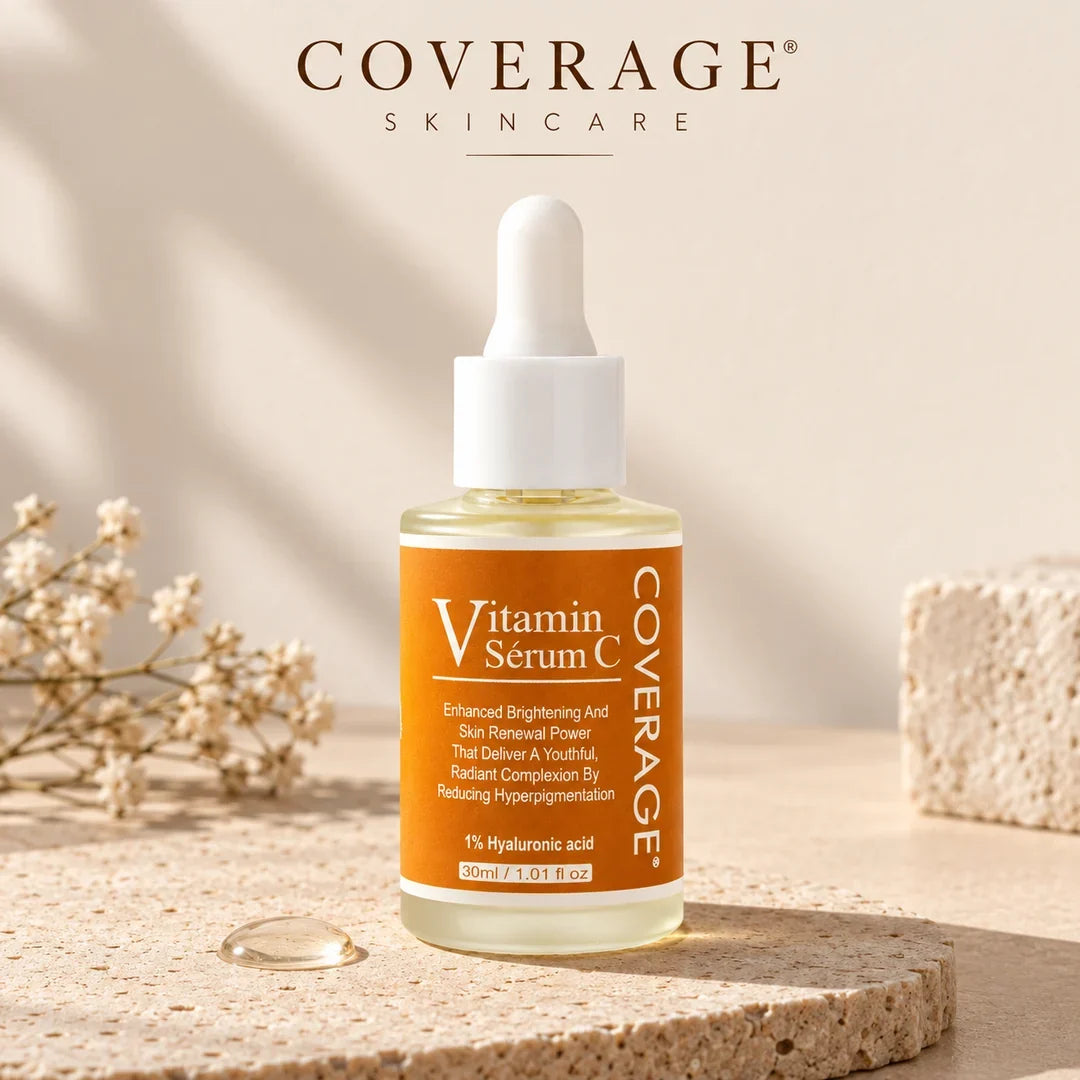
The COVERAGE Vitamin C + 1% HA Skin Serum uses stable Ethyl Ascorbic Acid with niacinamide and 1% hyaluronic acid, in a light, watery texture that does not pill under sunscreen.
See the serum
- What vitamin C actually does in skin
- The forms of vitamin C explained
- Why vitamin C serums turn orange
- The COVERAGE Vitamin C + 1% HA Skin Serum
- Why vitamin C is paired with HA and niacinamide
- What the percentage actually means
- Where vitamin C fits in your routine
- Vitamin C and sunscreen
- Who it suits by skin type
- Storage and knowing when it has gone off
- Realistic timelines
- Pakistan-specific: heat, counterfeits, local vs imported
- Related concerns: pigmentation, melasma, acne
- Myths worth unlearning
- Building a routine around it
- Frequently asked questions
- References
What vitamin C actually does in skin
Vitamin C is a topical antioxidant that works in three main ways: it neutralises free radicals generated by sun and pollution, it interferes with the pigment-making enzyme tyrosinase to help fade uneven tone, and it acts as a cofactor for the enzymes that build collagen. Together these support brighter, more even, better-defended skin over time.

A 2026 systematic review of vitamin C in dermatology published in the Journal of Clinical and Aesthetic Dermatology describes three distinct actions: inhibiting tyrosinase and so reducing melanin synthesis, keeping prolyl and lysyl hydroxylase active so collagen can be built, and neutralising reactive oxygen species through electron transfer. Three separate jobs, which is why one ingredient gets marketed for so many concerns.
Antioxidant and free-radical defence
Vitamin C donates electrons to neutralise reactive oxygen species, the unstable molecules that UV light and pollution create in skin. By absorbing that damage first, it helps protect collagen and DNA. This is the reasoning behind using vitamin C in the morning as antioxidant support underneath sunscreen, not as a replacement for it.
Sunlight and pollution generate reactive oxygen species that damage skin proteins and lipids. Vitamin C is a potent water-soluble antioxidant that quenches these molecules. This is different from what a sunscreen does. Sunscreen filters UV photons before they enter the skin, while vitamin C mops up the free radicals that form anyway. The two are complementary, which is the entire logic of a morning antioxidant step.
The pigment pathway
Vitamin C helps with dark spots by inhibiting tyrosinase, the enzyme that controls melanin production. Less tyrosinase activity means less new pigment. This is a gradual, supportive effect on the look of daag dhabbe and uneven tone, not a bleaching action, and it works best combined with daily sunscreen.
Melanin, the pigment behind dark spots and uneven tone, is produced by an enzyme called tyrosinase. Vitamin C interferes with tyrosinase activity, which is why it appears in so many brightening products. It is important to be honest here: topical vitamin C nudges the pigment pathway, it does not switch it off. Results are gradual and depend heavily on sun protection, because UV exposure constantly re-triggers pigment production.
Collagen support
Vitamin C is an essential cofactor for prolyl and lysyl hydroxylase, the enzymes that stabilise and cross-link collagen. Without adequate vitamin C these enzymes cannot function properly. Topically, this supports the skin structural repair over months, though the strongest collagen data comes from studies using pure L-ascorbic acid, not derivatives.
Your skin cannot build stable collagen without vitamin C, which is why severe deficiency causes the skin fragility seen in scurvy. Applied topically, vitamin C supports the collagen-building enzymes in the dermis. One honest caveat that most brand pages skip: the collagen-synthesis studies were done using free L-ascorbic acid at the cellular level. Extending those findings to derivatives assumes efficient in-skin conversion, which is a reasonable expectation but not something proven to be identical.
The forms of vitamin C explained
There are five forms of vitamin C you will commonly see on serum labels in Pakistan: L-ascorbic acid, Ethyl Ascorbic Acid, Sodium Ascorbyl Phosphate, Magnesium Ascorbyl Phosphate and Tetrahexyldecyl Ascorbate. They differ in stability, the pH they need, how gentle they are, and how much human evidence backs them. The form on the label tells you more than the percentage does.

This is the single most useful thing to understand about vitamin C, and the part most product pages skip. Vitamin C is not one ingredient. It is a family, and the members behave very differently in a bottle sitting in a hot bathroom in Multan.
| Form | Stability in heat and light | Solubility and pH | Gentleness | Human evidence |
|---|---|---|---|---|
| L-ascorbic acid (pure vitamin C) | Low, oxidises quickly | Water-soluble, needs pH below 3.5 | Can sting, especially sensitive skin | Strongest, most clinically validated |
| Ethyl Ascorbic Acid (3-O-ethyl ascorbic acid) | High, far more thermostable | Water-soluble, works near skin pH | Generally gentle | Strong lab and mechanism data, limited human trials |
| Sodium Ascorbyl Phosphate (SAP) | Good | Water-soluble, works around pH 6 to 7 | Very gentle | Some acne and pigmentation data |
| Magnesium Ascorbyl Phosphate (MAP) | Good | Water-soluble, near-neutral pH | Very gentle | Pigmentation data at low concentrations |
| Tetrahexyldecyl Ascorbate (THD) | Good, but degrades above about 45C | Oil-soluble, works pH 4 to 6 | Gentle | Photodamage and pigment data, needs correct formulation |
L-ascorbic acid
L-ascorbic acid is pure vitamin C and the most researched form, with the strongest evidence for brightening, antioxidant and collagen benefits. Its weaknesses are practical: it needs a low pH below 3.5 to absorb, it can sting sensitive skin, and it oxidises quickly in heat, light and air, turning serums orange then brown.
Foundational work by Pinnell and colleagues published in Dermatologic Surgery in 2001 established that L-ascorbic acid penetrates best at a concentration of 10 to 20 percent and a pH below 3.5. Below that pH the molecule is uncharged and lipid-soluble enough to cross the skin barrier. Above it, a 20 percent vitamin C serum can be functionally inactive for penetration. This is the gold-standard form for evidence, but it is also the diva of the family: reactive, acidic and short-lived once opened.
Ethyl Ascorbic Acid, the stable derivative
Ethyl Ascorbic Acid, or 3-O-ethyl ascorbic acid, is a stabilised vitamin C derivative built to resist heat and light. Lab studies show it is significantly more thermostable than pure L-ascorbic acid and can be formulated closer to skin pH, so it is gentler. Its main trade-off is that human topical trials are limited compared to L-ascorbic acid.
This is the form COVERAGE chose, and the reasoning is climate. A 2017 study in Biological and Pharmaceutical Bulletin by Golonka and colleagues compared ethyl ascorbic acid with pure ascorbic acid and found the ethylated derivative was more thermally stable, holding up across a range of temperatures where plain ascorbic acid degraded. Mechanistically, a 2021 study in Free Radical Biology and Medicine by Chen, Hseu, Yang and colleagues showed ethyl ascorbic acid suppresses tyrosinase, TRP-1, TRP-2 and MITF, the machinery of pigment production, in laboratory cells and in a zebrafish model. A 2021 study in the journal Life by Zerbinati and colleagues found a 30 percent ethyl ascorbic acid serum produced a highly significant decrease in melanin content in reconstructed human skin tissue.
Here is the honest limitation, because it earns trust: as of now there is no completed, published randomised controlled trial of topical ethyl ascorbic acid alone on human melasma with MASI outcomes. The evidence is strong on stability and on mechanism in cells, and thinner on head-to-head human trials. What this means practically: you choose ethyl ascorbic acid for reliability in heat and for gentleness, not because it is proven superior to L-ascorbic acid for results.
Sodium Ascorbyl Phosphate
Sodium Ascorbyl Phosphate is a stable, water-soluble vitamin C derivative that works at a near-neutral pH, so it rarely irritates. Skin enzymes convert it to active vitamin C. It has some published evidence for acne, likely from a skin-soothing effect, making it a useful gentle option for oily and blemish-prone skin.
A randomised, double-blind, controlled trial by Woolery-Lloyd, Baumann and Ikeno in the Journal of Cosmetic Dermatology in 2010 tested a 5 percent sodium ascorbyl phosphate lotion for acne vulgaris and found benefit. It is one of the gentlest members of the family, though generally considered less potent than pure ascorbic acid.
Magnesium Ascorbyl Phosphate
Magnesium Ascorbyl Phosphate is another stable, gentle, water-soluble derivative that performs at a near-neutral pH. It is best known for pigmentation support at relatively low concentrations and is well tolerated by sensitive skin, though like other derivatives it relies on enzymatic conversion in skin to become active vitamin C.
Small clinical studies have explored magnesium ascorbyl phosphate for melasma, including work delivering it through vesicular carriers such as ethosomes and niosomes, which showed a clinically and statistically significant fall in melanin. It is a sensible choice for people who find pure vitamin C too harsh.
Tetrahexyldecyl Ascorbate (THD)
Tetrahexyldecyl Ascorbate is an oil-soluble vitamin C ester that penetrates the skin lipid layers well and works at skin-friendly pH. It is stable in the right formulation but still degrades above roughly 45C, and it is one of the most expensive forms, which is why it appears mostly in premium serums.
THD is favoured for sensitive skin and often paired with stabilisers such as acetyl zingerone. Reviews note it targets pigmentation and photodamage, but it requires an oil or silicone base to work and is not immune to heat, degrading above about 45 degrees Celsius, a temperature reached inside many Pakistani homes in summer.
Why vitamin C serums turn orange, and why Pakistan makes it worse
A vitamin C serum turns orange or brown because L-ascorbic acid oxidises, converting first to dehydroascorbic acid and then irreversibly to diketogulonic acid, a yellow-brown compound with no antioxidant benefit. The colour change is a visible sign the active has degraded. Heat, light and air all speed this up, which is a serious problem in Pakistan climate.

The chemistry of the colour change
Oxidation of L-ascorbic acid happens in two steps: ascorbic acid loses electrons to become dehydroascorbic acid, which the skin can still partly use, then it breaks down further into diketogulonic acid, which is biologically inactive. A clear or pale serum is fresh, yellow means early oxidation, and deep orange to brown means the active is largely spent.
The colour is a rough at-home gauge of potency. Trace metals like iron and copper, a pH above 3.5, dissolved oxygen, light and heat all accelerate the reaction. In a poorly formulated or badly stored bottle, meaningful oxidation can happen within weeks of opening. This is exactly why stable derivatives exist: Ethyl Ascorbic Acid does not follow this orange-to-brown path the way pure L-ascorbic acid does, so it keeps working closer to the last drop.
Why Pakistan heat matters so much
Pakistan is one of the harshest possible environments for pure vitamin C. Summer temperatures routinely cross 40C, most homes have no year-round climate control, and long power outages mean bathroom shelves can sit hot for hours. Heat is one of the biggest accelerators of vitamin C oxidation, so a heat-stable form is not a luxury here, it is practical.
This is the strongest Pakistan-specific reason to think about the form of vitamin C. During the June 2024 heatwave, Karachi reached 47.2C on 25 June, and the PDMA reported 568 deaths in Sindh between 20 and 26 June, 141 of them on 25 June alone. Twelve-hour power cuts, routine in summer, turned homes into heat traps. The 2025 heat season arrived early again: in mid-April 2025 the Pakistan Meteorological Department forecast Balochistan reaching up to 49C, while central and southern Pakistan hit 47.7C, nearing the April record of 50C set at Nawabshah in 2018. A serum formulated in a cool climate and shipped to a bedroom in Jacobabad in June is living a completely different life. A pure L-ascorbic acid serum can be past its best before you have used half of it. A stable derivative like Ethyl Ascorbic Acid is simply a better fit for garmi.
The COVERAGE Vitamin C + 1% HA Skin Serum
The COVERAGE Vitamin C + 1% HA Skin Serum is a 30ml morning serum built around stable Ethyl Ascorbic Acid, with niacinamide second in the formula and 1 percent hyaluronic acid. It is light, watery and fast-absorbing, non-comedogenic and suitable for all skin types including oily and acne-prone, and it does not pill under sunscreen.

Everything above is the reasoning. Here is how it maps onto the product. COVERAGE chose Ethyl Ascorbic Acid specifically because most vitamin C serums use L-ascorbic acid, which oxidises in heat and light, and that is why so many bottles turn orange then brown and stop working weeks before you finish them. This is a formulation decision made for Pakistan climate, not a copy of a Western formula. You can see the full serum here.
| Specification | Detail |
|---|---|
| Product | Vitamin C + 1% HA Skin Serum |
| Size | 30ml |
| Vitamin C form | Ethyl Ascorbic Acid, a stable derivative, first in the ingredient list |
| Second active | Niacinamide |
| Hydration | Hyaluronic Acid at 1% |
| Texture | Light, watery, fast-absorbing, no sticky film |
| Comedogenicity | Non-comedogenic |
| Skin types | All skin types, including oily and acne-prone |
| Best time to use | Morning, for antioxidant support alongside SPF |
Ingredient by ingredient
The formula leads with Ethyl Ascorbic Acid for stable brightening, backs it with niacinamide for tone, oil control and barrier support, and adds 1 percent hyaluronic acid for hydration. Supporting humectants keep the texture light and comfortable rather than sticky, so it layers cleanly under sunscreen.
- Ethyl Ascorbic Acid: the stable vitamin C, first on the list, doing the brightening and antioxidant work without the orange-to-brown oxidation of pure L-ascorbic acid.
- Niacinamide: second in the formula. Well studied for improving the look of hyperpigmented spots, texture, red blotchiness and sallowness, and for supporting the barrier and helping regulate oil, useful for keel muhase-prone and oily skin.
- Hyaluronic Acid at 1%: a humectant that binds water to keep skin plump and comfortable, offsetting any dryness and countering khushki.
- Light, watery base: fast-absorbing with no sticky film, so it does not pill under sunscreen or makeup.
- Non-comedogenic: formulated so it will not clog pores, which is why it suits oily and acne-prone skin in humid weather.
Who this serum is for
This serum suits anyone wanting a simple, heat-appropriate morning brightening step, and it is designed for all skin types. The light, non-comedogenic, watery texture and the niacinamide make it especially comfortable for oily and acne-prone skin in a humid climate, while the hyaluronic acid keeps it comfortable for those who find plain vitamin C drying.
If your skin is new to vitamin C, patch test first. COVERAGE products are made through the brand own family manufacturing operation rather than outsourced white-label production. Shop the Vitamin C + 1% HA Skin Serum.
Why vitamin C is paired with hyaluronic acid and niacinamide
Vitamin C, hyaluronic acid and niacinamide are paired because they cover different jobs without conflict: vitamin C brightens and defends, hyaluronic acid hydrates and offsets any dryness, and niacinamide supports tone, oil control and the skin barrier. The old warning that niacinamide and vitamin C cannot be mixed is outdated and based on 1960s lab conditions that do not reflect modern formulas.

The hyaluronic acid pairing
Hyaluronic acid is a humectant that can hold many times its weight in water, drawing moisture into the upper skin layers. Pairing it with vitamin C offsets the mild dryness or tightness some people feel from vitamin C, keeping skin plump and comfortable. Low molecular weight hyaluronic acid penetrates the stratum corneum, while high molecular weight sits on the surface as a hydrating film.
A double-blind, randomised controlled trial in elderly dry skin published in 2024 found low molecular weight hyaluronic acid produced significantly higher skin hydration than high molecular weight or a plain vehicle after four weeks. In practice, hyaluronic acid is the comfort layer that makes a daily vitamin C step sustainable, particularly if you battle khushki.
Niacinamide plus vitamin C, and the debunked myth
You can use niacinamide and vitamin C together safely. The myth that they cancel out or form irritating nicotinic acid traces to 1960s laboratory studies that combined pure, unstabilised forms under high heat, conditions that do not reflect how modern serums are made or stored. Today they are considered one of the most complementary morning combinations available.
Dermatology-aligned sources trace the fear to studies from the early 1960s that used non-stabilised ingredients under extreme conditions. Niacinamide itself is well backed: a split-face trial by Bissett and colleagues in the International Journal of Cosmetic Science in 2004 found 5 percent niacinamide improved the look of hyperpigmented spots, fine lines, texture, red blotchiness and sallowness over 12 weeks, and Hakozaki and colleagues in the British Journal of Dermatology in 2002 showed niacinamide reduces pigment by suppressing the transfer of melanosomes to skin cells. Putting both in one bottle, with vitamin C first and niacinamide second, is a rational, evidence-aligned choice.
What the percentage actually means, and why higher is not better
Percentage tells you how much vitamin C is in the bottle, not how well it works. For L-ascorbic acid, the studied effective range is about 10 to 20 percent, and absorption plateaus around 20 percent while irritation keeps rising. For derivatives, stability, pH and formulation matter more than the number. A high percentage in an oxidised or wrong-pH formula does nothing.
The dermatology literature, including the review by Telang in the Indian Dermatology Online Journal in 2013, places the effective L-ascorbic acid range at roughly 10 to 20 percent, with lower being ineffective and higher raising irritation without adding penetration. The lesson for shoppers in Pakistan is to stop chasing the biggest number on the label. A stable derivative at a sensible concentration, formulated near skin pH and still active in the bottle, beats a huge-percentage pure vitamin C that oxidised in transit. This is why the form and stability story matters more than a percentage race.
Where vitamin C fits in your routine, step by step
Apply vitamin C in the morning on clean skin, before heavier creams and sunscreen. The order is: cleanse, tone if you use one, apply a few drops of vitamin C serum, wait one to two minutes, add moisturiser if needed, then finish with SPF. On clean skin the serum absorbs quickly, and a light formula will not pill under sunscreen.

| Step | Morning (AM) | Night (PM) |
|---|---|---|
| 1 | Gentle cleanser | Cleanser |
| 2 | Toner (optional) | Toner (optional) |
| 3 | Vitamin C + HA serum | Treatment such as azelaic acid |
| 4 | Moisturiser (if needed) | Moisturiser |
| 5 | Broad-spectrum SPF (essential) | No SPF needed at night |
Morning or night?
Vitamin C is best used in the morning, because its antioxidant action complements daytime sun protection by mopping up UV-generated free radicals. It is stable and safe at night too, but you get more value from it in the day. If you use a retinoid or a strong exfoliant at night, keeping vitamin C in the morning also keeps your routine simple and calm.
Most routines built around vitamin C lean morning. That said, vitamin C is not damaged by being used at night, so if mornings are rushed, a PM application is still worthwhile. Consistency matters more than the exact clock time.
Layering order and what not to mix
Apply vitamin C on clean skin before thicker products, and give it a minute to absorb. It layers well with hyaluronic acid, niacinamide and sunscreen. Avoid using pure L-ascorbic acid in the same layer as strong exfoliating acids or a benzoyl peroxide product, which can cause irritation or reduce effectiveness, use those at a different time of day instead.
A stable derivative like Ethyl Ascorbic Acid is more forgiving about layering than low-pH L-ascorbic acid. Still, the sensible rule is one strong active per step, and let each absorb before the next.
Vitamin C and sunscreen: the antioxidant-under-SPF logic
Vitamin C and sunscreen do two different jobs and belong together every morning. Sunscreen filters UV before it enters skin, while vitamin C neutralises the free radicals that form anyway. Applied under SPF, vitamin C supplements protection, it does not replace it. No serum, however antioxidant-rich, provides the tested UV protection of a broad-spectrum sunscreen.

The landmark study here is Lin and colleagues in the Journal of Investigative Dermatology in 2005, which showed that adding ferulic acid to a solution of 15 percent L-ascorbic acid and 1 percent vitamin E doubled its photoprotection against solar-simulated light, from roughly four-fold to about eight-fold, measured by redness and sunburn-cell formation. An earlier study by the same group in the Journal of the American Academy of Dermatology in 2003 established that topical vitamins C and E give meaningful UV photoprotection that works by a different mechanism to sunscreen and supplements it. The American Academy of Dermatology recommends applying vitamin C before sunscreen in a morning routine, with a broad-spectrum SPF 30 or higher as the final layer.
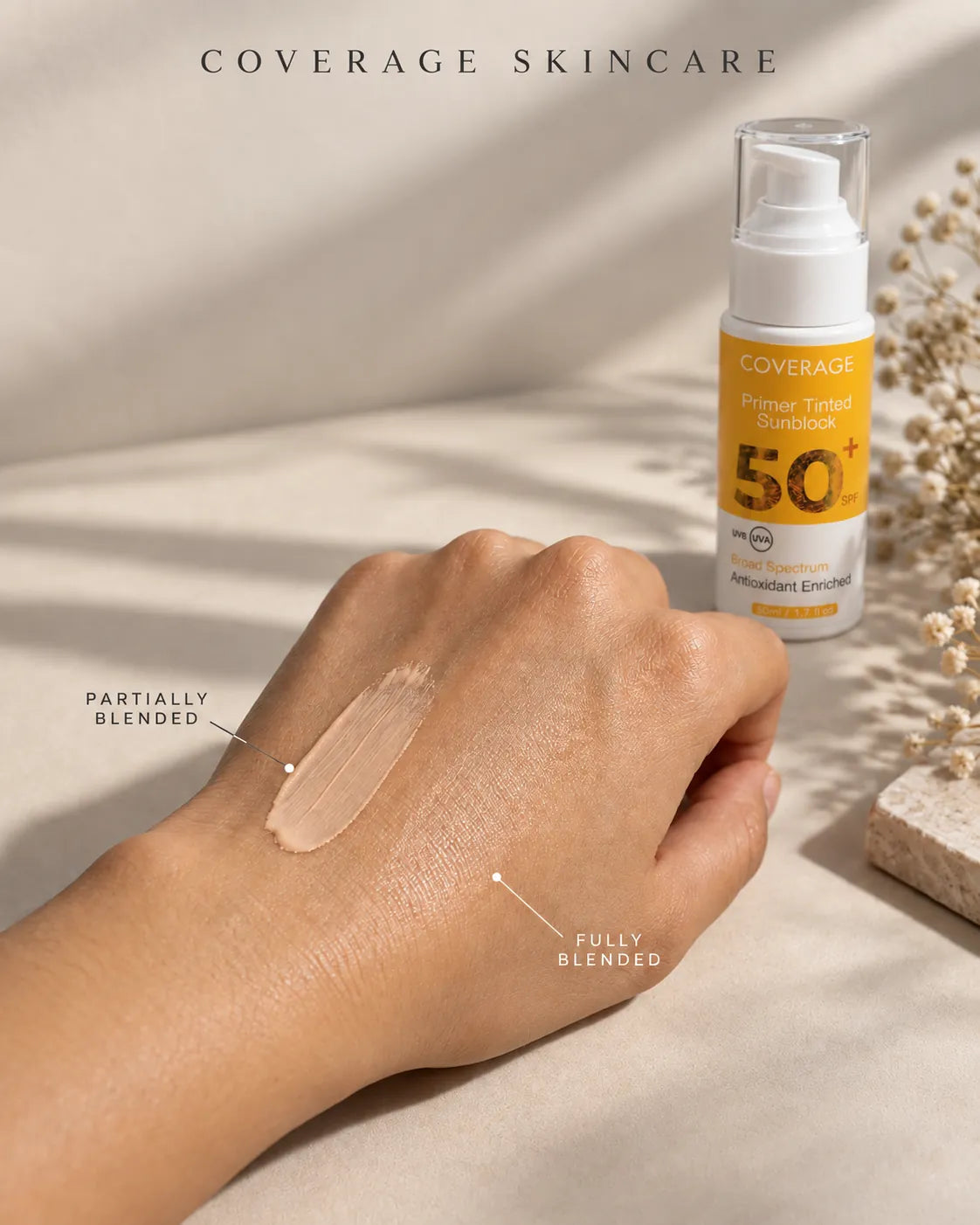
In Pakistan this pairing is even more important, because our UV load is high year-round. The COVERAGE serum is positioned for exactly this morning antioxidant step, working alongside a sunscreen such as the Primer Tinted Sunblock SPF 50+. For more on why a high SPF genuinely matters here, see is SPF 50 enough in Pakistan.
Who it suits by skin type
A well-formulated vitamin C and hyaluronic acid serum suits all skin types. Oily and acne-prone skin does best with a light, non-comedogenic, water-based texture and benefits from niacinamide oil control. Dry skin benefits from the hyaluronic acid. Sensitive skin usually tolerates a stable derivative near skin pH far better than low-pH pure L-ascorbic acid.

Oily and acne-prone skin: choose a watery, non-comedogenic formula. Sodium ascorbyl phosphate and niacinamide both have evidence relevant to blemish-prone skin, and a light Ethyl Ascorbic Acid serum will not sit heavy. Dry skin, or khushki: the hyaluronic acid is your friend, and you can layer a richer moisturiser on top. Sensitive skin: gentle derivatives at near-neutral pH are far less likely to sting than pure L-ascorbic acid at pH 3. Always patch test a new active.
How to store it, and how to tell when it has gone off
Store vitamin C serum somewhere cool, dark and dry, with the cap closed tightly, away from sunny windowsills and hot bathrooms. A fridge is optional but helpful in summer. You will know a pure vitamin C serum has degraded when it turns deep yellow, orange or brown, smells off, or changes texture. A stable derivative resists this, but good storage still helps.
| Colour or sign | What it means | Action |
|---|---|---|
| Clear or very pale | Fresh, full potency | Use normally |
| Light yellow | Early oxidation beginning | Use up sooner |
| Deep orange or amber | Significant degradation | Largely spent, replace |
| Brown | Active mostly gone | Replace |
| Sour or off smell, or separation | Formula has changed | Stop using |
The whole point of choosing a stable form is that these warning signs arrive much later, or not in the same dramatic way. But even a stable serum should be kept out of a hot car glovebox or a windowsill in June.
Realistic timelines, and what vitamin C will and will not do
Be patient and realistic. Most vitamin C studies run 8 to 12 weeks, and visible changes in brightness and even tone typically take at least that long with daily use plus sunscreen. Vitamin C supports a brighter, more even, better-defended complexion. It does not bleach skin, does not change your natural skin colour, and does not replace medical treatment for stubborn pigment.
Set expectations by the evidence. Niacinamide studies measured improvements over 12 weeks. Visible cosmetic change is a months-long project. If a serum promises rang gora or overnight fairness, that is a marketing claim, not a scientific one, and no ingredient in this category can deliver it. What you can reasonably expect is gradual improvement in the look of daag dhabbe, dullness and overall chehre ki rangat, provided you also protect from the sun.
Pakistan-specific: heat, counterfeits, local vs imported
Three things matter specifically in Pakistan: the heat degrades pure vitamin C fast, so choose a stable form; counterfeits and grey-market stock are common online, so buy from a source you trust; and imported serums often arrive after long, hot transit and storage, which can leave them partly oxidised before you even open them.

Counterfeit and substandard cosmetics are a real problem here. Pakistani dermatologists and consumer authorities have repeatedly warned about fake and low-quality products sold in markets and online, and under the Punjab Drug (Amendment) Bill 2020 penalties of up to one million rupees apply to making or selling counterfeit cosmetics. Imported serums face an extra hazard specific to this ingredient: a vitamin C bottle that spent weeks in a hot warehouse or courier van can be oxidised on arrival, which is invisible until you notice the colour. A locally made, stable formula bought directly from the brand sidesteps both the counterfeit risk and the hot-transit risk. It is one more practical argument for a heat-appropriate, direct-from-brand option.
Related concerns: pigmentation, melasma and acne
Vitamin C is one tool among several for pigment concerns, and different problems have different best answers. For choosing between actives, comparing dark-spot serums, tackling melasma or treating acne, we have dedicated guides that go deeper than this page can, so this section points you to them rather than repeating them.
If you are weighing vitamin C against azelaic acid, our full comparison covers exactly when each one wins, read azelaic acid vs vitamin C in Pakistan. For a considered roundup of which serum to pick for dark spots and pigmentation, see our best serum for dark spots and pigmentation guide. Melasma, or chaiyan, is a distinct and stubborn condition that deserves its own approach, and our melasma and chaiyan ka ilaj guide covers it in depth. And for keel muhase, see our dedicated acne treatment guide.
Myths worth unlearning
Several vitamin C myths circulate widely in Pakistan: that you cannot mix it with niacinamide, that a higher percentage is always better, that vitamin C makes you fair, that it replaces sunscreen, and that all vitamin C is the same. None of these hold up. Understanding why makes you a much smarter shopper and protects your money.
- Myth: niacinamide and vitamin C cancel out. Outdated, from 1960s conditions that do not apply to modern serums. They work well together.
- Myth: higher percentage is always better. Absorption of L-ascorbic acid plateaus near 20 percent while irritation keeps climbing, and for derivatives, form and stability matter more than the number.
- Myth: vitamin C makes skin fair. It does not change your natural colour. It supports a brighter, more even look. Rang gora promises are marketing, not science.
- Myth: vitamin C replaces sunscreen. It supplements protection by a different mechanism. You still need SPF.
- Myth: all vitamin C is the same. The five forms behave very differently, especially in heat, which is the whole point of this guide.
Building a routine around it
A simple, effective morning routine is cleanse, vitamin C and HA serum, moisturiser if needed, then sunscreen. You can add a toner and a night treatment as your skin allows. To make this easy, COVERAGE offers ready-matched bundles that pair the vitamin C serum with sunblock and supporting steps, so the order is done for you.

Start with the Vitamin C + 1% HA Skin Serum as your morning brightening step. Pair it with the Primer Tinted Sunblock SPF 50+ to complete the antioxidant-under-SPF logic. For a done-for-you pairing, the Bright Shield Duo combines vitamin C and sunblock, while the Complete Day Protection three-step and the All-in-One Skincare Routine build the full sequence. To layer in barrier support, the Rice & Milk Toner with ceramide and peptide is a gentle first step, and if pigmentation is your main concern you can alternate in the Azelaic Acid 10% Serum at night. Explore the full brightening collection for more. New to Korean-style layering? Start with what is a Korean toner.
Frequently asked questions
What is the best vitamin C serum in Pakistan?
The best vitamin C serum in Pakistan is one that uses a heat-stable form of vitamin C, because our climate degrades pure L-ascorbic acid quickly. A serum built on Ethyl Ascorbic Acid, like the COVERAGE Vitamin C + 1% HA Skin Serum, is well suited to local conditions, gentle, and paired with niacinamide and hyaluronic acid.
How much does a vitamin C serum cost in Pakistan?
Vitamin C serum prices in Pakistan vary widely by brand, form and size. Rather than quote a figure that goes out of date, check the current price on the product page directly. Focus less on price alone and more on the form of vitamin C, its stability in heat, and whether you are buying from a trusted source.
Vitamin C serum kaise use karein?
Subah cleanser ke baad, chehre par vitamin C serum ke chand qatre lagayein, ek do minute absorb hone dein, phir zaroorat ho to moisturiser aur uske baad hamesha sunblock lagayein. Raat ko bhi use kar sakte hain, lekin subah zyada faidemand hai kyunke yeh dhoop ke against antioxidant support deta hai.
Can I use vitamin C with niacinamide?
Yes. The belief that they cannot be combined comes from 1960s laboratory conditions that do not reflect modern skincare. Used together they are complementary: vitamin C brightens and defends while niacinamide supports tone, oil control and the barrier. The COVERAGE serum contains both, with niacinamide sitting second in the formula.
Why did my vitamin C serum turn orange?
Because the L-ascorbic acid in it oxidised. On exposure to air, light and heat it converts to dehydroascorbic acid and then to diketogulonic acid, a yellow-brown compound with no antioxidant benefit. The colour signals lost potency. Stable derivatives like Ethyl Ascorbic Acid resist this, which is why they suit a hot climate.
Is vitamin C serum good for oily skin?
Yes, especially in a light, watery, non-comedogenic formula. Oily and acne-prone skin benefits from niacinamide oil-regulating and barrier-supporting effects, which is why a combined vitamin C and niacinamide serum works well. Avoid heavy, oily textures and choose a fast-absorbing water-based serum instead.
Vitamin C serum morning or night?
Morning is best, because vitamin C antioxidant action complements daytime sun protection by neutralising UV-generated free radicals. It is perfectly stable and safe at night too, so if mornings are rushed you can use it in the evening. Consistency matters more than the exact time of day.
Ethyl Ascorbic Acid vs L-ascorbic acid, which is better?
They serve different priorities. L-ascorbic acid has the strongest human evidence but oxidises fast and needs an irritating low pH. Ethyl Ascorbic Acid is far more heat-stable and gentler, though its human trial data is more limited. In Pakistan heat, the reliability of Ethyl Ascorbic Acid is a strong practical advantage.
Does vitamin C work in hot weather?
Vitamin C itself works, but pure L-ascorbic acid degrades quickly in heat, so a hot-climate serum needs a stable form. Heat is a major accelerator of oxidation, which is why a bottle can turn orange in a warm Pakistani bathroom. A stable derivative like Ethyl Ascorbic Acid is designed to hold up in these conditions.
Can vitamin C serum remove dark spots and daag dhabbe?
Vitamin C can help fade the look of dark spots and daag dhabbe over time by interfering with the pigment enzyme tyrosinase, but it works gradually and does not erase pigment instantly. Results depend heavily on daily sunscreen. For stubborn spots, see our dedicated pigmentation and dark spot guides.
Will vitamin C make my skin fair or gora?
No. Vitamin C does not change your natural skin colour and cannot make you fair. It supports a brighter, more even, healthier-looking complexion by fading uneven tone and dullness. Any product promising rang gora or fairness is making a marketing claim that no vitamin C ingredient can honestly deliver.
Can I use vitamin C serum every day?
Yes, daily use is how vitamin C delivers its benefits, and most studies are based on once or twice daily application. If your skin is new to it or sensitive, start every other day and build up. A gentle, stable derivative near skin pH is usually well tolerated with daily use.
Do I still need sunscreen if I use vitamin C?
Absolutely yes. Vitamin C supplements sun protection by neutralising free radicals, but it does not filter UV and cannot replace sunscreen. Dermatologists recommend applying vitamin C first, then a broad-spectrum SPF 30 or higher as the final morning layer. In Pakistan high UV, SPF is non-negotiable.
Can vitamin C serum cause acne or breakouts?
A well-formulated, non-comedogenic, water-based vitamin C serum should not cause acne, and some vitamin C derivatives have evidence relevant to blemish-prone skin. Heavy, oily formulas are more likely to clog pores. If you are acne-prone, choose a light texture, and patch test any new product first.
What is 1% hyaluronic acid doing in a vitamin C serum?
The hyaluronic acid is a hydration and comfort layer. It binds water into the upper skin, offsetting any dryness or tightness that vitamin C can cause and keeping skin plump. This makes daily use more comfortable, particularly for dry skin or in air-conditioned indoor air that causes khushki.
How long does vitamin C serum take to work?
Give it at least 8 to 12 weeks of consistent daily use, which is the timeframe most clinical studies use. Brightness and even tone improve gradually, not overnight. Pairing it with daily sunscreen is essential, because unprotected sun exposure constantly undoes the pigment benefits you are working toward.
How should I store my vitamin C serum in summer?
Keep it in a cool, dark, dry place with the cap tightly closed, away from sunny windowsills and hot bathrooms. In peak summer, the fridge is a helpful option. A stable derivative resists heat far better than pure L-ascorbic acid, but good storage still protects any formula and extends its useful life.
Is a locally made vitamin C serum as good as an imported one?
A well-formulated local serum can be a better practical choice, because imported vitamin C often arrives after long, hot transit that can partly oxidise it before you open it, and the counterfeit and grey-market risk online is significant. Buying a stable formula directly from a trusted local brand sidesteps both problems.
References
- Clinical Applications of Vitamin C in Dermatology: A Systematic Review. Journal of Clinical and Aesthetic Dermatology, 2026.
- Golonka I, et al. Selected Physicochemical and Biological Properties of Ethyl Ascorbic Acid Compared to Ascorbic Acid. Biological and Pharmaceutical Bulletin, 2017;40(8):1199-1206.
- Chen SJ, Hseu YC, Yang HL, et al. The anti-melanogenic effects of 3-O-ethyl ascorbic acid. Free Radical Biology and Medicine, 2021;173:151-169.
- Zerbinati N, et al. The Anti-Ageing and Whitening Potential of a Cosmetic Serum Containing 3-O-ethyl-L-ascorbic Acid. Life, 2021;11(5):406.
- Pinnell SR, Yang H, Omar M, et al. Topical L-ascorbic acid: percutaneous absorption studies. Dermatologic Surgery, 2001;27(2):137-142.
- Telang PS. Vitamin C in dermatology. Indian Dermatology Online Journal, 2013;4(2):143-146.
- Lin FH, Lin JY, Gupta RD, et al. Ferulic acid stabilizes a solution of vitamins C and E and doubles its photoprotection of skin. Journal of Investigative Dermatology, 2005;125:826-832.
- Lin JY, Selim MA, Shea CR, et al. UV photoprotection by combination topical antioxidants vitamin C and vitamin E. Journal of the American Academy of Dermatology, 2003;48:866-874.
- Bissett DL, et al. Topical niacinamide reduces yellowing, wrinkling, red blotchiness, and hyperpigmented spots in aging facial skin. International Journal of Cosmetic Science, 2004;26:231-238.
- Hakozaki T, et al. The effect of niacinamide on reducing cutaneous pigmentation and suppression of melanosome transfer. British Journal of Dermatology, 2002;147:20-31.
- Woolery-Lloyd H, Baumann L, Ikeno H. Sodium L-ascorbyl-2-phosphate 5% lotion for the treatment of acne vulgaris. Journal of Cosmetic Dermatology, 2010;9(1):22-27.
- Effectiveness of topical hyaluronic acid of different molecular weights in xerosis cutis treatment in elderly: a double-blind, randomized controlled trial, 2024.
- American Academy of Dermatology. Guidance on vitamin C, dark spots, and applying sunscreen as the final morning step.
This article is for general informational purposes only and is not a substitute for professional medical advice. All information and claims referenced above are drawn from publicly available dermatological studies and expert sources. Always consult a dermatologist for advice specific to your skin.


Leave a comment
This site is protected by hCaptcha and the hCaptcha Privacy Policy and Terms of Service apply.