


Rice Water for Hair: The Honest Guide for Pakistani Hair
Rice water for hair, chawal ka pani, is one of the most searched home remedies in Pakistan, and almost everything circulating about it on TikTok, Facebook and Instagram exaggerates it in one direction or the other. One video promises waist-length hair in a month. The next says it will destroy your hair completely. Neither is true.
This is the honest version. What the science actually supports, what it does not, how to make and use rice water properly, where the homemade jar in your fridge stops working, and how all of it behaves in Pakistani hard water, Pakistani heat and Pakistani oiling culture. No growth claims we cannot back, and no pretending a rinse is a medicine.

The short answer
Rice water contains inositol, starch, amino acids and B vitamins. The best-supported effect is cosmetic: it coats and partly penetrates the hair strand, reduces friction, cuts breakage and adds shine. There is no strong clinical evidence that it grows hair or reverses hair loss.
Homemade rice water works at a low level but has no preservative, no measurable protein concentration, no pH control, no cleansing or conditioning agents, and a genuine protein overload risk. In Lahore or Karachi summer heat a jar can spoil in a day.
Used correctly: once a week, 10 to 20 minutes, rinsed out, always followed by conditioner. Never overnight, never daily.
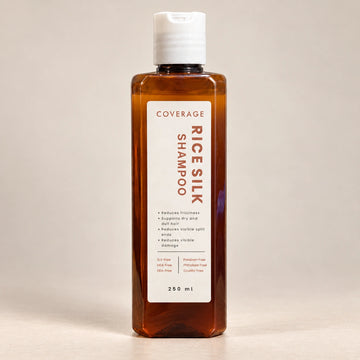
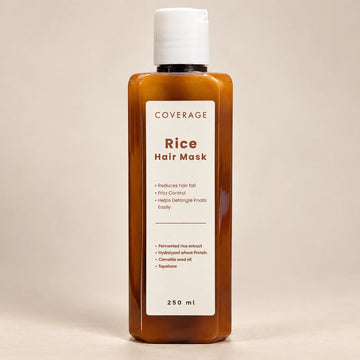
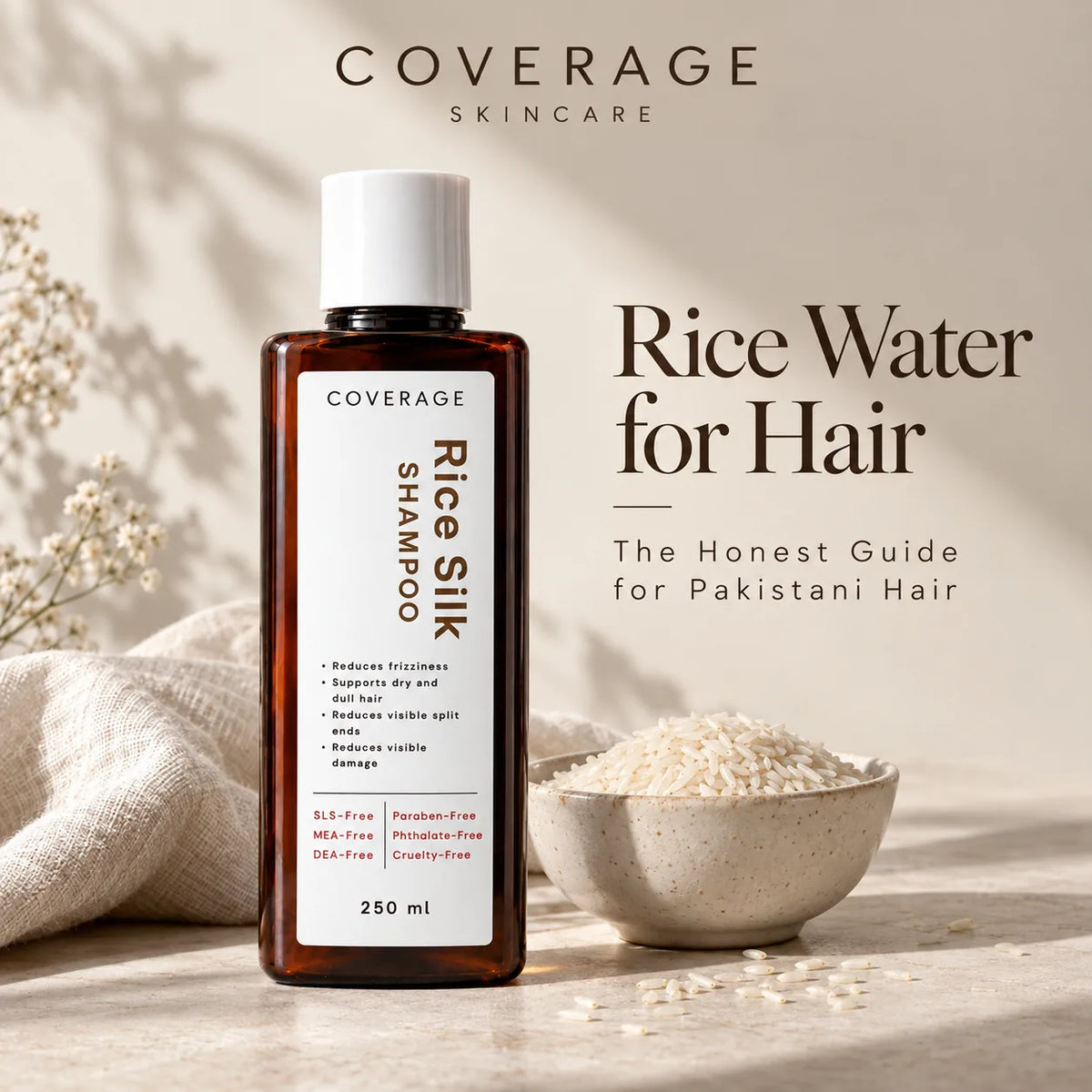
Want the rice idea without the fridge jar? COVERAGE builds the same concept into a standardised, preserved, pH-controlled formula. The Rice Silk Shampoo 250ml and the Rice Hair Mask 250ml both use Fermented Rice Extract with Hydrolyzed Wheat Protein, sulphate-free, in a batch that measures the same every single time. Both are available together in the Shiny & Silky Hair Duo.
What Is Rice Water, and What Is Actually In It
Rice water is the starchy, cloudy liquid left behind after you soak, rinse or boil rice. It carries small amounts of the compounds found in the grain: inositol, amino acids, B vitamins, vitamin E, and minerals such as magnesium and zinc. That mix is why it has been used on hair across Asia for centuries.
The dominant component is dissolved starch. Depending on the variety, rice is roughly 60 to 90 percent starch, and a share of that ends up suspended in the water along with trace nutrients. That is what gives rice water its milky look and its slightly slippery feel on the hand.
Be clear about what that means before going any further. Rice water is a mild, surface-level cosmetic rinse. It does not enter your bloodstream. It does not feed the follicle from inside. It is not a treatment for hair loss, and no amount of fermenting changes that. Everything it does happens on and just inside the hair strand itself.
That is not a reason to dismiss it. A large share of what people call "hair fall" in Pakistan is actually breakage, strands snapping partway along their length rather than releasing from the root, and breakage is precisely the thing a surface treatment can genuinely help with. If you have never worked out which one you are dealing with, our guide to the best shampoo for hair fall in Pakistan walks through the difference.

The Science: Inositol, Starch and Rice Protein
The strongest evidence for rice water is cosmetic, not clinical. Inositol can coat and penetrate the hair strand and reduce surface friction, which lowers breakage and adds smoothness. There are no large human trials showing that rice water increases hair count or regrows hair.
What inositol appears to do
The most widely cited work on rice water was carried out at Japan's SPring-8 synchrotron on the Infrared Materials Science beamline, in association with the cosmetics manufacturer Kracie Home Products. Using infrared imaging, researchers reported that inositol from rice water penetrates the hair and appears to remain there even after rinsing, giving a lasting protective effect. A 2010 paper in the International Journal of Cosmetic Science reported a similar finding: inositol can penetrate the hair shaft and stay put after rinsing.
Two honest caveats sit on top of that. First, this is cosmetic-science work with an industry link, not an independent clinical trial. Second, and more important, it explains smoothness and reduced breakage. It does not explain growth, and it was never designed to measure growth. The Wimpole Clinic's clinical review of the topic states plainly that there is no scientific evidence supporting a hair-growth effect from rice water.
What the starch does
Dermatologists describe the mechanism in simple terms: the starch behaves like a light conditioner. It lays along the cuticle, the overlapping outer scales of the hair, so that strands glide past each other instead of catching and fraying. Less friction means less mechanical damage during combing, tying and towel drying, which is where a great deal of everyday breakage actually happens.
What rice protein does
Hydrolyzed rice protein, a processed form broken into fragments small enough to bind to damaged areas of the hair, can temporarily improve strength and elasticity. This is the well-established principle behind protein treatments in general and it is real, but note the word temporarily. Protein fills gaps in a damaged fibre. It does not rebuild the fibre permanently, and it washes out.
Homemade rice water contains far less usable protein than a formulated protein treatment, and you have no way of knowing how much is in any given batch. That is a theme we return to below.
Where the evidence is thin, we say so. Claims that rice water stimulates follicles, reverses balding, or doubles growth rate are social-media claims, not scientific consensus. Any brand telling you otherwise is selling you something with a story rather than a formula.
The Yao Women of Huangluo, and What That Story Proves
The Yao women of Huangluo village in China are famous for extremely long hair and a tradition of washing it in fermented rice water. It is a genuine cultural practice, but it is anecdotal. It is not a controlled study, and it does not prove that rice water alone causes hair length.
Huangluo, in Longsheng county, Guangxi, is recognised by Guinness World Records as the world's first "Long Hair Village." Photographs of women with floor-length dark hair, unwrapped from a traditional coil, are the single most shared image in rice water content worldwide.
It is heritage, and it is beautiful, and it is not evidence. The hair health of those women is shaped by genetics, diet, an entire lifestyle, extremely gentle handling, and effectively zero heat styling or chemical processing, across generations. Attributing the result to one rinse is exactly the reasoning error most rice water articles are built on. We include the story as tradition, and label it as tradition.

Rice Water Benefits for Hair, Realistically
The realistic rice water benefits are cosmetic: smoother strands, reduced surface friction, less breakage during combing, more shine and better manageability. These effects are real but modest. They improve how hair looks and feels, not how many hairs you have.
| Claimed benefit | Verdict | What actually happens |
|---|---|---|
| Less breakage | Best supported | Inositol and starch reduce friction between strands, so fewer snap during combing and styling |
| Shine | Supported | A smoother, flatter cuticle reflects light more evenly |
| Frizz control | Supported | A sealed cuticle lifts less in humidity, which matters in coastal Karachi |
| Elasticity | Partly supported | Protein temporarily fills gaps in damaged strands so they stretch before snapping |
| Detangling and slip | Partly supported | Starch coating makes combing easier, which indirectly protects length |
| Faster hair growth | Not supported | No clinical evidence. Hair grows at roughly half an inch a month regardless |
| Regrowing bald patches | Not supported | Rice water does not act on the follicle. This needs medical assessment |
| Stopping hair fall | Not supported | It can reduce breakage, which looks similar. It does not address true shedding |
Read that table honestly and rice water becomes genuinely useful rather than magical. If your hair is dry, rough, frizzy, dull and snapping when you comb it, a rice treatment is a sensible thing to reach for. If your parting is widening or you are seeing clumps come out at the root, it is not, and no amount of chawal ka pani will change that.
Plain vs Fermented vs Boiled Rice Water
Plain soaked rice water is the mildest and easiest to tolerate. Fermented rice water has a lower pH and is generally considered stronger, but smells sour and is easier to overdo. Boiled rice water is the most concentrated in starch and the most likely to leave heavy residue.
| Type | How it is made | pH and strength | Best for | Main drawback |
|---|---|---|---|---|
| Plain (soaked) | Soak rinsed rice 30 minutes, then strain | Near neutral, mild | Beginners, fine hair, first trials, low-porosity hair | Weakest effect |
| Fermented | Leave soaked rice water at room temperature 24 to 48 hours, then strain | Lower pH, more available inositol, stronger | Coarse, rough or chemically treated hair wanting more slip | Sour smell, spoils fast, easy to overdo |
| Boiled | Reserve and dilute the water left after boiling rice | Highly concentrated starch | A quick option using what is already in the kitchen | Can feel heavy, leaves starchy residue if not rinsed well |
Fermentation lowers the pH closer to hair's own natural acidity, which is around 4.5 to 5.5, and is thought to make the nutrients more available. That is the reasoning behind the common claim that fermented rice water works better, and most people who compare the two do report a difference. Be aware, though, that there is no published clinical comparison proving fermented beats plain. Treat it as reasoned tradition, not proven fact.
The trade-off is real: a strong sour smell, and a much faster spoilage clock. In a Lahore kitchen in June, that clock runs very fast indeed.
How to Make Rice Water at Home, Step by Step
To make rice water: rinse half a cup of rice and discard that first water, add two to three cups of clean water, soak for 30 minutes for plain rice water or leave 24 to 48 hours for fermented, strain the liquid into a clean bottle, dilute if fermented, and store it in the fridge.
- Rinse. Wash half a cup of rice once to remove dust, husk fragments and surface dirt. Throw that first rinse away. You do not want it on your scalp.
- Soak. Add the rinsed rice to two to three cups of clean, filtered water. Filtered matters in Pakistan, for reasons covered in the hard water section below.
- Wait. For plain rice water, soak for 30 minutes. For fermented, cover loosely and leave at room temperature for 24 to 48 hours, until it smells faintly sour. In summer heat, check at 12 hours rather than 24.
- Strain. Pour the cloudy liquid into a clean glass jar or bottle and discard the rice. Any grains left in the bottle accelerate spoilage.
- Dilute if fermented. Mix fermented rice water with equal parts plain water before use. This single step prevents most cases of protein overload.
- Store cold. Keep it in the fridge and use it within a few days. If it smells strongly off, sharp or unpleasant rather than faintly sour, throw it out without hesitation.

How to Use It, and How Long to Leave It In
Use rice water about once a week. After shampooing, pour it over the lengths and scalp, massage gently for a minute, leave it in for 10 to 20 minutes, then rinse thoroughly with plain water and follow with a moisturising conditioner or mask. Do not leave it in overnight.
The correct sequence on wash day looks like this:
- Oil the scalp beforehand if that is your routine, and leave it on for an hour or overnight.
- Shampoo to remove the oil, dirt and buildup. Rice water applied over an oily scalp does very little.
- Apply rice water to damp hair, concentrating on the mid-lengths and ends where damage lives.
- Leave for 10 to 20 minutes. Clip it up, do not wrap it in a hot towel.
- Rinse thoroughly with plain water until hair no longer feels slippery or coated.
- Follow with a conditioner or a moisturising mask. This step is not optional.
Leaving rice water in for hours or overnight, which a great many local videos suggest, raises two separate problems. The first is a stiff, straw-like texture from too much protein sitting on the strand. The second, in Pakistani heat, is a straightforward hygiene issue on a warm, damp scalp. Rinse it out.
Always finish with moisture. Protein without moisture is the single most common way people turn a helpful treatment into damaged hair.
Where DIY Rice Water Caps Out
Homemade rice water has real, structural limits: no preservative so it spoils within days, no way to measure protein or inositol concentration, no pH control, a fermentation smell, no cleansing or conditioning agents, no slip or sealing oils, and a protein overload risk when it is used unbuffered and too often.
This is the part most DIY articles quietly skip, because it complicates a simple story. Your jar of rice water in the fridge is:
- Unpreserved. It grows bacteria and yeast within a few days, considerably faster in a warm kitchen. There is no preservative system in it at all.
- Unstandardised. You cannot know how much protein, starch or inositol any given batch contains. Rice variety, soak time, water ratio and room temperature all change it. That is why results swing so wildly between people, and between one batch and the next for the same person.
- Uncontrolled for pH. Hair and scalp prefer a mildly acidic pH. Too alkaline roughens the cuticle, too acidic irritates the scalp. Ferment for an unknown time in an unknown temperature and you have no idea where you have landed.
- Not a cleanser and not a conditioner. It has no surfactants, so it does not clean, and no emollients, oils or fatty alcohols, so it does not properly condition. It sits in an awkward gap between the two.
- Missing the sealing step. Protein smooths and reinforces. Oils and butters seal. Rice water gives you the first and none of the second, which is exactly why it can leave hair feeling rough if you stop there.
- Prone to protein overload. Used neat, too often, without a moisture step afterwards, it tips hair into stiffness and snapping. This is the most common way people hurt their hair with a remedy meant to help it.
None of this makes DIY useless. It means DIY has a ceiling, and that ceiling is precisely the problem a properly formulated rice product is built to solve.
The Standardised Version: The COVERAGE Rice Range
COVERAGE is a Korean-formulated Pakistani brand, made in our own GMP and ISO certified facility with proper lab testing behind every batch. The rice range takes the same idea as the jar in your fridge and removes every one of the variables listed above: a measured, standardised Fermented Rice Extract, a preserved and pH-controlled formula, and the cleansing and conditioning agents rice water on its own does not have.

Rice Silk Shampoo 250ml
A sulphate-free shampoo for dry, frizzy and dull hair. If your hair feels rough, looks dull, frizzes the moment you step outside, or refuses to stay smooth however much you condition it, this is the one to start with.
The Fermented Rice Extract sits fifth in the formula, not buried at the bottom next to the fragrance, and it carries the amino acids that get into the hair shaft and smooth it from the inside rather than merely coating the outside. Hydrolyzed Wheat Protein reinforces the hair fibre and helps strands hold on to moisture, which is what keeps frizz down between washes, particularly if you are washing in hard water.
- Size: 250ml
- Best for: Dry, frizzy, rough and dull hair
- Key actives: Fermented Rice Extract, Hydrolyzed Wheat Protein
- Free from: Sulphates, parabens, phthalates, DEA, MEA
- Use: As often as you wash
See the Rice Silk Shampoo and its full ingredient list

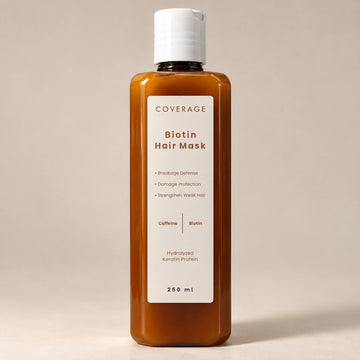
Rice Hair Mask 250ml
A deep conditioning treatment for dry, rough and chemically treated hair. This is the moisture half of the equation, the step that unbuffered rice water simply does not have.
It works inside and outside at once. Fermented Rice Extract and Hydrolyzed Wheat Protein get into the hair shaft to smooth and reinforce it. Camellia Seed Oil, Shea Butter and Squalane seal the cuticle down on the outside so moisture stays put between washes instead of escaping. Niacinamide supports a healthier scalp alongside it, and the mask detangles as it conditions, so combing gets easier and the breakage that comes from tugging goes down.
- Size: 250ml
- Best for: Dry, damaged and chemically treated hair, heat and colour damage
- Key actives: Fermented Rice Extract, Hydrolyzed Wheat Protein, Camellia Seed Oil, Shea Butter, Squalane, Niacinamide
- Free from: Sulphates, parabens, phthalates, DEA, MEA
- Use: After shampooing, once or twice a week
See the Rice Hair Mask and its full ingredient list
The two are built on the same fermented rice extract, so they work on the same problem from both ends rather than pulling in different directions. Together they are the Shiny & Silky Hair Duo.
If your main concern is breakage, thinning and hair fall rather than dryness and frizz, the rice range is not the right starting point. Read the biotin shampoo guide instead, because that range is built for strength.

DIY Rice Water vs a Formulated Rice Product
DIY rice water is cheaper and uses what is already in your kitchen, but it is inconsistent, unpreserved and incomplete. A formulated rice product is standardised, preserved, pH-controlled and also cleanses and conditions. Choose based on whether you value cost or control.
| Factor | Homemade rice water | Formulated rice product |
|---|---|---|
| Cost | Effectively free | A product purchase |
| Consistency | Varies by batch, rice type, soak time and temperature | Standardised extract, same in every bottle |
| Shelf life | A few days refrigerated, sometimes one day in summer heat | Preserved, stable for the life of the bottle |
| pH | Unknown and uncontrolled | Controlled in formulation |
| Cleansing | None | Sulphate-free surfactant system in the shampoo |
| Moisture and sealing | None | Camellia seed oil, shea butter and squalane in the mask |
| Smell | Sour when fermented | Formulated fragrance |
| Overload risk | High if used neat and often | Buffered with moisture in the same system |
| Effort | Soak, ferment, strain, store, discard, repeat weekly | Wash day as normal |
There is no dishonest answer here. If you enjoy the ritual, have the time, and your hair is not badly damaged, DIY rice water is a perfectly reasonable thing to do. If you have tried it and ended up with stiff hair, a sour-smelling bathroom and no consistent result, that is not a failure on your part. It is the ceiling described above, and it is exactly what a formulated version exists to clear.
Side Effects and Protein Overload
The most common rice water side effect is protein overload: hair that feels stiff, dry, straw-like and snaps easily. Other issues are scalp irritation and product buildup. The fix is to stop using rice water, deep condition for moisture, and then use it no more than once a week.
How to recognise protein overload
- Strands that feel rough and wiry rather than soft
- Hair that snaps with very little stretch instead of bending
- Sudden appearance of short, broken hairs around the crown and parting
- Dullness that conditioner does not fix
- Hair that seems to resist moisture entirely, water beading off it
People with low-porosity hair, meaning hair with a tightly closed cuticle that resists absorbing water, are noticeably more prone to this. So is anyone stacking rice water on top of other protein treatments without a moisture step in between.
How to fix it
- Stop all protein treatments, including rice water, immediately.
- Deep condition with a moisture-focused mask, and leave it on properly rather than rinsing after a minute.
- Repeat for two to three wash days until the hair feels soft and elastic again.
- Reintroduce rice water at most once a week, diluted, always followed by conditioner.
Rice water should also be avoided entirely on an inflamed scalp, or one affected by psoriasis or eczema. And if your shedding is sudden, severe, patchy, or comes with scalp pain, redness or flaking, see a doctor rather than reaching for a home remedy. Those signs point to medical causes a rinse cannot address.

Rice Water in the Pakistani Climate
In Pakistan, hard water in cities like Lahore and Karachi already leaves mineral deposits on hair that can make it feel rough and coated, so adding unbuffered rice water on top can push hair into stiffness faster. Homemade rice water also spoils very quickly in Pakistani summer heat, sometimes within a single day.
Hard water
Boring water and tanker water across much of Lahore and Karachi carries calcium and magnesium that deposit on the hair shaft and can leave it feeling rough, dull and coated. Pile neat rice water on top of that and the combined coating is a fast route to hair that feels stiff, which people then wrongly diagnose as dryness and treat with more protein, making it worse.
The research on exactly how much hard water weakens the hair fibre is genuinely mixed, and we have written about that honestly in our guide to hard water and hair fall in Pakistan. What is not in dispute is the coated, rough feel, and that a stripping shampoo on top of it is the part you can control.
Heat and spoilage
In a Lahore or Karachi summer, a jar of fermented rice water can turn in a day or less. Room temperature in an unairconditioned kitchen sits well above the range at which fermentation stays controlled. The "it's free" argument quietly carries a cost in wasted batches, and a hygiene risk if you use one you should have thrown away. If it smells sharp rather than faintly sour, it goes in the sink.
Oiling culture
Rice water is a rinse, not a replacement for champi. The two are not in competition and they do different jobs. Oil the scalp before wash day, shampoo it out properly, use rice water as a post-shampoo treatment on the lengths, then condition. Applying rice water over an oiled scalp is the most common wasted step we see.
Local advice worth ignoring
Three pieces of advice circulate constantly in Pakistani hair content and all three are wrong: leave rice water in overnight, use it daily, and skip the conditioner afterwards so you "do not wash away the goodness." Follow all three and you will produce textbook protein overload within a month.

Rice Water for Different Hair Types and Concerns
Rice water suits dry, frizzy, coarse and chemically treated hair best. Fine and low-porosity hair needs it diluted and infrequent. Oily scalps should keep it off the roots entirely. It is not the right tool for an itchy, flaking or inflamed scalp.
| Hair type or concern | Suitable? | How to adjust |
|---|---|---|
| Dry and frizzy | Yes, ideal | Weekly, lengths and ends, always follow with a mask |
| Coarse or thick | Yes | Fermented and diluted, weekly |
| Coloured or chemically treated | Yes, with care | Diluted, fortnightly at first, heavy moisture afterwards |
| Fine or limp | With caution | Plain soaked only, diluted, every two weeks, ends only |
| Low porosity | With caution | Highest overload risk. Plain, diluted, monthly, watch for stiffness |
| Oily scalp | Lengths only | Keep off the roots entirely, rinse very thoroughly |
| Curly or wavy | Yes | Excellent for slip and definition, but moisture must follow protein |
| Itchy, flaking or inflamed scalp | No | Treat the scalp condition first. Rice water is not a scalp treatment |
| Active hair loss at the root | No | See a doctor. This needs assessment, not a rinse |
Rice Water for Hair Fall: What It Cannot Do
Rice water does not stop hair fall. It can reduce breakage, which looks similar in the shower drain and often feels like improvement, but it does not act on the follicle and it does not address the medical, hormonal or nutritional causes behind true shedding.
This distinction matters more in Pakistan than almost anywhere, because searches for baal jhar rahe hain kya karein and baal girna ka ilaj run enormously high, and rice water is the first answer most people meet. Spending six months on a rinse while an underlying cause goes unaddressed is six months lost.
Breakage and shedding look different once you know what to check. A shed hair has a small white or pale bulb at one end, the root. A broken hair does not, and is usually noticeably shorter than the rest of your hair. If most of what you are finding has no bulb and is short, you are dealing with breakage, and rice water and a rice mask are reasonable tools. If most of it has a bulb, you are shedding, and you need a different approach entirely.
For the full picture on causes, and what a shampoo can and cannot realistically change, read Best Shampoo for Hair Fall in Pakistan: What Actually Works? and Biotin Shampoo in Pakistan: Does It Actually Stop Hair Fall?.
Realistic Timelines
Give any hair routine three to four months before judging it, because hair grows on a slow cycle at roughly half an inch a month. Rice water can improve shine and reduce breakage within a few weeks, but it will not add length or density on a short timeline.
| Timeframe | What is realistic | What is not |
|---|---|---|
| Wash 1 | More slip, easier combing, a little more shine | Any change in thickness |
| Weeks 2 to 4 | Noticeably less frizz, fewer broken hairs on the comb | New growth, visible density |
| Months 2 to 3 | Ends holding better, less obvious splitting, smoother overall texture | Length gains from faster growth |
| Month 4 and beyond | Length retained rather than lost to snapping, so hair reaches longer | Regrowth in thinning areas or bald patches |
The mechanism behind that last row is worth understanding, because it is the most useful thing in this entire article. Rice water does not make hair grow faster. It reduces breakage, so the growth you already had reaches a longer length before it snaps. Over four to six months that reads as longer hair, which is where a great deal of the "rice water grew my hair" testimony comes from. It is a real effect achieved by a completely different mechanism than people think.

A Complete Weekly Rice Routine
A workable weekly rice routine: oil the scalp the night before or an hour before, shampoo with a sulphate-free rice shampoo, apply either homemade rice water or a rice mask, leave 10 to 20 minutes, rinse, then air dry and comb gently with a wide-tooth comb.
The DIY version
- Night before: oil the scalp, leave on.
- Wash day: shampoo thoroughly to remove all oil.
- Treatment: apply diluted rice water to damp lengths, 10 to 20 minutes.
- Rinse: plain water, until no coating remains.
- Moisture: conditioner or mask, 3 to 5 minutes, rinse.
- Dry: squeeze with a soft cotton t-shirt rather than rubbing with a towel. Air dry where possible.
- Comb: wide-tooth comb, from the ends upward, never from the roots down.
The formulated version
- Night before: oil the scalp, leave on.
- Wash day: Rice Silk Shampoo, worked into the scalp and rinsed through the lengths.
- Treatment: Rice Hair Mask on mid-lengths and ends, 5 to 10 minutes.
- Rinse, dry and comb as above.
The second routine is the first routine with the variables removed. That is the entire pitch, and it is deliberately not dressed up as anything more.

Chawal Ka Pani Baalon Ke Liye: Roman Urdu Guide
Chawal ka pani baalon ke liye kaisa hai? Chawal ka pani baalon ko shine aur smoothness deta hai aur breakage kam karta hai. Lekin yeh naye baal nahi ugaata. Growth ka koi scientific saboot nahi hai.
Kaise banayein? Aadha cup chawal dho kar pehla pani phenk dein. Phir 2 se 3 cup saaf pani mein 30 minute bhigo dein. Fermented chahiye to 24 se 48 ghante room temperature par chhor dein. Chaan kar bottle mein fridge mein rakhein.
Kitni dair lagayein? Shampoo ke baad 10 se 20 minute. Raat bhar bilkul nahi. Baad mein conditioner zaroor lagayein.
Kitni baar? Hafte mein sirf aik baar. Rozana lagana protein overload ki sab se aam wajah hai.
Baal lambe karne ka tarika kya hai? Rice water breakage rokta hai, is liye baal apni length behtar rakhte hain, lekin growth tez nahi hoti. Asal tarika breakage rokna, gentle handling, aur sehatmand diet hai.
Rukhe aur frizzy baalon ke liye? Haan, yeh isi ke liye sab se behtar hai. Lekin protein ke baad moisture zaroori hai, warna baal sakht ho jayenge.
Baal jhar rahe hain, kya rice water kaafi hai? Nahi. Agar baal jar se nikal rahe hain, tootne ke bajaye, to doctor se milein.
Six Rice Water Myths, Corrected
- "Rice water grows hair." No clinical evidence supports this. It reduces breakage, which retains length. Different mechanism, different expectation.
- "Leave it overnight for better results." Longer contact does not mean better results. It means stiffness, and on a warm damp scalp, a hygiene problem.
- "Skip the conditioner so you don't wash away the goodness." The opposite. Protein without moisture is how hair gets damaged. Always condition.
- "Fermented is always better." Fermented is stronger, which is not the same as better. On fine or low-porosity hair it is more likely to cause problems.
- "It's natural, so it can't hurt your hair." Protein overload from rice water is one of the most common self-inflicted hair problems there is.
- "A rice shampoo is just rice water in a bottle." A formulated product contains a standardised extract, a preservative system, a controlled pH, surfactants and conditioning agents. Rice water contains none of those.

Frequently Asked Questions
Does rice water really grow hair?
There is no strong clinical evidence that rice water grows hair or increases hair count. It can reduce breakage and add shine, which makes hair look fuller and helps it reach a longer length, but that is a cosmetic effect rather than new growth.
How long should I leave rice water in my hair?
Leave rice water in for 10 to 20 minutes, then rinse it out with plain water. Do not leave it overnight, as that raises the risk of stiffness, protein overload and, in Pakistani heat, hygiene problems on a damp scalp.
How often should I use rice water?
About once a week is enough for most people. Even coarse or damaged hair rarely needs it more than once or twice a week. Using it daily is the most common cause of protein overload.
Is fermented rice water better than plain?
Fermented rice water has a lower pH and is thought to contain more available inositol, so many people find it more effective. It is also stronger smelling and more likely to cause overload, so dilute it with equal parts water and use it less often.
How long does homemade rice water last?
Refrigerated, homemade rice water lasts only a few days because it contains no preservative. In Pakistani summer heat at room temperature it can spoil within a single day. Discard it if it smells sharp or strongly off rather than faintly sour.
Can rice water cause hair fall?
Rice water does not cause true hair loss, but overuse can cause breakage through protein overload, which looks like extra shedding in the shower. Used correctly once a week and followed with conditioner, it is safe for most people.
What is protein overload from rice water?
Protein overload is when too much protein makes hair stiff, dry, brittle and prone to snapping with very little stretch. The fix is to stop all protein treatments, deep condition for moisture over two or three wash days, then reduce rice water to once a week at most.
Is rice water good for frizzy hair?
Yes. Rice water helps frizzy hair by smoothing the cuticle and reducing surface friction. Always follow it with a moisturising conditioner or a rice-based mask, because protein without moisture can make frizz worse rather than better.
Is rice water safe for coloured or chemically treated hair?
Yes, and it often suits it well, because chemically treated hair is porous and damaged and accepts protein readily. Dilute fermented versions, start fortnightly rather than weekly, and always follow with heavy moisture to avoid stiffness.
Can I use rice water with oiling?
Yes. Oil the scalp before wash day, shampoo it out properly, then use rice water as a post-shampoo treatment on the lengths and condition afterwards. Applying rice water over an oiled scalp is a wasted step, as it cannot reach the hair through the oil.
Does boiled rice water work?
Boiled rice water contains concentrated starch and can add slip, but it is heavier and more likely to leave residue. Dilute it well and rinse thoroughly. Soaked or fermented rice water is usually easier to control.
Is a rice shampoo better than DIY rice water?
A formulated rice shampoo is preserved, pH-controlled and standardised, and it also cleanses and conditions, none of which DIY rice water does. DIY is cheaper but inconsistent and spoils quickly. Choose based on whether you value cost or control.
Which rice is best for rice water?
Any plain white or brown rice works. Basmati is perfectly fine and is what most people in Pakistan have in the kitchen. Avoid pre-seasoned, parboiled or flavoured rice, and always discard the first rinse whatever variety you use.
Can I put rice water on my scalp?
You can massage it lightly into the scalp, but the real benefit is on the hair strand itself, so concentrate on the mid-lengths and ends. Avoid it entirely on an inflamed, itchy or flaking scalp, and on scalps affected by psoriasis or eczema.
Does rice water help with dandruff?
Rice water is not a dandruff treatment. It acts on the hair strand rather than on the scalp conditions that cause flaking. Persistent dandruff needs a targeted shampoo and, if it does not settle, a doctor.
Why does my hair feel stiff after rice water?
That is protein overload, and it is the single most common rice water mistake. Stop using it, deep condition for two or three wash days until softness returns, then reintroduce it diluted and no more than once a week.
Can I use rice water on hair that has been straightened or rebonded?
Yes, and chemically processed hair often benefits, because it is porous. Use it diluted and pair it with a rich mask, since rebonded hair is usually protein-damaged and moisture-starved at the same time and needs both addressed.
Does rice water work in hard water?
Less well. Hard water leaves calcium and magnesium deposits on the hair that can already make it feel rough and coated, and unbuffered rice water on top can push it into stiffness faster. A formulated, pH-controlled rice product handles hard water conditions more predictably.
Chawal ka pani baalon ke liye kaisa hai?
Chawal ka pani baalon ko shine aur smoothness deta hai aur breakage kam karta hai, lekin yeh naye baal nahi ugaata. Hafte mein aik baar use karein, 10 se 20 minute lagayein, phir dho kar conditioner lagayein.
Rice water se baal lambe karne ka tarika kya hai?
Rice water breakage rokta hai, is liye baal apni length behtar rakhte hain, lekin growth tez nahi hoti. Baal lambe karne ka asal tarika breakage rokna, gentle handling aur sehatmand diet hai, sirf rinse nahi.
When should I see a doctor instead?
See a doctor or dermatologist if hair fall is sudden, severe or patchy, or comes with scalp pain, redness or flaking. Those signs suggest a medical cause that needs proper treatment rather than a home remedy.
Related Reading
- Best Shampoo for Hair Fall in Pakistan: What Actually Works?
- Biotin Shampoo in Pakistan: Does It Actually Stop Hair Fall?
- Hard Water & Hair Fall in Pakistan: Does Hard Water Really Cause Hair Loss?
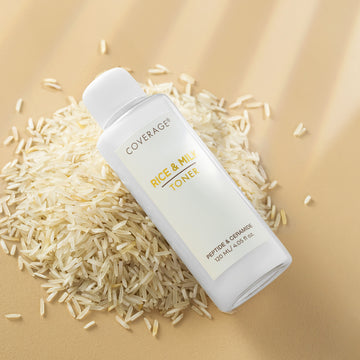
- Rice & Milk Toner in Pakistan: rice for skin, not just hair
- Shop the full COVERAGE hair care range
References
- Cleveland Clinic Health Essentials, "Rice Water for Hair: Benefits and How to Make It," with commentary from Dr. Shilpi Khetarpal, MD and Dr. Alok Vij, MD.
- TODAY.com, "Rice water is a popular DIY hair treatment. Dermatologists explain," with Dr. Shasa Hu and Dr. Shari Lipner.
- Nebraska Medicine, "Rice water for hair: Is it the miracle social media claims?" with Dr. Matthew Stephany.
- University of Minnesota Medical School, dermatology commentary on the rice water trend.
- SPring-8 synchrotron, Infrared Materials Science beamline (BL43IR), in association with Kracie Home Products: infrared imaging of inositol penetration into hair.
- International Journal of Cosmetic Science, 2010: inositol penetration and retention in hair.
- The Wimpole Clinic, clinical review of rice water for hair growth.
- Guinness World Records, Huangluo "Long Hair Village," cultural reference.
This article is for general informational purposes only and is not a substitute for professional medical advice. All information and claims referenced above are drawn from publicly available dermatological studies and expert sources. Always consult a dermatologist for advice specific to your skin.

Leave a comment
This site is protected by hCaptcha and the hCaptcha Privacy Policy and Terms of Service apply.