
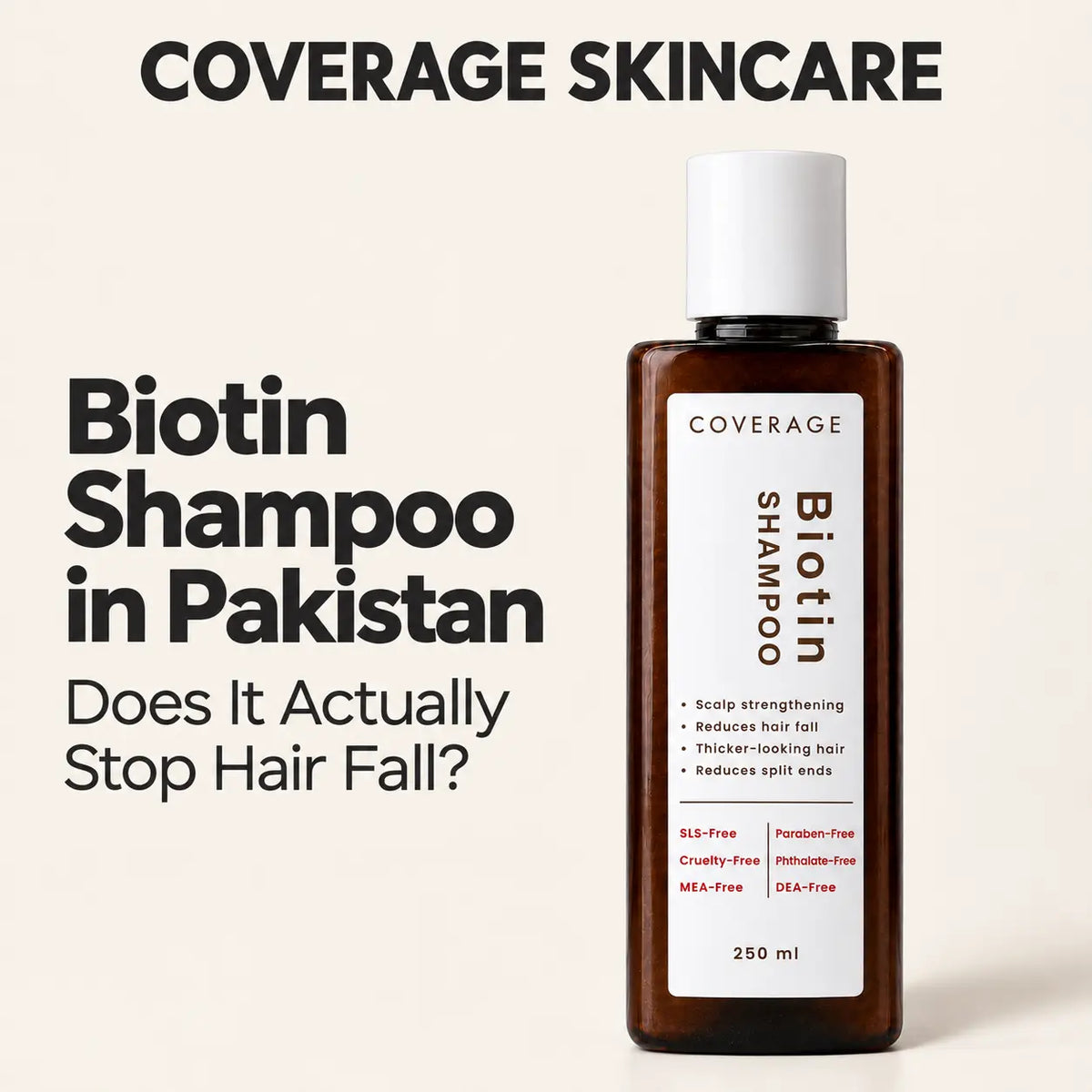
Biotin Shampoo in Pakistan: Does It Actually Stop Hair Fall?
You notice it in the shower first. A tangle of strands wrapped around your fingers, more on the comb, a few on the pillow, and the question that follows almost everyone: will a biotin shampoo fix this?
Here is the honest answer, before anything else. A well formulated biotin shampoo can reduce the hair fall that comes from breakage, the snapping of fragile strands during washing, combing and styling. It cannot stop hair loss driven by genetics, hormones, thyroid disease or a nutritional deficiency, because those problems begin inside the follicle and inside the body, and no rinse-off product reaches that far. The single most useful thing you can do is work out which kind of problem you actually have, because the right answer for one is the wrong answer for another.
That is what this guide is for. It explains how to tell shedding from breakage from medical hair loss, what the science genuinely supports, and where a product like the COVERAGE Biotin Shampoo realistically fits.
Three Different Problems People Call "Hair Fall"
In everyday language, and in Roman Urdu, almost everything gets called baal girna or baal jharna. But there are three distinct things happening, and telling them apart is the whole game.
- Hair shedding. The hair completed its natural growth cycle and was released from the follicle. This is normal in moderation. The American Academy of Dermatology states it is normal to shed between 50 and 100 hairs a day. When you shed significantly more than usual, the condition is called telogen effluvium.
- Hair breakage. The shaft snapped somewhere along its length. The follicle is fine, the fibre failed. This is a hair-quality problem, and it is the one most influenced by how you wash, condition and handle your hair.
- Medical hair loss. A broader category involving follicle-level processes, such as androgenetic alopecia (pattern hair loss), alopecia areata, and inflammatory or scarring disorders. These need a diagnosis, not a shampoo.
Readers use "hair fall" to mean all three at once, and that is precisely why the same product advice does not work for everyone. A shampoo that meaningfully helps breakage will do very little for pattern hair loss, and nothing for a thyroid problem.

How to read your own hair
You cannot diagnose yourself, but you can gather clues.
- Look at the strand. A shed hair usually has a small white or pale bulb at the root end. A broken hair has no bulb at either end, it is just a snapped-off piece.
- Look at the length. If your hair is long but you keep finding short fragments, that points to breakage.
- Look at where it happens. Breakage clusters around friction points: brushing, tying, straightening, rough towel drying. Shedding is more evenly spread.
- Look at your part and hairline. A visibly widening part, or thinning at the temples or crown, points toward pattern hair loss and is worth a professional opinion.

What Biotin Actually Is
Biotin is vitamin B7, a water-soluble B vitamin once known as vitamin H. Biologically, it works as a cofactor for a group of carboxylase enzymes involved in metabolising fats, carbohydrates and amino acids. Amino acids are the building blocks of keratin, the structural protein your hair shaft is made from. That is the real, undisputed link between biotin and hair.
The adequate intake for adults is set at 30 micrograms a day. You get biotin from a range of foods, including meat, fish, eggs and organ meats such as liver, along with nuts, seeds and some vegetables. According to the NIH Office of Dietary Supplements, most people get enough biotin from the foods they eat, and biotin deficiency is very rare.
This matters because of a leap in logic that gets made constantly. Biotin deficiency genuinely does damage hair: it can cause thinning hair, loss of body hair, brittle nails and a scaly rash around the eyes, nose and mouth. Correcting a true deficiency helps. But it does not follow that adding extra biotin to a person who already has enough will grow more hair. Beyond the point where your body's needs are met, more is not better, the surplus is simply excreted.
The evidence bears this out. A 2017 systematic review in Skin Appendage Disorders found 18 published cases of biotin improving hair or nail problems, and in every single case the patient had an underlying condition that caused a deficiency in the first place. A 2024 review in the Journal of Clinical and Aesthetic Dermatology went looking for high-quality human trials of biotin for hair and found only three that qualified. The strongest, a double-blind placebo-controlled study from 1966, gave 28 women with diffuse hair thinning 10mg of biotin daily and compared them with 18 women on placebo over four weeks. Both groups improved from baseline, with no significant difference between them.
The takeaway is simple and worth stating once, clearly: biotin is necessary for healthy hair, but taking or applying extra biotin is not a proven treatment for hair loss in people who are not deficient.

So Does Biotin Shampoo Stop Hair Fall?
No, not in the way the phrase is usually sold. But it is not a useless product either, and the distinction is where the honesty lives.
A shampoo is a rinse-off product. It works on the scalp surface and on the hair fibre, not on the follicle biology that drives medical hair loss. There is also a real pharmacological limit that no marketing can overcome: a shampoo sits on the scalp for a minute or two and is then rinsed away. That is a very short contact window for any active ingredient meant to change what happens inside a follicle.
Here is what a good hair fall shampoo genuinely can do:
- Clean the scalp properly. Oil, sweat, dead skin, pollution and product build-up accumulate faster in heat, and a clean scalp is a healthier environment for the hair growing in it.
- Reduce mechanical damage. Wet hair is at its weakest. A harsh detergent combined with rough handling produces snapped strands. A gentle system reduces that.
- Strengthen the fibre. This is where ingredients like hydrolysed keratin come in, and where the evidence is genuinely interesting, though it is fibre-mechanics evidence, not hair-growth evidence.
And here is what it cannot do: reverse androgenetic alopecia, correct a thyroid disorder or iron deficiency, undo a hormonal shift, or coax hair from a follicle that has stopped producing. If your hair fall is being driven by any of those, a shampoo is a supporting act at best, and the real answer lies elsewhere.
What Actually Causes Hair Fall
It helps to see the full landscape, because it clarifies where a shampoo belongs and where it does not.
Causes that begin inside the body or the follicle. A shampoo does not treat these:
- Androgenetic alopecia, the common pattern hair loss driven by genetics and hormones.
- Telogen effluvium, a temporary surge in shedding triggered by a stressor. It typically shows up two to three months after the trigger, such as a high fever, major illness, surgery, crash dieting or acute stress, and it usually recovers once the trigger passes.
- Postpartum shedding, a specific and very common telogen effluvium. The AAD notes that shedding usually peaks about four months after giving birth and that most women see their hair return to its normal fullness by their child's first birthday.
- Thyroid disorders. The evidence here is strong: both an underactive and an overactive thyroid can cause diffuse shedding, and corrective treatment often halts the shedding once thyroid levels normalise.
- Iron status. This one is genuinely contested. The largest controlled study, published in the Journal of the American Academy of Dermatology in 2010, found no statistically significant increase in iron deficiency among women with female pattern hair loss or chronic telogen effluvium versus controls, and dermatology reviews conclude there is insufficient evidence to treat hair loss with iron in the absence of iron-deficiency anaemia. Other studies do report an association, so the fair summary is that the link is plausible but unproven.
- Alopecia areata, an autoimmune condition causing patchy loss; scarring alopecias, where follicle openings are destroyed; and certain medications and scalp conditions.
Causes that are mechanical or chemical. This is where a routine changes the outcome:
- Traction from tight ponytails, braids and extensions.
- Heat and chemical damage from straighteners, dryers, bleaching, colouring and keratin treatments.
- Everyday breakage from rough brushing, aggressive towel drying and detangling from the roots down.
The first group needs medical attention. The second group is where formulation and technique genuinely decide how much hair you lose to breakage.

Why Formulation Matters More Than the Word on the Bottle
If your problem is fragile hair and breakage, the most important part of a shampoo is not the hero ingredient printed on the front. It is the cleansing system, because that is the bulk of the product and it is what touches every strand every wash.
The cleansing system
Surfactants are the detergents that do the cleaning, and they vary enormously in how gentle they are. Sodium lauryl sulphate sits at the harsh end. At the mild end are amino-acid-derived and sugar-derived surfactants. Three names worth knowing:
- Sodium Lauroyl Sarcosinate is often confused with Sodium Lauryl Sulphate because the names look similar, but it is a different molecule. It is derived from the amino acid sarcosine, and it is considered a mild surfactant.
- Decyl Glucoside is a gentle sugar-derived surfactant well tolerated by sensitive skin.
- Cocamidopropyl Betaine is a mild coconut-derived co-surfactant. It is worth a transparent note: it was named Allergen of the Year by the American Contact Dermatitis Society in 2004, and can cause allergic contact dermatitis in a minority of sensitised people. The reactions are often attributed to manufacturing impurities rather than the molecule itself. For most people it is well tolerated, but if you have a reactive scalp, it is a name worth recognising.
A fully sulphate-free system matters most for the person washing often in a hot climate, where frequent cleansing is a fact of life rather than a choice.
The fibre strengthener: hydrolysed keratin
Hydrolysed keratin is where cosmetic science gets specific, so let us be precise about what it shows and what it does not.
A 2020 study in the International Journal of Cosmetic Science tested keratin peptides of different sizes on hair fibres. Low and mid molecular weight peptides penetrated deep into the hair cortex, while the largest peptide mostly adsorbed onto the surface. Crucially, both the mid and high molecular weight peptides increased the hair's Young's modulus, a measure of stiffness, and reduced breakage at both 20% and 80% relative humidity. A 2025 study in the journal Molecules found that hydrolysed keratin formed a protective film on the cuticle and helped hair retain its tensile strength after UV exposure, whereas untreated hair lost strength.
Read the fine print, though. These are fibre-mechanics studies on hair swatches in a laboratory. They are strong evidence that keratin peptides can make a hair fibre more resilient and less prone to snapping. They are not clinical trials of a finished shampoo, and they are not evidence that keratin grows hair. Strengthening the fibre reduces breakage, it does nothing for the follicle.
Where ingredients sit on the label
Ingredient lists run in descending order of concentration, so the position of an active tells you something real. If biotin appears near the very end of a long list, it is present in a token amount. If the mild surfactants and the fibre-strengthening peptides sit high up, the formula is built around them rather than around a single word on the front.
COVERAGE Biotin Shampoo: What Is Actually In It

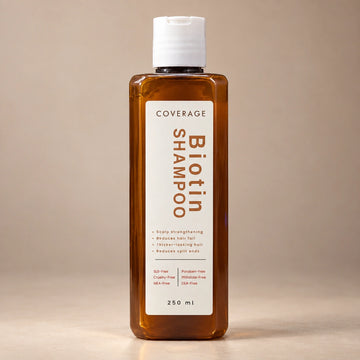
The COVERAGE Biotin Shampoo (250ml, Rs. 1,900) is built around the logic above. Its cleansing system is fully sulphate-free, and it is the three mild surfactants discussed earlier, Cocamidopropyl Betaine, Decyl Glucoside and Sodium Lauroyl Sarcosinate, that sit second, third and fourth in the formula. Biotin and Hydrolyzed Keratin follow in fifth and sixth position.
Full ingredient list: Aqua, Cocamidopropyl Betaine, Decyl Glucoside, Sodium Lauroyl Sarcosinate, Biotin, Hydrolyzed Keratin, Guar Hydroxypropyltrimonium Chloride, Amodimethicone, Vinyl Crosspolymer, Ethylene Glycol Distearate, Sodium Chloride, Ethylhexylglycerin, Disodium EDTA, Parfum, CI 77019.
It is free from sulphates, parabens, phthalates, DEA and MEA. It is lightly fragranced rather than fragrance-free, which is worth knowing if your scalp is sensitive to fragrance. It is best suited to hair fall from breakage, and to thinning, weak and fragile hair, the kind of hair that is snapping rather than the kind that is leaving the follicle for medical reasons.
Now the part that matters most for trust. The presence of biotin and keratin in this formula is not proof that the finished product treats hair loss. COVERAGE has not conducted clinical trials on this shampoo, and it will not claim to regrow hair, cure baldness or stop medical hair loss. What it is designed to do is clean gently and support stronger, less breakage-prone strands. That is a real and worthwhile job, and it is the honest limit of what any shampoo in this category should promise.
Why Pair a Shampoo With a Hair Mask
A shampoo and a mask do two different jobs, and understanding the division of labour is the key to using both well.
A shampoo cleanses, works on the scalp, and is rinsed away quickly. A mask is left on the mid-lengths and ends for several minutes, so it has time to condition the oldest and most damaged part of the hair. This matters for fragile hair specifically, because a well-conditioned strand has more slip. When hair detangles easily, a comb glides through instead of catching and tugging, and less hair snaps in the process. Reduced friction is not a cosmetic luxury for breakage-prone hair, it is one of the most direct ways to lose fewer strands to mechanical damage.
A mask does not stimulate follicles or treat medical alopecia. Its work is entirely on the fibre you already have.
COVERAGE Biotin Hair Mask

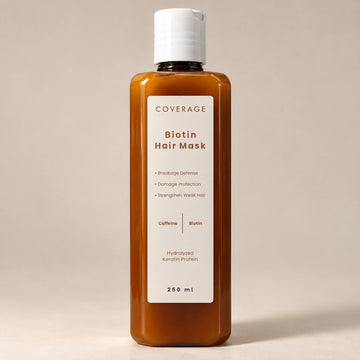
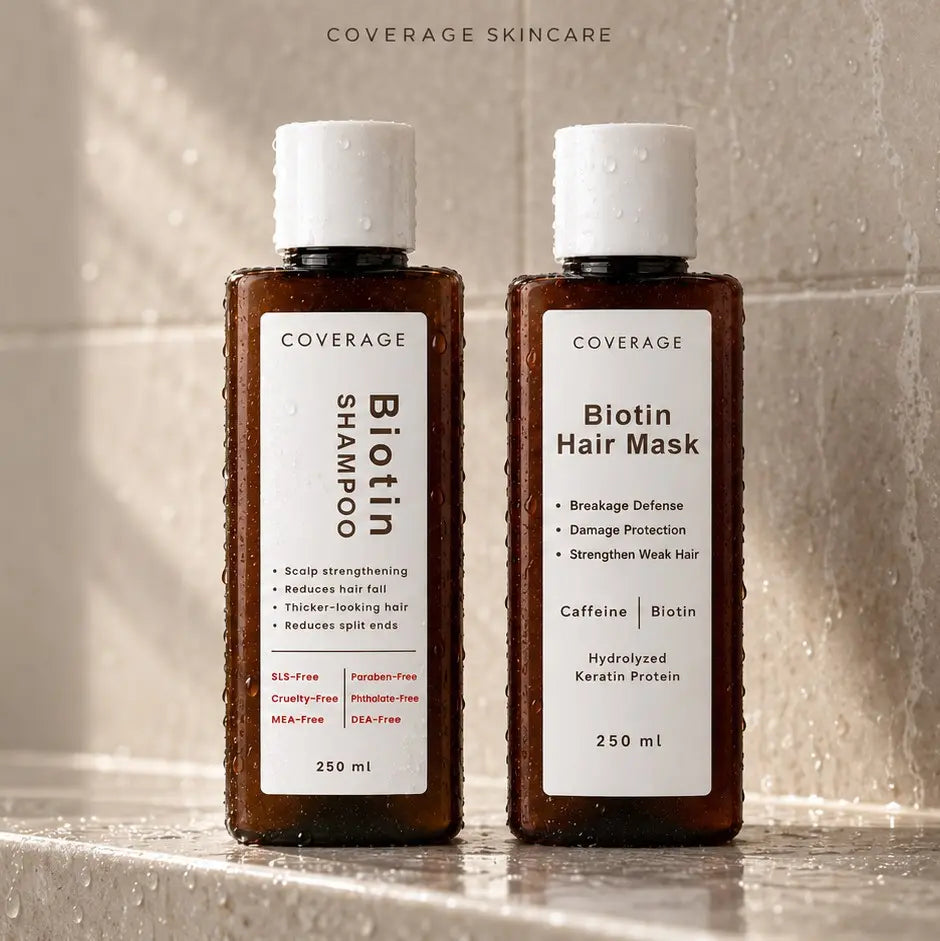
The COVERAGE Biotin Hair Mask (250ml, Rs. 1,999) is the conditioning partner to the shampoo.
Full ingredient list: Aqua, Behentrimonium Methosulfate, Ceteth Phosphate, Biotin, Vinyl Crosspolymer, Hydrolyzed Keratin, Panthenol, Caffeine, Tocopheryl Acetate, Parfum, Citric Acid, Disodium EDTA, Phenoxyethanol, Ethylhexylglycerin. Free from sulphates, parabens, phthalates, DEA and MEA.
Two ingredients deserve an honest note.
Panthenol, provitamin B5, is a well-established conditioning agent. Cosmetic-science evidence supports it as a humectant that helps the hair shaft retain moisture and improves softness and manageability. It is a genuine conditioning benefit. It is not a hair-growth ingredient, and no reputable evidence claims it is.
Caffeine requires care, because it is the ingredient most often oversold. There is real laboratory evidence that caffeine applied to the scalp in a shampoo penetrates into the hair follicle within about two minutes of contact, reaching a depth of roughly 200 micrometres and remaining detectable for up to 24 hours. There is also a 2017 study in Skin Pharmacology and Physiology in which a leave-on 0.2% caffeine solution performed comparably to 5% minoxidil in 210 men with pattern hair loss over six months. But two honest caveats apply. That trial used a leave-on liquid applied twice daily, not a rinse-off product, and it was open-label. Evidence for a leave-on solution cannot be transferred to a rinse-off mask. So the honest position is this: caffeine is a well-studied and interesting scalp ingredient, but its presence in a rinse-off product supports a healthier scalp environment rather than any promise of regrowth.
As with the shampoo, ingredient presence is not proof of clinical efficacy, and COVERAGE makes no clinical claims for this mask.
Hair Care in Pakistani Conditions

Local conditions genuinely shape what a good routine looks like.
Heat, sweat and oily scalps. In hot, humid weather the scalp gets oily faster, and many people wash more often as a result. Frequent washing does not cause hair loss, this is a persistent myth. The hairs you see in the drain were already detached and on their way out. What matters is not how often you wash but how harshly. A mild, sulphate-free shampoo makes frequent washing sustainable rather than damaging.
Oiling and champi. There is nothing wrong with oiling, and it has a modest evidence base. A much-cited study by Rele and Mohile in the Journal of Cosmetic Science found that coconut oil, used as a pre-wash treatment, reduced protein loss from hair, most likely because its lauric acid penetrates the shaft. That is a fibre-protection benefit, not a growth benefit. The pitfalls are practical: a vigorous champi on wet or fragile hair pulls and snaps strands, and heavy oil sometimes tempts people back toward a harsh clarifying shampoo to remove it. Oil gently, and rinse with a mild shampoo.
Hard water. This deserves honesty because the evidence is genuinely mixed. A 2013 study in the International Journal of Trichology found that hard water did not significantly change the tensile strength or elasticity of hair compared with distilled water. A separate scanning electron microscopy study by the same group did find greater mineral deposition on hair washed in hard water, and other work has reported reduced tensile strength, so the picture is not settled. Water-quality research in Pakistani cities has reported hardness above WHO limits in parts of Karachi and elevated calcium in some areas of Lahore, but levels vary widely by locality. The fair conclusion: hard water can leave deposits that make hair feel rough and dull, but it is not established as a cause of hair fall, and it should not be blamed for thinning that has another cause.
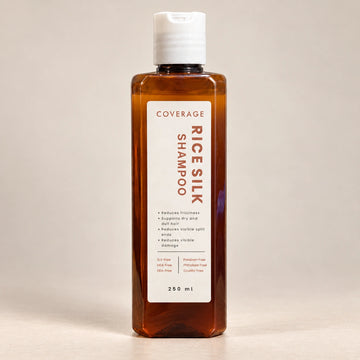
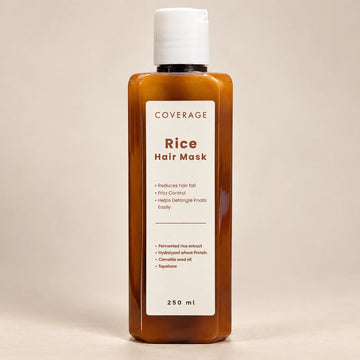
Heat styling and colour. Straighteners, dryers, bleaching and colouring are among the most common causes of breakage. If you are losing hair to breakage, reducing heat and chemical stress will often do more than any single product. If dryness, frizz and dullness rather than breakage are your main concern, the Rice Silk Shampoo and Rice Hair Mask are the better fit.
Buying authentic product. Counterfeits are a real problem in this market. Buy from the brand's own website or an authorised seller so that what is in the bottle matches the label you are trusting.
How to Use Biotin Shampoo and Hair Mask Correctly
Technique matters as much as product for breakage-prone hair. This routine follows COVERAGE's official directions.
- Wet hair thoroughly with lukewarm water. Very hot water is unnecessary and drying.
- Use a coin-sized amount of shampoo and massage it into the scalp with your fingertips for 30 to 60 seconds. Focus on the scalp, not the lengths.
- Be gentle. Wet hair is at its weakest, so avoid scrubbing the lengths into a tangle.
- Rinse fully until the water runs clear.
- Squeeze out excess water before the mask, so it is not diluted on application.
- Apply the mask through the mid-lengths and ends, working a little into the scalp.
- Comb it through gently with a wide-tooth comb, starting at the ends and working upward.
- Leave the mask on for 5 to 10 minutes, then rinse thoroughly with cool water.
- Dry and detangle carefully. Blot with a towel rather than rubbing, and detangle from the ends upward.
Use the shampoo two to three times a week, or as often as you wash. Use the mask after every wash, or two to three times a week. The two are also sold together as the Hair Fall & Strength Duo for people who want the full routine.

How Long Before You See Anything?
Set expectations by mechanism.
- Softness and easier combing usually appear within the first few washes, because conditioning is immediate.
- Less breakage takes weeks of consistent, gentle handling, because you are changing the ongoing rate at which strands snap.
- Anything to do with actual growth is measured in months, since scalp hair grows roughly a centimetre a month, and a shampoo is not a growth treatment in any case.
A fair rule: judge a hair fall product aimed at breakage over two to three months of consistent use. If your hair still feels fragile and keeps snapping after that, the problem may not be one a shampoo can solve.

When to See a Dermatologist
Most hair fall is not an emergency, and much of it settles on its own or responds to gentler handling. But some patterns are worth a professional opinion, and earlier evaluation generally gives better outcomes. Consider seeing a dermatologist if you notice:
- Sudden or severe shedding, or hair coming out in clumps.
- Bald patches, or a visibly widening part or thinning at the crown or temples.
- Itching, pain, burning, scaling or visible inflammation of the scalp.
- Smooth, shiny patches where the follicle openings seem to have disappeared, which can indicate scarring.
- Loss of eyebrows or eyelashes.
- Shedding alongside fatigue, weight change, or irregular periods, which can point to a thyroid or other systemic issue.
- Persistent, unexplained shedding that does not settle.
None of this is cause for panic. It is simply the point at which a diagnosis will help you more than another product.

Frequently Asked Questions
Does biotin shampoo stop hair fall?
It can reduce hair fall caused by breakage, by cleaning the scalp gently and helping strengthen fragile strands so fewer snap. It cannot stop hair loss driven by genetics, hormones, thyroid disease or a deficiency, because those start inside the body and follicle, beyond the reach of a rinse-off product.
Does biotin shampoo actually work?
It works as a gentle cleanser and fibre-care product, which is a real benefit for breakage-prone hair. What it does not do is deliver biotin into your body or regrow hair. Judge it as a good shampoo, not as a treatment, and it can genuinely help.
Is biotin shampoo good for hair growth?
There is little evidence that topical biotin grows hair. A clean scalp and less breakage help your existing hair look fuller and reach its length without snapping, but that is different from stimulating new growth from the follicle.
Is biotin shampoo good for thin hair?
It can help thin, fragile hair look and feel fuller by reducing breakage and improving condition and manageability. If your thinning comes from pattern hair loss or a medical cause, a shampoo supports the hair you have but will not reverse the underlying thinning.
Is biotin shampoo safe to use?
For most people, yes. The gentle surfactants used in sulphate-free formulas are mild. If you have a reactive scalp, note that Cocamidopropyl Betaine can occasionally cause irritation in sensitised individuals, and patch testing a new product is sensible.
Can I use biotin shampoo regularly?
Yes. Washing frequently does not cause hair loss, and a mild, sulphate-free shampoo is designed for regular use, two to three times a week or as often as you wash. In hot, humid weather, regular gentle washing keeps the scalp healthy.
Should I take biotin supplements too?
If you eat a varied diet, you almost certainly get enough biotin already, and supplements have weak evidence for hair growth in non-deficient people. Importantly, high-dose biotin can interfere with lab tests: the US FDA has warned it can cause falsely low troponin results and skew thyroid and pregnancy tests. Tell your doctor if you take it.
Can a hair mask stop hair fall?
A mask reduces the hair fall that comes from breakage, by conditioning the lengths so hair detangles easily and snaps less. It does not act on the follicle, so it cannot stop shedding or medical hair loss. It is a fibre-care product, and a useful one for fragile hair.
What is the best shampoo for hair fall in Pakistan?
There is no single best for everyone, because the right choice depends on your cause. If your issue is breakage, look for a fully sulphate-free cleansing system, a fibre-strengthener such as hydrolysed keratin placed high on the label, and honest claims. If your issue is medical, the best first step is a dermatologist.
How do I tell breakage from shedding?
Check the strand. A shed hair has a small pale bulb at the root, a broken hair has no bulb and is often a short fragment. Lots of short pieces on long hair, clustered around brushing and styling, points to breakage. Even, bulb-tipped loss points to shedding.
The Bottom Line

If your hair is snapping, a genuinely well formulated, sulphate-free shampoo with a fibre-strengthener, used gently and paired with a conditioning mask, can meaningfully reduce how much you lose to breakage. That is a real, achievable result, and it is where the COVERAGE Biotin Shampoo and Biotin Hair Mask are designed to help. If your hair is shedding heavily, thinning in a pattern, or falling out for reasons that start inside your body, the honest and more useful step is a proper diagnosis. Knowing which problem you have is worth more than any bottle.
You can explore the full hair care range here.
This article is for general informational purposes only and is not a substitute for professional medical advice. All information and claims referenced above are drawn from publicly available dermatological studies and expert sources. Always consult a dermatologist for advice specific to your skin.

Leave a comment
This site is protected by hCaptcha and the hCaptcha Privacy Policy and Terms of Service apply.