
Hard Water & Hair Fall in Pakistan: Does Hard Water Really Cause Hair Loss?
Quick answer: Hard water does not directly cause hair loss from the root. The current evidence suggests hard water can leave calcium and magnesium deposits on the hair shaft, making strands feel rough, dull and more prone to snapping. That breakage can look like hair fall, but it is different from true shedding, which usually has other medical causes.
If you live in Lahore, Karachi or Rawalpindi and your hair has started feeling rough, dull and impossible to rinse clean, you have probably already heard someone blame the water. It is one of the most repeated claims in Pakistani hair care, and it is also one of the most exaggerated. This guide separates what the research actually shows from what the internet keeps repeating.
What hard water actually is
Water hardness is a measure of how much dissolved calcium and magnesium your water carries. As rain filters down through limestone, chalk and dolomite, it picks up these minerals and carries them into wells, tube-wells and municipal supplies. Hardness is reported in milligrams per litre as calcium carbonate equivalent, which is the same as parts per million.

The World Health Organization describes hardness as the traditional measure of how much soap water needs before it lathers, and sets no health-based guideline for it. Hard water is a nuisance rather than a danger to drink. Pakistan's own national drinking water standards set a maximum total hardness of 500 mg/L.
Temporary vs permanent hardness
Temporary hardness comes from bicarbonates and can be reduced by boiling, which is why a white layer forms inside your kettle. Permanent hardness comes mainly from sulphates and chlorides and is not removed by boiling. So the common belief that boiling fixes hard water is only half true.
Hard is not the same as contaminated
Water can be very hard and still be microbiologically safe, or soft and unsafe. Calcium and magnesium are not toxins. Bacteria, arsenic and nitrates are separate issues entirely, and a water softener does nothing about them.
Why minerals build up on hair
When hard water meets shampoo, calcium and magnesium ions react with the cleansing surfactants to form an insoluble residue, the same soap scum you see on taps and shower glass. On hair, this leaves a thin mineral film that makes strands feel coated, look dull, tangle more and resist conditioner.

There is a second, less obvious effect. Because shampoo lathers poorly in hard water, people instinctively use more product and scrub harder. That extra friction does its own damage, independent of the minerals.
Does hard water actually cause hair fall?
No, not in the sense of true hair loss from the follicle. There is no robust clinical evidence that hard water causes androgenetic alopecia, telogen effluvium, alopecia areata or any permanent follicle-based hair loss. What the evidence supports is narrower: hard water can deposit minerals on the hair shaft, and in some studies this is associated with weaker, more breakage-prone strands.

| Term | What is happening | Link to hard water |
|---|---|---|
| Hair shedding | Whole hairs release from the follicle, often with a small pale bulb at the root. | Not shown to be caused by hard water. Usually genetics, hormones, iron, thyroid, stress or illness. |
| Hair breakage | The shaft snaps along its length. No root bulb, uneven lengths, short fragments. | Plausibly worsened by hard water through mineral buildup and reduced shaft strength. |
| Hard-water concern | Mineral deposition, roughness, dullness, tangling, possible weakening. | This is where the evidence sits: surface condition and breakage, not follicular disease. |
Shedding between 50 and 100 hairs a day is normal. When mineral-coated hair snaps during brushing, washing or tying, you see more hair on the comb and pillow. It looks like increased hair fall, but it is breakage of hair you already grew, not the follicle giving up.
That distinction is genuinely good news. Breakage is largely reversible with gentler handling and better conditioning. True follicular loss needs medical treatment, and no shampoo will fix it. For more on that difference, read our guide on whether biotin shampoo actually stops hair fall.
What the science really shows
The best available evidence is small laboratory and observational studies. There are no large randomised trials on hard water and scalp hair loss, and no systematic review specific to hair. So conclusions should stay measured.
- Srinivasan et al. (2013, International Journal of Trichology) soaked hair from 15 volunteers in hard water for 30 days. There was no statistically significant difference in tensile strength or elasticity.
- Srinivasan & Chakravarthy Rangachari (2016, International Journal of Dermatology) used electron microscopy and reported hard-water-treated hair had a ruffled appearance with higher mineral deposition.
- Alahmmed et al. (2017, IJDVL), working in a hard-water region of Saudi Arabia, found no significant difference in surface damage. Magnesium deposition was significantly higher, but calcium deposition was not.
- Luqman et al. (2016, Journal of the Pakistan Medical Association) sampled tap water across districts of Khyber Pakhtunkhwa, identified Kohat as hardest at 486.7 mg/L, and found hair treated in it was significantly weaker. The authors framed it as weakening of hair, explicitly not hair loss.
- Luqman et al. (2018, International Journal of Trichology) repeated this with 70 men across three groups and again found significantly lower tensile strength in hard water, concluding that hard water decreases hair strength and increases breakage.
How to read this honestly: the Indian studies found deposition without measurable weakening. The Pakistani studies, using much harder water, found real weakening. The reasonable synthesis is that heavy, long-term deposition can reduce shaft strength in some conditions. But even the strongest studies stop at breakage. None demonstrate follicular hair loss.
Signs you might notice
These are possible cosmetic and hair-shaft effects, not diagnostic signs of disease:
- Rough, straw-like or dry-feeling hair
- Dullness and loss of shine
- Frizz and increased tangling
- A coated feeling, or hair that never seems properly clean
- More static and reduced manageability
- Increased breakage and split ends
- Shampoo that refuses to lather properly
If instead you see a widening part, visible scalp, bald patches, or handfuls of whole hairs with root bulbs, that pattern points to shedding or a scalp condition, not your taps.
Hard water and different hair types
Effects tend to be more noticeable on hair that is already porous or damaged, because a raised, damaged cuticle gives minerals more to cling to. That includes chemically treated, bleached, colour-treated, relaxed and heat-damaged hair, as well as naturally curly, coily or dry hair. Very fine hair can look limp and weighed down faster. Coarse hair may simply feel drier. Healthy virgin hair is the most resilient. These are tendencies, not absolutes.
Hard water and the scalp
Be careful here, because this is where most articles overreach. Hard water does not straightforwardly cause dandruff. Dandruff and seborrheic dermatitis are driven mainly by Malassezia yeast, sebum and individual skin-barrier susceptibility.
Mineral residue may leave the scalp feeling dry, tight or itchy. But a randomised controlled trial of ion-exchange water softeners for eczema in children found no significant improvement, and a 2021 systematic review reached the same verdict for established disease. Persistent flaking, itching, redness or scaling should be treated as a scalp condition and evaluated properly, not simply blamed on the water.
Hard water and shampoo: clarifying vs chelating
In hard water, surfactants partly bind to calcium and magnesium instead of lifting oil and dirt, so cleansing feels less effective and residue lingers. Two product categories get confused constantly.

Clarifying shampoos use stronger surfactants to strip oil, product and silicone buildup. They deep-clean the surface but do not reliably remove bonded minerals.
Chelating shampoos contain binding agents, most commonly EDTA and sometimes citric or phytic acid, that grab metal and mineral ions so they can be rinsed away. For genuine hard-water buildup, a chelating agent is the ingredient that matters.
One caution: EDTA listed low on an ingredient list is usually there as a preservative stabiliser, not as an active mineral-removing dose. Both product types are strong and drying, so use them occasionally and always follow with conditioner. To be transparent, COVERAGE does not currently make a dedicated chelating or clarifying shampoo, so this section is educational rather than a pitch.
How to protect your hair from hard water

- Test your water first. Hardness varies enormously between homes, so a simple test kit or lab test tells you far more than guessing from your city.
- Cleanse appropriately. For most people a gentle, well-formulated shampoo used regularly is enough. If buildup is heavy, an occasional deep clean or a chelating product helps, used sparingly rather than daily.
- Condition every single wash. This is the highest-value habit on the list. Conditioner smooths the cuticle and reduces friction, which is exactly the mechanism by which hard water causes trouble.
- Use a mask when hair feels fragile. A weekly strengthening or moisturising treatment restores softness and manageability.
- Consider filtration or softening, but understand what each actually does. See the next section.
- Cut mechanical and chemical stress. Avoid rough towel-drying, aggressive brushing on wet hair, excessive heat, very tight hairstyles and frequent chemical processing. On mineral-coated hair, gentle handling matters more, not less.
Shower filters vs water softeners: be precise
This is where a lot of marketing is quietly misleading. A shower filter is not a water softener.

Most shower filters use carbon or KDF media designed to reduce chlorine, some heavy metals and sediment. They generally do not remove dissolved calcium and magnesium, so they do not soften water. Limescale usually keeps forming even with a filter fitted.
A water softener uses ion-exchange resin to swap calcium and magnesium for sodium, genuinely reducing hardness. Some newer salt-free devices condition water by changing how minerals crystallise rather than removing them.
The practical takeaway: do not assume a product softens water just because it is sold for hard water. Judge the actual technology and any independent certification. If your problem is genuinely hardness, a basic filter alone is unlikely to solve it.
Home remedies, honestly assessed
- Diluted apple cider vinegar rinse. The most defensible DIY option. Roughly one to two tablespoons per cup of water, once or twice weekly after shampooing. The acidity can help the cuticle lie flatter and cut the coated feeling. Evidence is limited, it is not a treatment for dandruff or hair loss, and undiluted vinegar can irritate. Patch test first.
- Lemon juice. Similar acidity but harsher, potentially irritating and photosensitising. Use cautiously, if at all.
- Baking soda. Popular and risky. Strongly alkaline, it can damage the cuticle and disrupt the scalp barrier with repeated use. Mixing it with vinegar simply neutralises both. Not recommended as routine care.
- A final rinse with filtered or bottled water. Harmless and can reduce residue, though impractical for a full wash in most households.
No home remedy here is a medical treatment, and none should be applied undiluted to the scalp.
When hard water is not the real cause
If you have genuine, ongoing shedding, look past your taps. Common medical contributors include:
- Telogen effluvium, diffuse shedding triggered by illness, surgery, childbirth, crash dieting or major stress, typically two to three months after the trigger
- Iron deficiency or low ferritin, a well-documented association with diffuse shedding, especially in women
- Thyroid disorders, both underactive and overactive
- Androgenetic alopecia, genetic pattern hair loss
- Postpartum shedding, hormonal changes and PCOS
- Nutritional deficiencies, rapid weight loss, certain medications and scalp disorders
These have specific treatments that have nothing to do with water quality. This article cannot diagnose you, and persistent shedding deserves a proper assessment.
When to see a dermatologist

None of the signs above are hard-water problems, and none are fixed by a shampoo. It is worth asking your doctor to check ferritin, thyroid function and a blood count, and to examine the scalp directly.
The Pakistan angle: why your neighbour's water differs from yours
Pakistan has no single national water hardness, and it is simply wrong to say an entire city has one hardness level. It depends on local geology and the exact source, which changes street by street and season by season.

Groundwater vs municipal supply. Much of urban Pakistan relies on tube-wells and boreholes tapping mineral-rich aquifers. As demand outstrips piped supply, more households drill private bores, and two homes on the same road can draw from different depths and get very different water.
Lahore. Studies show enormous variation. Some neighbourhoods test relatively soft, while broader surveys of the Lahore aquifer record everything from soft to extremely hard across sampling points and seasons. There is no single Lahore number.
Karachi. A groundwater study of Shah Faisal Town sampling fifteen wells found hardness ranging from 600 to 1800 mg/L, averaging around 1200 mg/L, which is extremely hard. Coastal aquifers also face seawater intrusion. But piped and tanker supplies elsewhere in the city differ considerably, so this is not a citywide figure.
Islamabad and Rawalpindi. Sitting on the carbonate-rich Margalla limestone, twin-cities groundwater is often moderately hard to hard. One Islamabad study reported total hardness between 160 and 380 mg/L, consistent with calcite dissolution.
Storage matters too. Overhead tanks and underground storage, standard across Pakistan, can concentrate sediment and change water character between the mains and your tap.
How to tell if your water is hard

The visible clues are white scale on taps and showerheads, soap scum on tiles and glass, spotting on dried utensils, and shampoo that will not lather. These strongly suggest hardness, but they cannot quantify it. A home hardness test kit or a laboratory test gives you an actual number, which is the only thing worth acting on.
Do not assume your water is hard because of your city. Test it.
Where COVERAGE fits
Our hair range is built around strengthening the strand and reducing breakage, which is precisely the layer where hard water plausibly causes trouble.

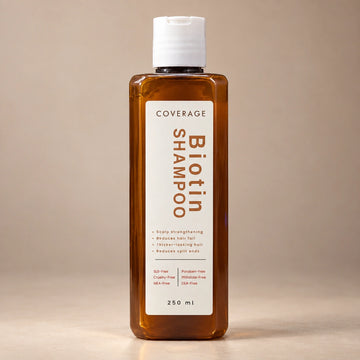
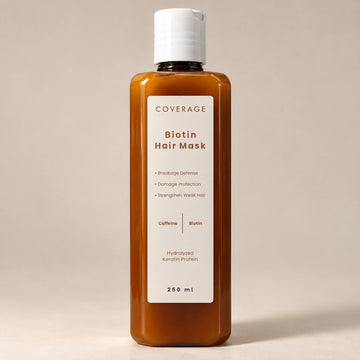
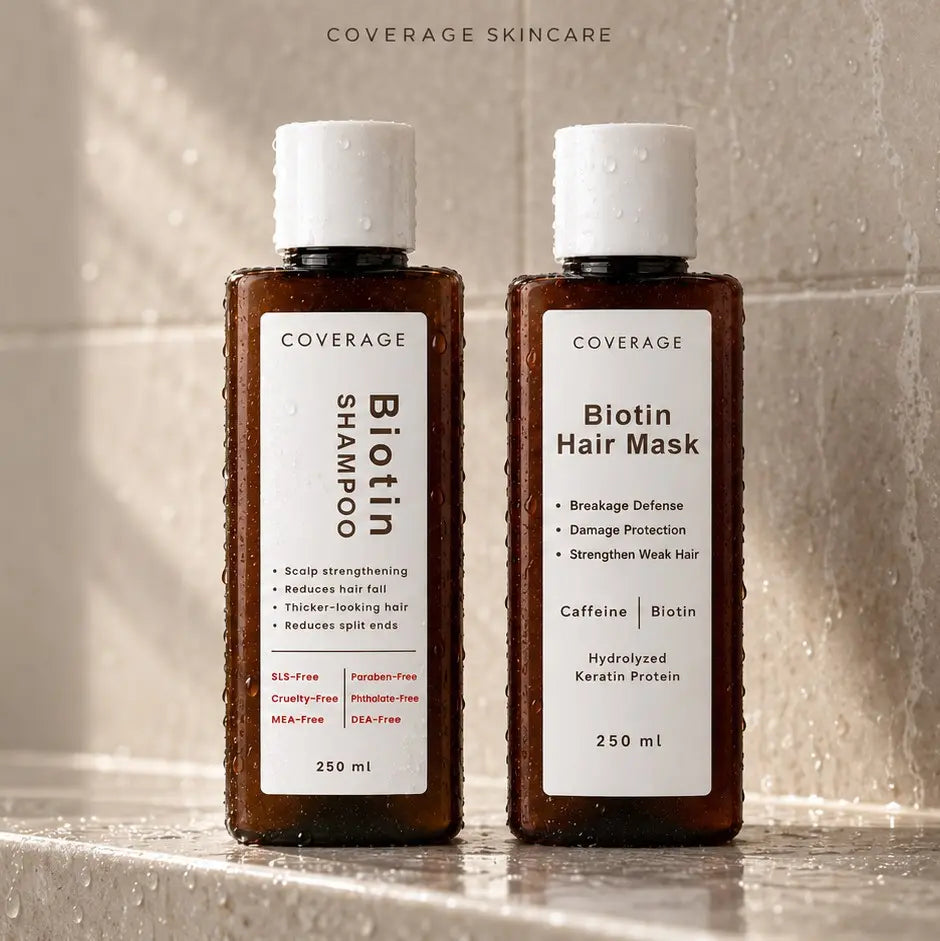
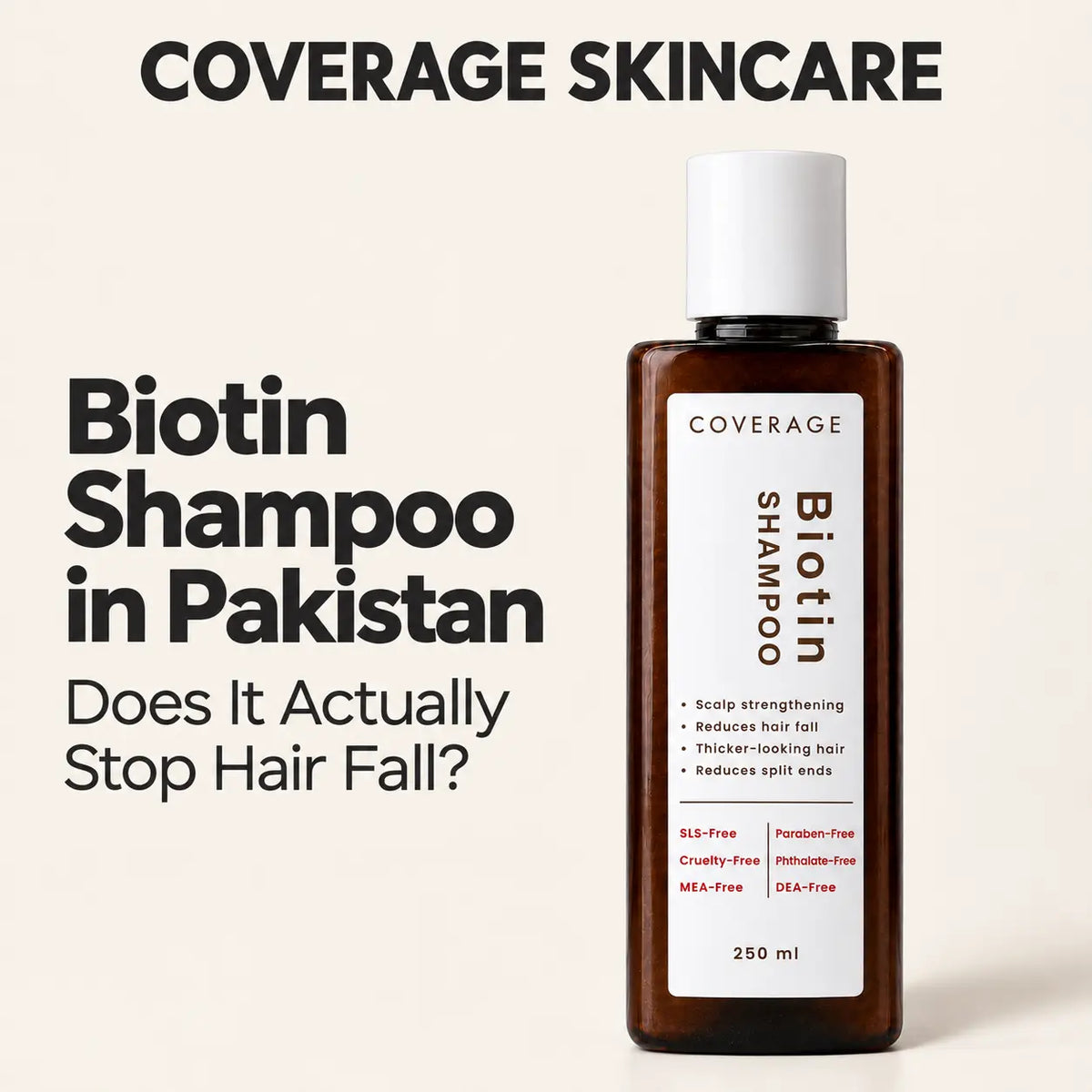
The Biotin Shampoo is sulphate-free, using milder cleansing chemistry so it cleans without stripping. The Biotin Hair Mask adds hydrolysed keratin, panthenol and caffeine to reinforce fragile fibres and reduce the snapping behind a lot of everyday hair fall. The two are sold together as the Hair Fall & Strength Duo.

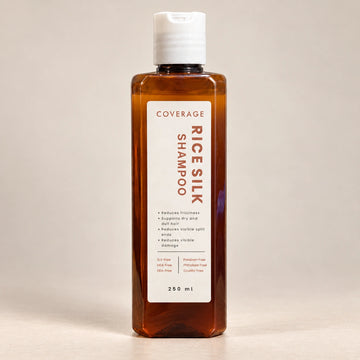
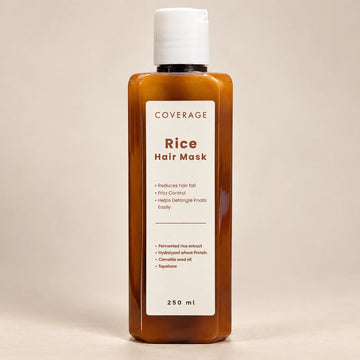
If your main concern is dryness, frizz and shine rather than fragility, the Rice Silk Shampoo and Rice Hair Mask are the better fit, also available as the Shiny & Silky Hair Duo.
To be straight with you: these are strengthening and smoothing products. They are not a cure for hair loss, not a dedicated chelating treatment, and we do not sell shower filters or softeners.
Frequently asked questions
Does hard water cause hair loss?
Not directly. There is no robust evidence that hard water causes permanent, follicle-based hair loss such as pattern baldness. It can leave mineral deposits that make hair rough and more prone to breakage, which can resemble hair loss.
Does hard water cause hair fall?
It can contribute to the appearance of hair fall by increasing breakage of existing strands, but it is not a proven cause of true shedding from the follicle.
Can hard water make hair thin?
Hard water can make hair look thinner and flatter because of buildup and breakage, but it does not shrink follicles or cause the progressive thinning seen in genetic hair loss.
Does hard water cause hair breakage?
Possibly. Two Pakistani studies found hair soaked in very hard water was measurably weaker. Other studies found no strength change, so the effect likely depends on how hard the water is and how damaged the hair already is.
How do I know if my water is hard?
Look for white scale on taps and showerheads, soap scum, spots on glass and poor lather. To quantify it, use a home hardness test kit or send a sample for laboratory testing.
Is Lahore water hard?
It varies widely by area, source and season. Some Lahore neighbourhoods test relatively soft while others are hard. There is no single value for the whole city.
Is Karachi water hard?
Groundwater in parts of Karachi has been measured as very hard, with one Shah Faisal Town study finding 600 to 1800 mg/L. Supplies differ across the city, so test your specific source.
Is Islamabad water hard?
Islamabad and Rawalpindi sit on limestone, and local studies have found water that is often moderately hard to hard, with one study reporting 160 to 380 mg/L.
What does hard water do to hair?
It can deposit calcium and magnesium on the shaft, leaving hair feeling rough, dull, coated and harder to rinse clean, and in some cases weaker and more prone to breakage.
Can hard water cause dandruff?
Not on its own. Dandruff is driven mainly by Malassezia yeast and the condition of the scalp. Mineral residue may make the scalp feel dry or itchy, but persistent dandruff needs medicated treatment.
Which shampoo is best for hard water?
A gentle, sulphate-free shampoo used with consistent conditioning suits most people. For heavy mineral buildup, an occasional shampoo containing a chelating agent such as EDTA helps, used sparingly.
Is clarifying shampoo good for hard water?
It helps remove oil and product buildup but does not reliably remove bonded minerals. For true mineral buildup, a chelating shampoo is more targeted.
What is the difference between clarifying and chelating shampoo?
Clarifying shampoos use strong surfactants to strip oil and product residue. Chelating shampoos use binding agents like EDTA to grab and rinse away mineral and metal ions left by hard water.
Does a shower filter remove hard water?
Usually not. Most shower filters reduce chlorine and sediment but do not remove dissolved calcium and magnesium. Genuine softening requires ion-exchange technology.
Does boiling water remove hardness?
Only temporary hardness from bicarbonates, which precipitates out as scale. Permanent hardness from sulphates is not removed by boiling.
Can switching to soft water improve hair?
It may make hair feel smoother and easier to manage by reducing buildup, and it can reduce breakage from friction. But it will not reverse genetic or medical hair loss.
How often should I use a chelating shampoo?
Sparingly, typically no more than once a week and for many people once or twice a month, always followed by conditioning.
Can hard water damage coloured hair?
Colour-treated hair is more porous, so minerals can cling more, dull the colour and worsen dryness. Some chelating shampoos can also fade colour, so choose colour-safe formulas.
The one thing to take away
Hard water may contribute to mineral buildup, hair-shaft weakening and breakage. Current evidence does not justify saying it directly causes permanent follicular hair loss. If your hair is snapping, better conditioning and gentler handling will help. If your hair is genuinely shedding from the root, the answer is a doctor, not a different shampoo.
References
- Srinivasan G, Srinivas CR, Mathew AC, Duraiswami D. Effects of hard water on hair. International Journal of Trichology. 2013;5(3):137-139. PMID: 24574692.
- Srinivasan G, Chakravarthy Rangachari S. Scanning electron microscopy of hair treated in hard water. International Journal of Dermatology. 2016;55(6):e344-e346. PMID: 26711619.
- Alahmmed LM, Alibrahim EA, Alkhars AF, Almulhim MN, Ali SI, Kaliyadan F. Scanning electron microscopy study of hair shaft changes related to hardness of water. Indian Journal of Dermatology, Venereology and Leprology. 2017;83(6):740. PMID: 28799530.
- Luqman MW, Ali R, Khan Z, Ramzan MH, Hanan F, Javaid U. Effect of topical application of hard water in weakening of hair in men. Journal of the Pakistan Medical Association. 2016;66(9):1132-1136. PMID: 27654734.
- Luqman MW, Ramzan MH, Javaid U, Ali R, Shoaib M, Luqman MA. To evaluate and compare changes in baseline strength of hairs after treating them with deionized water and hard water and its role in hair breakage. International Journal of Trichology. 2018;10(3):113-117. PMID: 30034190.
- Jabbar-Lopez ZK, Ung CY, Alexander H, et al. The effect of water hardness on atopic eczema and skin barrier function: a systematic review and meta-analysis. Clinical and Experimental Allergy. 2021;51(3):430-451. PMID: 33259122.
- Thomas KS, Dean T, O'Leary C, et al. A randomised controlled trial of ion-exchange water softeners for the treatment of eczema in children. PLoS Medicine. 2011;8(2):e1000395. PMID: 21358807.
- World Health Organization. Hardness in Drinking-water. WHO/SDE/WSH/03.04/06, 2003.
- U.S. Geological Survey Water Science School. Hardness of Water.
This article is educational and is not a substitute for personalised medical advice. If you are worried about hair loss, please see a qualified dermatologist.
This article is for general informational purposes only and is not a substitute for professional medical advice. All information and claims referenced above are drawn from publicly available dermatological studies and expert sources. Always consult a dermatologist for advice specific to your skin.


Leave a comment
This site is protected by hCaptcha and the hCaptcha Privacy Policy and Terms of Service apply.