

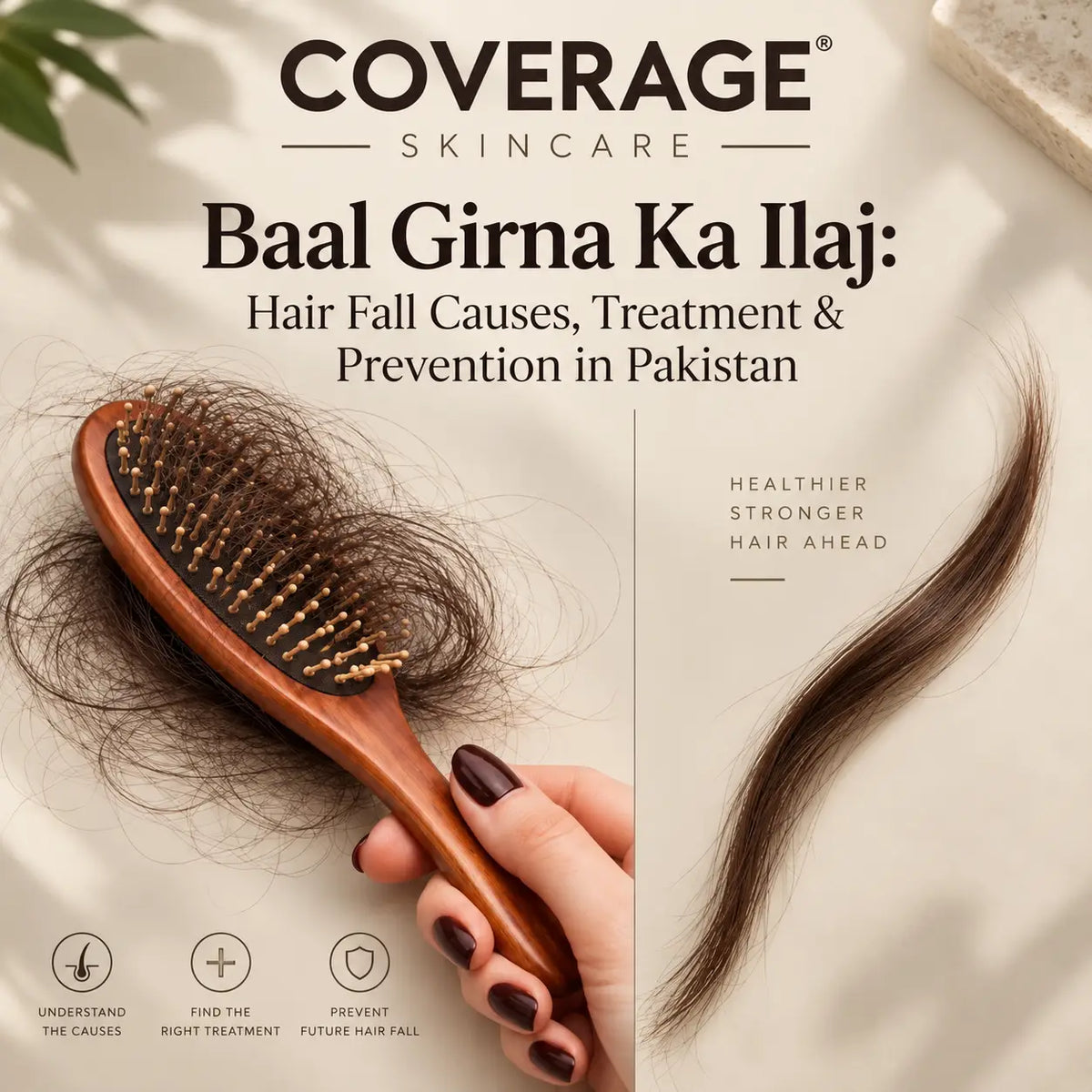
Baal Girna Ka Ilaj: Hair Fall Causes, Treatment & Prevention in Pakistan

You saw hair on your pillow this morning. Or in the comb after you towel-dried. Or gathered at the shower drain, and now you are typing "baal girna ka ilaj" into Google at 11pm, half convinced you are going bald.
Before anything else: 50 to 100 hairs falling out on a normal day is not hair loss, it is how hair works. Every strand on your head grows for a few years, rests for a few months, then sheds to make room for the next one. Seeing hair is not the problem. The real question is which of three things is actually happening to you.
Quick self-check:
1. Sudden, all-over shedding — more hair than usual, coming out evenly from all over your scalp. Usually traces back to a fever, dengue, typhoid, childbirth, crash dieting, stress, or a nutrient gap. This is telogen effluvium, and it is almost always temporary.
2. Slow, gradual thinning — a receding hairline, a widening middle part, a thinning crown, especially if a parent or sibling has the same pattern. This points to pattern hair loss (androgenetic alopecia), and it genuinely needs a plan, ideally with a dermatologist.
3. Hair that snaps rather than falls — short broken pieces, flyaways, a ponytail that feels thinner without an actual bald patch. This is usually breakage, not follicular hair loss at all, and it responds well to better hair care.
Most people searching "baal girna ka ilaj" are living in more than one of these buckets at once. This guide walks through all three honestly: what actually causes each one, what the evidence says works and what doesn't, when to worry, and where a good haircare routine — including our own COVERAGE Biotin Shampoo and COVERAGE Biotin Hair Mask — genuinely fits.
Baal Girna Kyun Hota Hai? — Quick Answer
Baal girne ki teen bari wajah hoti hain: telogen effluvium (jism par kisi shock ki wajah se — bukhar, dengue, typhoid, delivery, crash diet, stress), pattern hair loss (genetic, gradual, hairline ya crown se shuru hoti hai), aur hair breakage (heat, chemicals, hard water, tight hairstyles se baal beech mein se toot jaate hain). Pehli qisam mahinon mein khud theek ho jaati hai. Doosri ko medical treatment chahiye. Teesri ko sirf achi haircare routine se sambhala ja sakta hai. Iss guide mein teeno ko alag alag samjhaya gaya hai.
Hair Fall vs Hair Breakage — Sab Se Pehle Yeh Samjhein
This is the single most useful distinction in this entire article, and almost nobody explains it clearly.
Hair fall / shedding means a hair comes out from the root — you can see a tiny white bulb at one end if you look closely. This is your follicle releasing a hair at the end of its natural cycle, or earlier than it should because of a trigger.
Hair breakage means the hair shaft itself snaps somewhere along its length — no root, no bulb, just a broken strand, often shorter and frayed at the end. You will see this as flyaways around your hairline, a rough or dry-feeling ponytail, and split ends.
Heat styling, chemical treatments, tight braids or buns, harsh sulphates, and rough towel-drying all cause breakage — not follicular loss. A huge number of people who think they are "going bald" are actually watching their hair snap, not fall. The fix for breakage is completely different from the fix for follicular hair loss: it is about protecting the hair shaft, not stimulating the follicle.
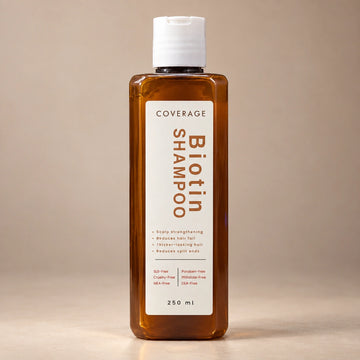
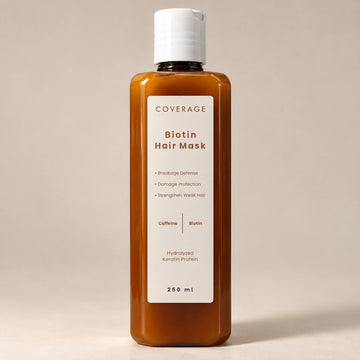
If your problem is genuinely breakage — snapping, frizz, a ponytail that feels thinner but no visible scalp or bald patch — a cleansing and conditioning routine matters more than anything else you will read in this guide. COVERAGE Biotin Shampoo cleanses gently with a fully sulphate-free surfactant system and carries Biotin and Hydrolyzed Keratin to reinforce fragile strands from within. Follow it with COVERAGE Biotin Hair Mask, which conditions the hair, adds Caffeine for scalp support and Panthenol to lock in moisture, so strands stay softer and less prone to snapping. Neither product regrows hair or treats a medical condition — what they do is reduce the breakage that a lot of "hair fall" actually is.

Shedding has a root bulb. Breakage does not.
How Many Hairs Falling Per Day Is Normal?
Din mein kitne baal girna normal hai? Somewhere between 50 and 100 strands a day is entirely normal — that is your hair's natural resting-and-shedding cycle (exogen phase) doing its job, not a sign of a problem. Counting hairs obsessively usually creates more anxiety than it resolves. What actually matters is the pattern over weeks: is the volume increasing, is it diffuse or patchy, and is your hair visibly thinner than it was six months ago.
How the Hair Growth Cycle Actually Works
Every hair on your head is on its own independent clock, moving through four phases:
- Anagen (growth): 2 to 8 years. Around 90% of your scalp hair is in this phase at any given time.
- Catagen (transition): a short 2 to 3 week phase where the follicle shrinks and growth stops.
- Telogen (resting): about 3 months, where the hair sits dormant before being released.
- Exogen (shedding): the old hair falls out to make room for a new one — this is your normal 50 to 100 hairs a day.
This cycle is why hair fall almost never shows up immediately after whatever caused it. Because telogen lasts around three months, a major stress — fever, illness, childbirth, a crash diet — pushes hairs into the resting phase early, and you only see the shedding two to three months later. This is also why treatments need patience: minoxidil or any genuine hair-fall treatment needs a full cycle, realistically 3 to 6 months, before you can judge whether it is working.
Major Causes of Hair Fall — Pakistan-Specific
1. Telogen Effluvium — the most common "sudden hair fall"
Baal jharne ki iss sab se aam wajah ko samajhna zaroori hai. Telogen effluvium diffuse, all-over shedding hai jo kisi bhi jismani ya emotional shock ke 2 se 3 mahine baad shuru hoti hai — bukhar, dengue, typhoid, COVID, surgery, delivery, crash dieting, ya severe stress. Yeh self-limiting hoti hai, matlab trigger khatam hone ke baad khud theek ho jaati hai, aksar 6 se 9 mahinon mein.
2. Pattern Hair Loss (Androgenetic Alopecia)
Genetic aur hormone (DHT)-driven hair loss, jo dheere dheere hoti hai — mardon mein hairline peechay jaati hai aur crown patla hota hai, aurton mein poori scalp par baal patle hotay hain lekin front hairline barqarar rehti hai. Family history is the biggest clue — if a parent has it, you are more likely to.
3. Iron Deficiency and Anaemia
This one deserves real emphasis in Pakistan. Pakistan's National Nutrition Survey found that 41.7% of women of reproductive age are anaemic, and roughly 18% of non-pregnant women of reproductive age have iron-deficiency anaemia specifically — rising to about 21% during pregnancy. Iron deficiency is one of the most common, most fixable causes of diffuse hair thinning, and it is dramatically under-tested. If your periods are heavy, your diet is low in red meat or leafy greens, or you have been restricting food, ask your doctor for a ferritin test, not just a basic haemoglobin count.
4. Vitamin D Deficiency
Widely common across Pakistan despite the sunshine, largely because of limited sun exposure with covered clothing and indoor lifestyles. Several studies link low vitamin D with diffuse hair thinning. Worth testing, not worth blindly megadosing.
5. Thyroid Disorders
Both an underactive and an overactive thyroid can cause diffuse shedding. A simple TSH blood test rules this in or out.
6. PCOS and Hormonal Hair Fall
PCOS can drive androgen-related thinning, usually at the crown, sometimes alongside other signs like irregular periods or acne. This needs a doctor's evaluation, not a shampoo.
7. Postpartum Hair Fall
Delivery ke 3 se 4 mahine baad shedding shuru hoti hai, 4 se 6 mahine par apne peak par pohanchti hai, aur aam taur par 12 mahinon ke andar khud theek ho jaati hai. Breastfeeding iska sabab nahi hai — yeh sirf pregnancy hormones ke wapis normal hone ka natural asar hai.
8. Stress
Severe emotional or physical stress can trigger the same telogen effluvium mechanism described above — again, showing up 2 to 3 months later and recovering once the stress resolves.
9. Crash Dieting and Rapid Weight Loss
Sudden calorie or protein restriction signals the body to conserve resources, and hair follicles are one of the first things deprioritised. This is a very common, very preventable cause.
10. Traction (Tight Hairstyles and Dupatta Friction)
Tight buns, ponytails, braids, and constant dupatta pinning at the same points along the hairline create sustained pulling. Over time this causes traction alopecia — thinning specifically along the pulled areas, which is different from diffuse shedding and is largely preventable by varying how tightly and where you style.
11. Dandruff and Scalp Conditions
Seborrheic dermatitis (the medical term for stubborn dandruff) inflames the scalp and can worsen shedding, though it is not usually a primary cause of baldness on its own. It is very treatable — see the dandruff section below.
Hair Fall After Dengue or Typhoid
If you had dengue or typhoid a couple of months ago and are now shedding hair, this is one of the most reassuring things in this entire guide: it is expected, it is temporary, and it will stop.
Post-fever telogen effluvium follows a well-documented pattern. In a case series of dengue patients, the average gap between the fever and the start of hair shedding was about 2.1 months, and the shedding itself typically stopped by around 2.9 months after onset. None of the patients in that series progressed to long-term (chronic) shedding. The mechanism is simple — a high fever pushes a large batch of hairs into the resting phase at once, and a few months later, they are all released together, which feels alarming but is your body's normal recovery process.
What actually helps during post-illness shedding: good nutrition (protein, iron, and overall recovery), patience, and gentle hair care so you are not adding breakage on top of the natural shedding. If it has gone on well past 6 to 9 months, or you also feel unusually tired, that is worth a doctor's visit to rule out an iron or thyroid issue sitting underneath it. While you wait it out, a gentle cleanse-and-condition routine — COVERAGE Biotin Shampoo followed by COVERAGE Biotin Hair Mask — protects the hair you still have from unnecessary breakage on top of the shedding itself.

Post-fever shedding starts roughly 2 to 3 months later and usually resolves within 6 to 9 months.
Hair Fall in Women
Female pattern hair loss looks different from male pattern loss — instead of a receding hairline, women typically see diffuse thinning across the crown with the frontal hairline staying mostly intact. Topical minoxidil is the first-line, evidence-backed treatment. Where PCOS or another hormonal driver is present, a doctor may add other therapy alongside it.
Postpartum shedding, iron deficiency, thyroid disease, and crash dieting are all disproportionately common causes of hair fall in women specifically, which is why the diagnostic approach below leans so heavily on nutritional and hormonal testing rather than jumping straight to hair-growth products.
Hair Fall in Men
In men, the classic pattern is a receding hairline at the temples and thinning at the crown, driven by genetics and the hormone DHT acting on genetically sensitive follicles. Family history is the strongest predictor — if your father or maternal grandfather experienced early pattern loss, you are at higher risk. The earlier this is identified and treated, the more hair can typically be preserved, which is why "wait and see" is usually the wrong instinct for a clearly receding hairline with a family history behind it.
What Tests Should You Get for Hair Fall?
You do not need every test for every kind of shedding, but if your hair fall is significant, prolonged, or unexplained, ask your doctor about:
- CBC (complete blood count) — screens for anaemia
- Serum ferritin — your actual iron stores, more sensitive than a basic haemoglobin check, and especially relevant given how common iron deficiency is in Pakistan
- TSH (thyroid function)
- Vitamin D (25-OH-D)
- When relevant: vitamin B12, zinc, and hormone testing (especially if PCOS symptoms are present)
A dermatologist will usually start with your history and a scalp exam, then order labs selectively based on what your pattern of shedding suggests — not everyone needs every test.
Evidence-Based Hair Fall Treatments — What Actually Works
This is where a lot of Pakistani content either overpromises or underdelivers. Here is the evidence, graded honestly.
| Treatment | Evidence level | What it's for |
|---|---|---|
| Topical minoxidil (2%/5%) | Strong | Pattern hair loss, men and women. Needs continuous use — results reverse if stopped. |
| Oral finasteride (men only, prescription) | Strong | Male pattern hair loss. Not for women, especially not in pregnancy. |
| Hair transplantation | Strong for suitable candidates | Stable pattern loss with adequate donor hair. Usually paired with ongoing medical therapy. |
| PRP (platelet-rich plasma) | Moderate — promising adjunct | Often combined with minoxidil/microneedling; results vary, needs more large trials. |
| Microneedling | Moderate — promising adjunct | Best combined with minoxidil rather than used alone. |
| Low-level laser therapy (LLLT) | Moderate, FDA-cleared as a device | Adjunct for pattern hair loss; benefit builds gradually over months of consistent use. |
| Rosemary oil | Moderate-promising | One well-cited trial found it performed comparably to 2% minoxidil over 6 months — a single study, worth knowing about, not a guarantee. |
| Ketoconazole 2% shampoo | Moderate for scalp health; limited-strong for dandruff specifically | Genuinely effective for dandruff/seborrheic dermatitis; some adjunct benefit suggested for pattern loss. |
| Onion juice | Limited — specific to alopecia areata only | Evidence exists for patchy alopecia areata, not for pattern hair loss. |
| Caffeine (topical) | Moderate-promising, mostly in leave-on formats | Some positive trial data; a rinse-off shampoo has less contact time to work with. |
| Coconut oil | Strong — for reducing breakage, not for regrowth | Genuinely reduces protein loss and shaft breakage. Does not regrow hair from follicles. |
| Scalp massage | Limited, but essentially zero-risk | Some evidence of improved thickness through mechanical stimulation; weak evidence tier overall. |
| Biotin supplements | Insufficient, unless you have a true biotin deficiency (rare) | No consistent benefit shown in people who are not deficient. High doses can also interfere with certain lab tests. |
| Rice water, castor oil, amla, fenugreek | Insufficient / cosmetic-conditioning only | Popular home remedies with little to no clinical trial evidence for actual hair growth. |
Read this table as a hierarchy, not a menu. Minoxidil, finasteride, and transplantation are proven medical treatments for pattern hair loss. PRP, microneedling, LLLT, and rosemary oil are reasonable adjuncts with real but smaller evidence. Coconut oil, scalp massage, and a good cleansing-and-conditioning routine genuinely help with breakage and hair condition — they are just not the same category of thing as a medical treatment, and we are not going to pretend otherwise.
Medical Treatment vs Haircare — Know Which One You Need
If your self-check above pointed you toward gradual pattern thinning, the honest next step is a dermatologist, not a shampoo — no cosmetic product, including ours, treats androgenetic alopecia, telogen effluvium, PCOS, or thyroid-related hair loss. If your self-check pointed you toward breakage — or you are supporting your hair while you wait out a diagnosed, self-resolving shedding phase like post-fever or postpartum telogen effluvium — that is exactly where a proper haircare routine belongs.
Home Remedies: What Actually Works, Honestly Graded
| Remedy | What it can do | What it can't do |
|---|---|---|
| Coconut oil | Reduces protein loss from the hair shaft, cuts breakage, improves scalp hydration | Does not regrow follicular hair |
| Onion juice | Some evidence for patchy alopecia areata regrowth | No evidence for pattern hair loss; strong smell limits daily use |
| Rice water | Mild conditioning, smoother feel | No clinical evidence it increases hair count or growth |
| Castor oil | Conditioning, some shine | No human trial evidence for growth; excessive use on curly/textured hair can cause matting |
| Amla, fenugreek | Traditional conditioning use | No robust human clinical trials supporting hair-fall claims |
| Scalp massage | Relaxing, may modestly improve hair thickness over time | Weak evidence tier; not a substitute for treating an underlying cause |
Myths vs Facts About Baal Girna
Myth: Oiling stops hair fall. Fact: oils like coconut reduce breakage and improve hair condition, but they do not stop follicular or pattern hair loss.
Myth: Shampoo causes hair fall. Fact: the hair you see in the shower was already in its shedding phase — shampoo doesn't cause follicular loss, though a harsh, stripping shampoo can worsen dryness and breakage.
Myth: Hard water causes baldness. Fact: hard water can roughen the hair shaft and worsen breakage and dullness. It does not stop follicles from producing hair.
Myth: Cutting your hair makes it grow back thicker. Fact: cutting doesn't change what a follicle produces — regrowth just feels coarser at the freshly cut, blunt tip.
Myth: Wearing a cap causes baldness. Fact: no evidence for normal cap-wearing; only sustained, tight pulling (as in traction alopecia) causes hair loss.
Myth: Minoxidil permanently cures genetic hair loss. Fact: it manages it for as long as you use it — stopping reverses the gains.
Myth: Biotin cures hair loss. Fact: it only helps if you have a true biotin deficiency, which is rare — and high doses can distort certain lab test results.
Myth: Dandruff always causes permanent baldness. Fact: it can worsen shedding, but it's treatable and is not a primary cause of true baldness.
Myth: Stress makes your hair fall out overnight. Fact: stress-related shedding shows up roughly 2 to 3 months later, then recovers once the stress resolves.
Myth: Expensive imported shampoos regrow hair. Fact: shampoos clean and condition; none of them reverse pattern hair loss, regardless of price.
Hard Water and Hair Fall
Kya hard water se baal girte hain? Not directly — but it can make things worse. Much of Pakistan has hard, mineral-heavy water, and the honest evidence on it is mixed: some studies find reduced tensile strength in hair washed with hard water over time, others find no meaningful difference at all. What's consistent is that mineral deposits can leave hair feeling rough, dull, and more prone to breakage and tangling — this is a hair-shaft and manageability issue, not a follicular one. It will not cause baldness on its own, but if you already have fragile, breakage-prone hair, hard water is one more thing working against you, which is exactly why a gentle, sulphate-free cleansing routine matters more in Pakistani cities than the marketing usually admits. This is exactly the gap COVERAGE Biotin Shampoo is built for — a fully sulphate-free wash that cleans without adding to what hard water is already doing to your strands.
Dandruff and Hair Fall
Dandruff (technically seborrheic dermatitis in its more stubborn form) inflames the scalp, which can genuinely worsen shedding — though it is rarely, on its own, a cause of permanent baldness. It is also one of the more treatable things on this entire list. Ketoconazole-based shampoos are a well-evidenced option for dandruff and scalp seborrheic dermatitis specifically. If dandruff is persistent, itchy, flaking heavily, or spreading beyond the scalp, that is worth a dermatologist visit rather than trial-and-error with different bottles. Once a flaking scalp is under control, a mild, sulphate-free everyday wash like COVERAGE Biotin Shampoo is a reasonable choice alongside it — it is not a dandruff treatment itself, just a gentle base that won't fight against whatever your dermatologist prescribes.
How to Prevent Hair Breakage
- Cleanse gently. A sulphate-free shampoo cleans without stripping the hair shaft of the oils that keep it flexible.
- Condition every wash. A hair mask or conditioner replaces moisture and smooths the outer cuticle so strands slide past each other instead of snapping.
- Reduce heat. Straighteners, dryers, and curling irons weaken the hair shaft over time — use them less often, and never on soaking-wet hair.
- Loosen tight hairstyles. Rotate where you pin your dupatta, keep ponytails and buns looser, and give your hairline a break from constant tension.
- Detangle from the ends up, not from the roots down, and always on damp, conditioned hair rather than dry.
- Go easy on chemical processing. Frequent colouring, bleaching, or relaxing compounds breakage over time.
COVERAGE Haircare Routine — For Breakage, Not for Medical Hair Loss
If you have read this far and landed in the breakage or general-haircare bucket — or you're supporting your hair through a diagnosed, self-resolving shedding phase — here is the routine we built for exactly that.

Step 1 — Cleanse: COVERAGE Biotin Shampoo
COVERAGE Biotin Shampoo is built on a fully sulphate-free surfactant system — Cocamidopropyl Betaine, Decyl Glucoside, and Sodium Lauroyl Sarcosinate cleanse without stripping the hair shaft the way a sulphate-heavy shampoo does, which matters more in hard-water cities. Biotin and Hydrolyzed Keratin sit high in the formula, not buried at the bottom next to the fragrance, and work to reinforce fragile strands from within. Gentle enough to use as often as you wash.
Step 2 — Condition: COVERAGE Biotin Hair Mask
COVERAGE Biotin Hair Mask follows with Biotin and Hydrolyzed Keratin working from inside the strand, Caffeine to support a healthier scalp environment, and Panthenol to lock in moisture so hair stays soft and manageable instead of stiff and prone to snapping.
Step 3 — Protect
Reduce excessive heat styling, harsh chemical treatments, and tight hairstyles that pull on the hairline. No product, including ours, can out-condition daily heat damage or constant traction — protecting the hair shaft day to day matters just as much as what you wash it with.
An honest note on what this routine is and isn't. COVERAGE Biotin Shampoo and COVERAGE Biotin Hair Mask cleanse, condition, and reduce the breakage behind a lot of everyday "hair fall." They do not regrow hair and are not a treatment for androgenetic alopecia, telogen effluvium, PCOS-related hair loss, thyroid-related hair loss, or any other diagnosed medical condition. If your self-check above points toward gradual pattern thinning, see a dermatologist first — then build this routine around whatever they prescribe.
Shop COVERAGE Biotin ShampooWho Should See a Dermatologist? — Red Flags
Most hair fall is one of the ordinary, explainable causes above. See a dermatologist promptly if you notice:
- Sudden, severe, or rapidly worsening shedding
- Patchy, round bald spots, especially if they're growing
- Scarring, shiny patches, or visible loss of the tiny follicle openings on the scalp
- Scalp pain, burning, severe itching, scaling, pus, or sores
- Eyebrow or eyelash loss alongside scalp shedding
- Hair loss in a child
- Shedding that has continued well past 6 to 9 months with no improvement
COVERAGE — Certified, Family-Run Manufacturing
COVERAGE is manufactured at our own GMP-certified and ISO 9001-certified facility, also Halal certified — built on a family manufacturing background of roughly 40 years. We formulate and produce in-house rather than through third-party white-label manufacturing, which is why we can be specific about what's actually in a formula and where it sits in the ingredient list, as we have been throughout this guide.
Frequently Asked Questions
Din mein kitne baal girna normal hai?
50 se 100 baal rozana girna bilkul normal hai — yeh aapke hair growth cycle ka aik natural hissa hai, kisi problem ki nishani nahi.
Baal girne ki sab se bari wajah kya hai?
Pakistan mein sab se aam wajah telogen effluvium hai — bukhar, dengue, typhoid, delivery, ya stress ke 2 se 3 mahine baad hone wali diffuse shedding, jo khud theek ho jaati hai. Genetic pattern hair loss doosri aam wajah hai.
Baal girna kaise roken?
Sab se pehle wajah pehchanein — agar yeh telogen effluvium hai to sirf waqt aur achi nutrition chahiye. Agar pattern hair loss hai to dermatologist se minoxidil ya finasteride jaisi proven treatment lein. Agar breakage hai to gentle, sulphate-free cleansing aur conditioning routine se farq padta hai.
Kya iron ki kami se baal girte hain?
Ji haan. Iron deficiency diffuse hair thinning ki aam wajah hai, khaas taur par Pakistani women mein jahan anaemia ki dar kaafi zyada hai. Ferritin test karwana behtar hai sirf haemoglobin check karne se.
Vitamin D deficiency se baal girte hain?
Low vitamin D diffuse hair thinning se juda paya gaya hai. Test karwana faidamand hai, lekin bina test ke high doses lena theek nahi.
Thyroid se baal girte hain?
Ji haan — thyroid ka zyada ya kam active hona dono diffuse hair shedding ka sabab ban sakte hain. TSH test se yeh pata chal sakta hai.
PCOS mein baal kyun girte hain?
PCOS mein androgen hormones baalon ke follicles ko affect kar sakte hain, jis se crown ke area mein thinning ho sakti hai. Iska sahi assessment doctor hi kar sakta hai.
Delivery ke baad baal kab tak girte hain?
Postpartum shedding aam taur par delivery ke 3-4 mahine baad shuru hoti hai, 4-6 mahine par peak hoti hai, aur 12 mahinon ke andar khud theek ho jaati hai.
Dengue ke baad baal kyun girte hain?
Tez bukhar aik saath bohot se baalon ko resting phase mein bhej deta hai. Yeh baal 2 se 3 mahine baad girna shuru hotay hain aur zyada tar cases mein 6-9 mahinon mein khud ruk jaate hain — yeh telogen effluvium hai, permanent hair loss nahi.
Typhoid ke baad baal kab tak girte hain?
Isi tarah ka pattern hota hai jaisa dengue ke baad — fever ke 2-3 mahine baad shedding shuru hoti hai aur kai mahinon mein khud theek ho jaati hai.
Kya stress se baal girte hain?
Severe stress bhi telogen effluvium trigger kar sakta hai, jo stress ke 2-3 mahine baad shedding ki soorat mein samne aata hai aur stress kam hone ke baad theek ho jaata hai.
Kya hard water se ganjapan hota hai?
Nahin. Hard water baalon ko rough aur breakage-prone bana sakta hai, lekin yeh follicles ko baal banane se nahi rokta — asli baldness ka sabab nahi banta.
Kya rosemary oil kaam karta hai?
Aik chhoti si study mein rosemary oil ne 6 mahinon mein 2% minoxidil jitna asar dikhaya — yeh promising hai lekin sirf aik study hai, guarantee nahi.
Kya onion juice se baal ugte hain?
Onion juice ka evidence sirf alopecia areata (patchy bald spots) ke liye hai, pattern hair loss ke liye nahi.
Kya biotin hair loss cure karta hai?
Sirf agar aap mein waqai biotin ki kami ho, jo rare hai. Aam logon mein biotin supplements se koi consistent farq nahi paya gaya.
Minoxidil kitne time mein kaam karta hai?
Nazar aane wala farq aam taur par 3-6 mahine lagta hai, aur asar barqarar rakhne ke liye istemal jaari rakhna zaroori hai.
Hair fall ke liye kaunse tests karwane chahiye?
CBC, serum ferritin (iron stores), TSH (thyroid), aur vitamin D — zaroorat ho to B12, zinc aur hormone tests bhi.
Hair fall aur hair breakage mein kya farq hai?
Hair fall mein baal jarh (root) se nikalta hai, breakage mein baal beech mein se toot jaata hai. Breakage heat, chemicals, hard water aur tight hairstyles se hota hai.
Kya shampoo se baal girte hain?
Nahin — shower mein nazar aane wale baal pehle se hi shedding phase mein thay. Lekin harsh, stripping shampoo dryness aur breakage barha sakta hai.
Kya oiling hair fall rok sakti hai?
Oiling breakage kam karti hai aur baalon ki condition behtar karti hai, lekin follicular ya pattern hair loss ko nahi rokti.
Kab dermatologist ke paas jana chahiye?
Achanak ya severe shedding, patchy bald spots, scalp par pain/pus/scaling, eyebrow ya eyelash loss, bachon mein hair loss, ya shedding jo 6-9 mahinon se zyada chale — in sab mein dermatologist se milna chahiye.
Kya COVERAGE Biotin Shampoo hair loss cure karta hai?
Nahin. COVERAGE Biotin Shampoo scalp cleanse karta hai aur fragile strands ko reinforce karke breakage kam karta hai — yeh medical hair loss ka ilaj nahi hai.
Kya rice water se baal lambe hote hain?
Rice water conditioning ke liye theek hai, lekin iska koi clinical evidence nahi ke yeh hair growth barhata hai.
This article is for general informational purposes only and is not a substitute for professional medical advice. All information and claims referenced above are drawn from publicly available dermatological studies and expert sources. Always consult a dermatologist for advice specific to your skin.

Leave a comment
This site is protected by hCaptcha and the hCaptcha Privacy Policy and Terms of Service apply.